

If your company does not show up in ChatGPT, you are missing from the sources the answer is built from. An AI answer to “Who offers X in Switzerland?” is assembled from directories, industry lists, review platforms, trade articles and forums that the system retrieves for exactly that question, plus the providers’ own websites. Everything written about you on someone else’s site is third-party evidence: a statement about your company on a page you do not own and do not control. Without such evidence, a company is rarely recommended, even with a technically flawless website.
There are only a few causes, and each one has a name. Below are nine of them, a test that takes 60 seconds, and for each cause what it costs and who fixes it: you in-house, your web agency, or AI visibility professionals.
Carigiet GEO is an AI visibility consultancy based in Männedorf in the canton of Zurich, working across Switzerland. Since 2026, Carigiet GEO has done one thing only: making sure AI assistants find, understand and recommend Swiss B2B companies with 11 to 500 employees. We publish the Schweizer KI-Empfehlungsindex (Swiss AI Recommendation Index), a monthly measurement of which Swiss providers ChatGPT, Claude, Copilot, AI Overviews and Perplexity recommend as an option in response to real buyer questions. Take the general inquiry view for fiduciary firms in Zurich (in German), the evaluation for one industry, one region and one buyer intent: 1,007 of the 1,086 firms measured, or 92.7 percent, are not recommended in a single answer (September 2026 edition; every index figure in this article was read on index.carigiet.com on September 22, 2026). This view is built on 24 buyer questions, each asked once per measurement wave of each of the five assistants: 120 logged answers per wave, 240 across the two waves the view is calculated from. The benchmark is every fiduciary firm in Zurich that appears in the commercial register, without any selection, and the 240 answers, with three to five names each, keep returning to the same names: only 79 firms are recommended at least once. So the 92.7 percent figure describes the shape of this market, not a verdict on any single firm.
One observation, not a sample, from eleven AI visibility analyses between June and September 2026 (five analysis calls with prospects, six client onboardings): the situation we found most often was a company that is fully described on its own website and barely exists anywhere else.
Key takeaways
- A company that does not show up in ChatGPT is usually missing from the third-party evidence, not from its own website.
- First check whether the AI crawlers, the programs ChatGPT uses to fetch websites, can get through. Until you have, no other measurement is valid.
- There is no universal franc figure. This article puts a number on the effort per cause instead and shows how to calculate your own inquiry volume.
The nine causes at a glance
They are listed in the order you fix them, not in order of frequency. Each row names the cause, what it costs, what the fix is and who does it.
| Cause | What it costs | Fix | Effort, and who does it |
|---|---|---|---|
| 1. AI crawlers locked out in the CDN (the network that delivers your website) or in the firewall | The whole case: your website appears in no answer, and no further measure is measurable | Open the bot protection for the AI crawlers | Hours. Whoever manages your CDN or firewall: web agency, hosting provider or your own IT |
| 2. Content only visible via JavaScript, PDF, image or slider | Your place in the shortlist: the page looks empty to the systems, even if it is complete in the browser | Core statements as text in the HTML | Days to weeks. Your web agency |
| 3. Company details inconsistent | The whole case: two candidates, neither with enough evidence; later evidence is attributed to the wrong one, too | Name, address, UID identical everywhere | Half a day, then correspondence. You, in-house |
| 4. Outdated details online | The unnoticed loss: your name appears, but the service named is the wrong one | Have old entries corrected | Minutes per entry, weeks in total. You, with support for stubborn sources |
| 5. No entry in directories and industry lists | Your place in the shortlist: the selection happens before anyone sees your website | Entries in the directories that get cited | Weeks, then ongoing. You or AI visibility professionals |
| 6. No independent mentions | Your place in the shortlist: without outside confirmation, the answer names the providers third parties write about | Win trade media, associations, partners | Months, ongoing. AI visibility professionals, with your expert input |
| 7. No reviews, or too few | Your place in the shortlist as soon as the buyer asks for “good,” “reliable” or “recommended” | Actively collect reviews | Ongoing, in day-to-day business. You and your team |
| 8. Content built on keywords instead of buyer questions | Part of the questions: the ones closest to a purchase, where the buyer describes the problem in full sentences | Rebuild pages around buyer questions | Weeks per page. Web agency or AI visibility professionals |
| 9. Claims that cannot be verified | Part of the questions: every question with a criterion, such as size, region or experience | State features, figures, prices | Days per page. You supply the facts; the writing happens in-house or externally |
Each cause is covered in detail further down, with the finding, the check and the cost.
Who fixes what, in three lines. You handle cause 3 and cause 7 in-house: align the company details, collect the reviews. Cause 1 and cause 2 belong to whoever runs your website technically, that is, your web agency, your hosting provider or your own IT. An agency that does not have this layer on its radar is not a bad agency: CDN and bot protection are rarely part of the brief, and nobody checks what nobody ordered. Ask for it instead of switching agencies. Causes 4, 5, 6, 8 and 9 are the long-haul work on third-party evidence and content; that is where AI visibility professionals work with you, and you supply expert input and approvals. Carigiet GEO does exactly these five: getting old entries corrected, securing directory and association listings, getting trade media and partners to cover you, and rebuilding your pages around complete buyer questions.
The 60-second test: can the AI systems read your website at all?
Two steps you can run in your browser without any tools. They tell you whether the AI crawlers find anything at all on your website; the technical cross-check is further down under cause 1.
- Read the robots.txt. Open
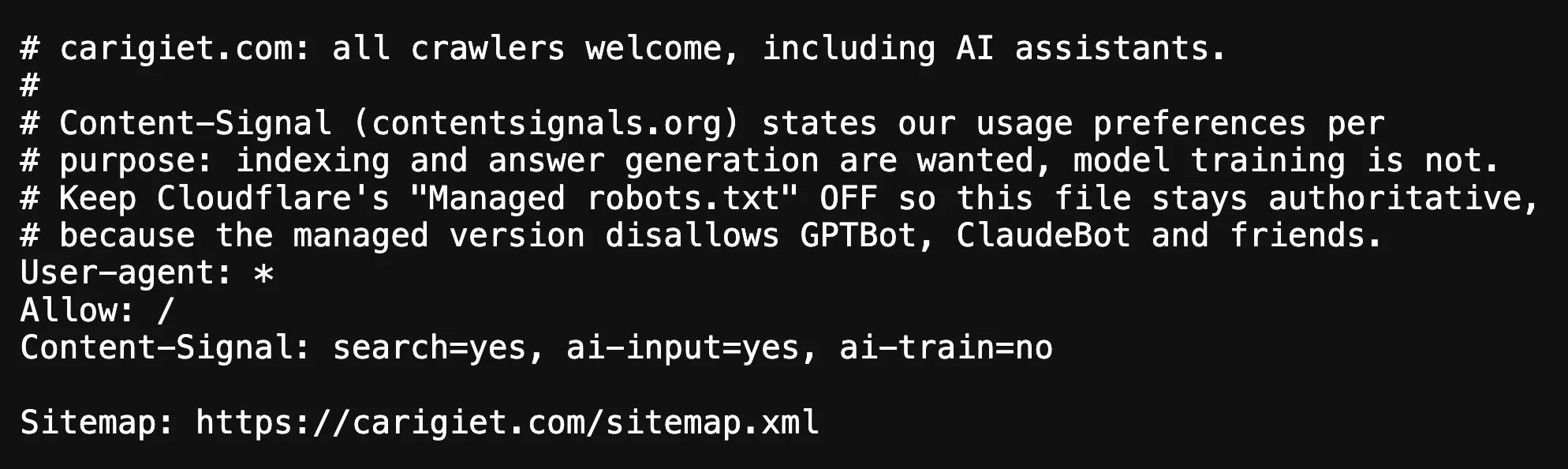
https://your-domain.ch/robots.txtand search with Ctrl+F (Cmd+F on a Mac) for the crawler names, not forDisallow: OAI-SearchBot, ChatGPT-User and PerplexityBot fetch the content for the answers, GPTBot and ClaudeBot fetch it for training. IfDisallow: /appears under one of these names, that crawler is locked out completely; if a path such asDisallow: /blog/appears there, that part of the website is blocked. OpenAI itself names one exception: because a user triggers the fetch by ChatGPT-User, the robots.txt rules may not apply to it. Only the first three affect whether you can be cited. If you search forDisallowinstead of the names, you will miss the section for the AI crawlers, which usually sits further down. If none of the five names appears, the file still is not in the clear: a crawler without a group of its own follows theUser-agent: *group, so aDisallowthere also applies to OAI-SearchBot, ChatGPT-User and PerplexityBot. Always read that group as well. Even then the question is not settled: the most common block sits in the CDN’s bot protection, one layer before the robots.txt, which is where cause 1 below takes you. Two public files for comparison: the robots.txt of carigiet.com allows every crawler and states in its comment that Cloudflare’s managed robots.txt has to stay off, because the managed version blocks GPTBot, ClaudeBot and others. The robots.txt of srf.ch shows the deliberate split: under the heading “AI Training” it blocks GPTBot, ClaudeBot, Google-Extended and Applebot-Extended, but leaves OAI-SearchBot, ChatGPT-User and PerplexityBot to the generalUser-agent: *group, which closes only individual paths such as the site search (both files read on September 22, 2026). - Read the page source. Open your most important service page and put
view-source:in front of the address in the address bar, soview-source:https://your-domain.ch/services. Search the source for three to five consecutive words from a body-text paragraph, not for a whole sentence, not for the headline and not for a phrase containing an apostrophe, quotation marks or an ampersand: headlines and long sentences are often broken up by markup in the source, and those characters are often stored as codes such as'for the apostrophe; either way the phrase cannot be found even on a page that is served correctly. If a short phrase turns up nothing, the text is being generated by JavaScript in the browser, and a plain fetch does not see it.
# Example: this is how a robots.txt is structured when the crawlers are
# regulated individually. Search your file for these names, not for
# Disallow.

# These three fetch the content an answer is built from.
# A Disallow here costs you citability.
User-agent: OAI-SearchBot
User-agent: ChatGPT-User
User-agent: PerplexityBot
Allow: /

# These two fetch content for training.
User-agent: GPTBot
Disallow: /

User-agent: ClaudeBot
Disallow: /

# This group applies to every crawler without a group of its own. The three
# names above have one, so a Disallow here would not hit them; in a file
# where they have no group, it would.
User-agent: *
Allow: /

Sitemap: https://your-domain.ch/sitemap.xml
One test run is not a finding
If you asked ChatGPT once and your name did not come up, that is an indication, not a finding. The same question does not return the same answer twice. The index tests this on its own data: the same question asked of ChatGPT three times returned the same set of recommendations in 0.0 percent of cases (methodology of the Swiss AI Recommendation Index, in German, September 2026 edition). A study with 600 volunteers found the same thing: it ran twelve questions 2,961 times through ChatGPT, Claude and Google’s AI answers, and for ChatGPT and Google’s AI the probability that two answers contain the same list of brands is below 1 percent, with Claude only slightly more consistent (not peer-reviewed; data collected November and December 2025). Ask the same question several times, in a neutral window, without logging in; our guide to checking your AI visibility yourself in 30 minutes shows how to do that cleanly in half an hour. Across many runs, the strong providers still show up regularly; if you are absent every time, that is a finding.
How is an AI answer to a provider question put together?
The systems break your question down and search in parallel. Google describes it in its own words: AI Mode breaks a question into subtopics and issues many queries at the same time. The answer is assembled from the hits. For provider questions close to a purchase, the evidence comes almost entirely from third-party domains, and within those it shifts toward directories and comparison portals: in a survey of 175 brands across five industries, 99.99 percent of the 49,391 citations evaluated pointed to third-party sites rather than the brand’s own website (vendor survey, Q2 2026). For Google’s AI summaries, the Pew Research Center found Wikipedia, YouTube and Reddit to be the most frequently cited sources.
For Switzerland, the index shows exactly which sources those are. The shares within a view are weighted, meaning each of the five assistants counts according to its published reach in Switzerland, not equally. In the Zurich fiduciary view, the assistants cite the providers’ own websites in 72.5 percent of answers, treuhandvergleich.ch in 21.7 percent, gryps.ch and local.ch in 19.2 percent each, treuhand-suche.ch and treuhand-vergleich-schweiz.ch in 16.7 percent each (September 2026 edition, in German, 240 logged answers, several sources per answer possible). For IT service providers in Switzerland, AI integration view (in German), the share of provider websites is 90.4 percent, followed by the websites of two individual AI consultancies, iapmesuisse.ch and ki-beratung.ch, at 15.8 percent each (240 logged answers).
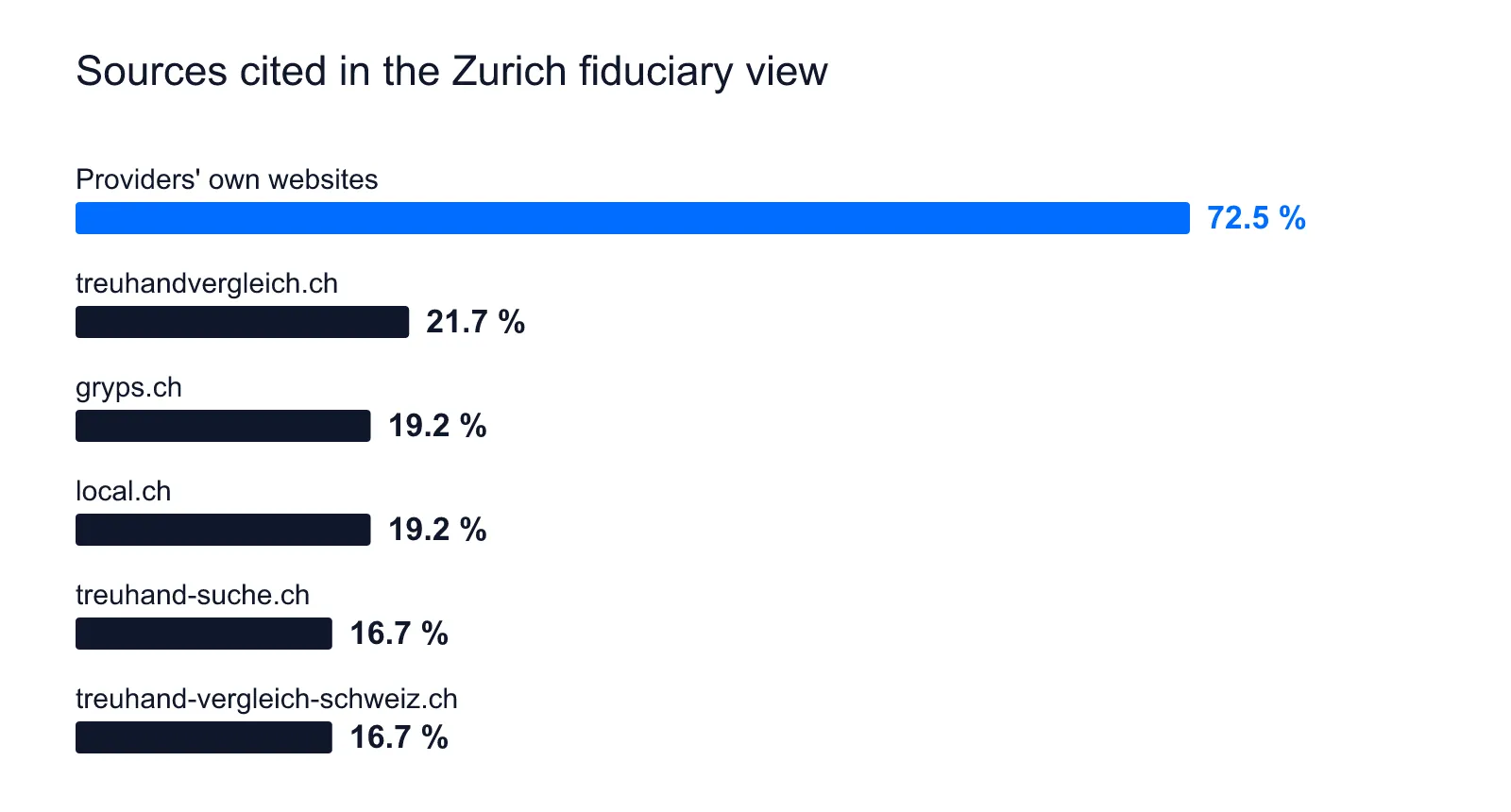
These figures do not contradict the first paragraph; they sharpen the point. Your website is the most-cited single source, and four of the nine causes are on it; how much weight it carries depends on the industry, and it is measurably higher for IT service providers than for fiduciary inquiries. But being cited is not the same as being recommended: in the same Zurich view, one fiduciary firm is cited as a source in 33.2 percent of answers and recommended as an option in 10.5 percent. Your website decides whether you can be cited. What others write about you decides whether you are recommended. If you need the vocabulary first, start with what Generative Engine Optimization is.
What does it cost you?
The effort per cause, and who carries it, is in column four of the table above. This section covers the other half: the inquiry volume that is at stake for you.
Why does a missing mention cost anything at all?
An AI answer to a provider question names a handful of names. There is no second page and no position eleven. In our own measurements, ChatGPT, Claude, Copilot, AI Overviews and Perplexity typically recommend three to five companies per answer. That is based on 3,120 logged answers from the Swiss AI Recommendation Index, the two measurement waves of the September 2026 edition: 960 answers from August 12 to 16 and 2,160 from September 2 to 4, 2026, spread across the 18 views, both figures stated in the index methodology. Only recommended companies from the industry being measured are counted. Two vendor surveys land mostly in the same range: an average of five brands per ChatGPT answer and 9.2 for Gemini (14,000 queries across ten industries, seven question types, four systems and five user profiles; the same prompt run 50 times per system), and for the Google systems 4.4 brands for Gemini, 4.5 in AI Overviews, 5.0 in AI Mode (218,178 answers, May 2026). A company that is not among them plays no part in this purchase decision.
| Survey | Basis | Companies per answer |
|---|---|---|
| Swiss AI Recommendation Index, September 2026 edition | 3,120 logged answers from two measurement waves, spread across 18 views | three to five |
| Conductor, vendor survey | 14,000 queries, ten industries, seven question types, four systems, five user profiles | 5.0 for ChatGPT, 9.2 for Gemini |
| Profound, vendor survey, May 2026 | 218,178 answers from the Google systems | 4.4 for Gemini, 4.5 in AI Overviews, 5.0 in AI Mode |
Our own measurement counts only recommended companies from the industry being measured; the two vendor surveys count brands per answer. Read the values side by side; do not net them against each other.
On top of that, the buyer often never leaves the answer. The same Pew analysis of 68,879 Google searches by 900 US adults found that users clicked a link inside an AI summary on only 1 percent of visits to pages that showed one. For many buyers, the research ends in the answer itself.
How many of your buyers search this way today?
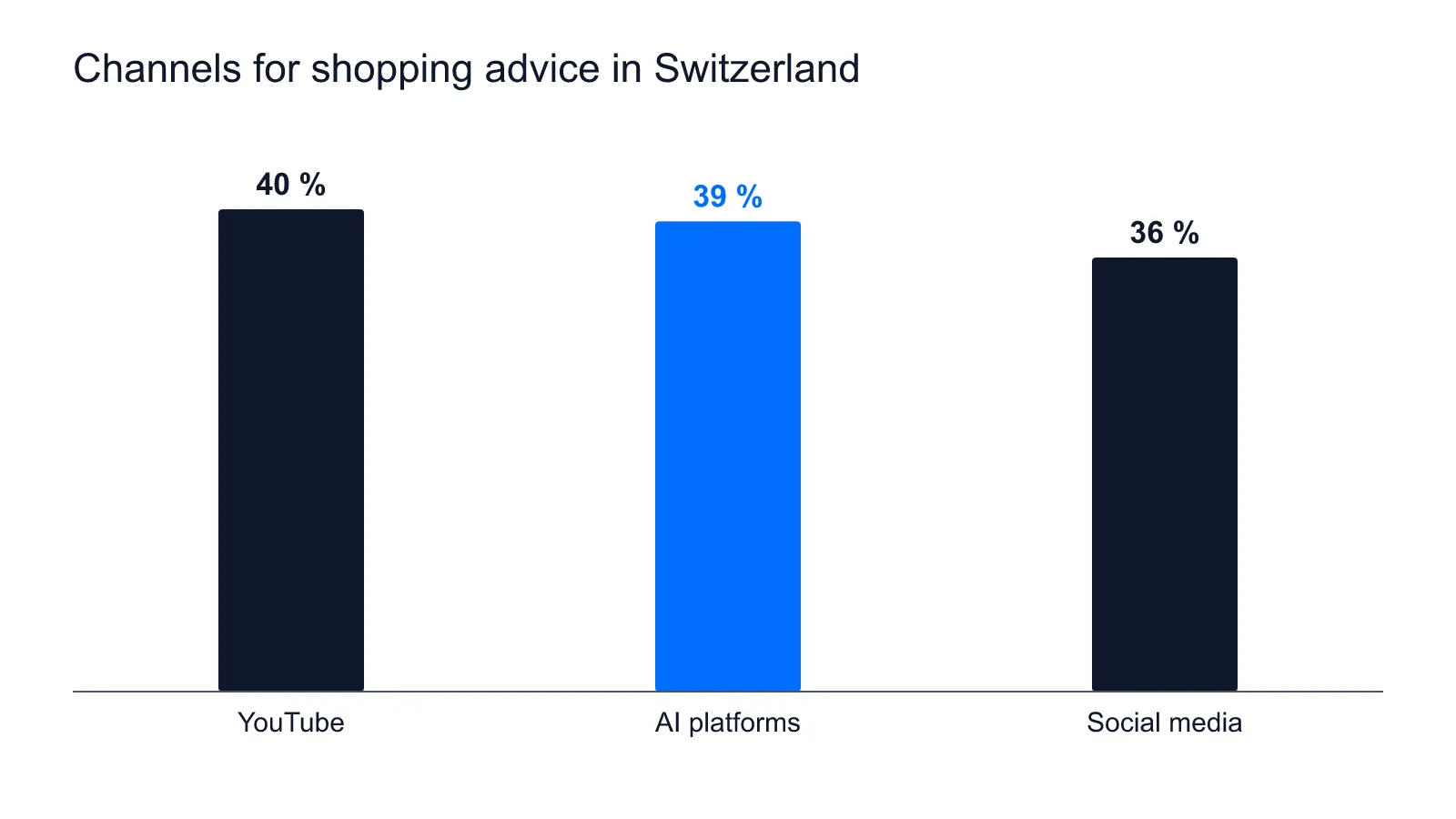
Three Swiss surveys give the range. Among the general public, 76.1 percent of adults use AI chatbots (in German), up from 62.4 percent the year before (Comparis/Innofact, March 2026, 1,035 respondents). For consumer purchase research, the IGEM Digimonitor 2026 gives the more specific figure: 39 percent use AI platforms for shopping advice (in German), level with YouTube (40 percent) and ahead of social media (36 percent); the base is the internet-using Swiss population aged 15 to 75 (Intervista on behalf of IGEM and WEMF, March to April 2026, 1,957 respondents).
For business purchasing, the relevant source is the B2B Monitor 2026 by Carpathia AG (in German): 27 percent of participants use AI to search for products and suppliers, and at companies with more than 50 employees the figure is 54 percent (April to July 2026, 146 complete responses). The sample is small; the 54 percent is based on about 28 responses, so it is a directional finding, not a point estimate.
Your own figure: the calculation
You need four numbers, all of which you already know. Work through them in this order:
- Inquiries per month from search and referrals. Only those that do not come from an existing relationship.
- Estimated share of buyers who shortlist a provider through an AI assistant. The B2B Monitor gives the reference point: 27 percent, and 54 percent at companies with more than 50 employees.
- Your close rate on such inquiries.
- Your average deal or customer value.
Here is one run with illustrative values: 20 inquiries per month, 27 percent of them shortlisted through an AI assistant, gives 5.4 inquiries. At a close rate of 25 percent that is 1.35 deals, and at an average deal value of CHF 12,000 about CHF 16,200 per month. That CHF 16,200 is neither a market figure nor a loss: it is the volume that, in this example, passes through an AI-mediated shortlist, which makes it the upper bound. Your loss is a part of it, the share where the shortlist pre-empts the decision; you win some of these buyers anyway, through Google, through a referral or because they already know you.
| Step | Quantity | Example from this article | Your value |
|---|---|---|---|
| 1 | Inquiries per month from search and referrals | 20 | |
| 2 | Share shortlisted through an AI assistant | 27 percent (54 percent at more than 50 employees) | |
| 3 | Shortlisted inquiries (1 times 2) | 5.4 | |
| 4 | Close rate on such inquiries | 25 percent | |
| 5 | Deals (3 times 4) | 1.35 | |
| 6 | Average deal or customer value | CHF 12,000 | |
| 7 | Volume per month (5 times 6), the upper bound | about CHF 16,200 |
The last row is the volume that passes through an AI-mediated shortlist, not your loss. The example values are illustrative; fill the right-hand column with your own figures.
The reverse direction matters too: visits that come to your website from AI answers are a small channel today. An analysis of more than 3.3 billion sessions from 1,215 client domains arrived at a share of 1.08 percent of all website visits (vendor survey, US data, May to September 2025), because a large part of the effect never becomes visible as a click. That is exactly why Carigiet GEO works with your figures and not with a market average, and measures against a documented baseline. Figures without a baseline are advertising, not measurement.
A public measurement shows who is being named in your category instead: the Swiss AI Recommendation Index reports every month which companies ChatGPT, Claude, Copilot, AI Overviews and Perplexity name as an option in response to real buyer questions, and it has a company lookup. In the September 2026 edition, 544 of 20,715 companies in the regions measured were recommended at least once in their region and industry.
In what order do you fix the causes?
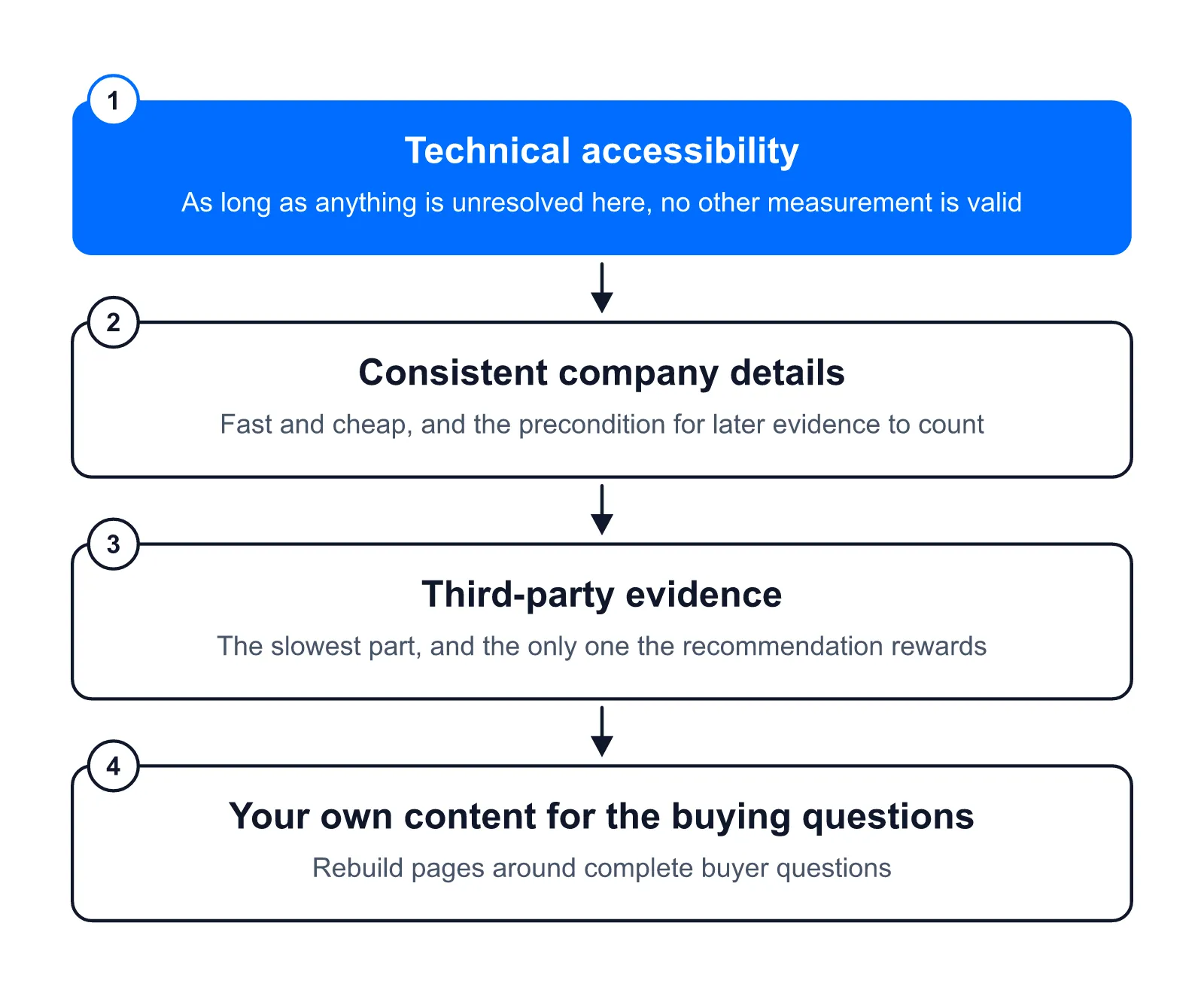
When several are present at once, one question settles it: which finding makes the other measurements unusable? That one comes first, regardless of effort. Technical accessibility first. Then consistent company details: fast, cheap, and the precondition for later evidence being attributed to the right company. Then the third-party evidence, the slowest part and the only one the recommendation itself rewards. Your own content for the buying questions comes last; the overview page on ChatGPT optimization describes the three levers behind this work: sources, content and corrections. The first reliable movement shows up in weeks to months, not days; we have written down how long it takes to become visible in AI answers, with time frames for each starting situation.
Whether the work makes any difference at all has been measured, at least in part. The original academic paper on the subject (Aggarwal et al., KDD 2024) states the effect literally as “GEO can boost visibility by up to 40% in generative engine responses”, measured on the 1,000-question test split of a benchmark of 10,000 questions from 25 domains; effectiveness varies by domain. What worked there was citing sources, adding statistics and adding quotations. Simply repeating keywords achieved little or nothing.
The nine causes in detail
They fall into four groups, in the order you fix them. Technical accessibility (group 1) comes first, because it invalidates every other measurement.
Group 1: The systems cannot reach you technically. As long as anything is unresolved here, no other measure can be measured.
1. The AI crawlers are locked out
Your page loads perfectly in the browser, and the AI systems still cannot retrieve it. In our technical audits, we do find AI crawlers blocked in the CDN or the firewall, and in most cases nobody set that block deliberately against AI assistants: either it is a default, or somebody checked a box two years ago when blocking AI crawlers seemed like the sensible thing to do. The setting does what it was built for. It just does not distinguish between a scraper and an answer engine. Cloudflare’s own figures show this is not a fringe phenomenon: in the robots.txt files of the largest domains, GPTBot was the most frequently blocked AI crawler in 2025.
Then there is a change that has been in effect since September 15, 2026. It is the second announcement of its kind, one year after the first Content Independence Day on July 1, 2025, when Cloudflare blocked AI crawlers by default for new domains. On July 1, 2026, Cloudflare had announced new defaults in the three categories Search, Agent and Training and on September 15 put them into effect in amended form: anyone who adds a new domain now chooses between two recommended presets, depending on whether the website earns money with advertising; for ad-funded sites, Training is set to “Disallow AI Training” and Agent to “Block on pages with ads,” while Search stays allowed in both cases. The blanket option “Block AI bots” has been replaced, and the managed robots.txt now runs under “Bot Preference Sync”; existing settings were carried over. What matters for findability: under “Disallow AI Training,” Applebot, Bingbot and Googlebot keep crawling for search; only the “Block” setting keeps them out entirely. If your website sits behind this CDN, what gets through can change without anyone at your company touching anything.
The crawlers are not all the same either. OpenAI runs several, and they can be controlled independently: GPTBot for training, OAI-SearchBot for search and citation in ChatGPT, ChatGPT-User for the fetch a user triggers. Blocking only GPTBot keeps you out of training and leaves you citable. Blocking OAI-SearchBot or PerplexityBot removes you from the citable sources.
How to check it: Hand this step to the person who looks after your website. They fetch the same page twice, once with a browser’s user agent and once with an AI crawler’s, the user agent being the identifier the crawler sends to the server. OpenAI and Perplexity publish the complete identifiers, including IP ranges, themselves; copy them from there, not secondhand. As of September 22, 2026, these four lines are documented there:
Mozilla/5.0 (Macintosh; Intel Mac OS X 10_15_7) AppleWebKit/537.36 (KHTML, like Gecko) Chrome/131.0.0.0 Safari/537.36; compatible; OAI-SearchBot/1.4; +https://openai.com/searchbotMozilla/5.0 AppleWebKit/537.36 (KHTML, like Gecko); compatible; GPTBot/1.4; +https://openai.com/gptbotMozilla/5.0 AppleWebKit/537.36 (KHTML, like Gecko); compatible; ChatGPT-User/1.0; +https://openai.com/botMozilla/5.0 AppleWebKit/537.36 (KHTML, like Gecko; compatible; PerplexityBot/1.0; +https://perplexity.ai/perplexitybot)
OpenAI explicitly labels the first two as examples whose version number changes; whoever runs the check should re-read them on the day. The fetch is done with a command-line tool, not the address bar: the same address twice, once with the browser identifier and once with the crawler identifier: curl -L -A "<identifier>" -sS -o response.html -w "%{http_code} %{size_download}" https://your-domain.ch/. The -L is required: if your domain redirects from the apex to the www address, both calls would otherwise return only the redirect, and the comparison would measure nothing. The check passes when both calls end with status 200, the responses are similar in size, and response.html contains the same short phrase you searched for in step 2 of the test. A plain 403 error is the easy case; the hard one is status 200 with a noticeably smaller response that lacks the phrase: what came back was a bot-protection challenge page, not your page.
# Fetch the same page twice: once as a browser, once as an AI crawler.
# Re-read the identifiers at OpenAI and Perplexity on the day of the check;
# the version number changes: developers.openai.com/api/docs/bots and
# docs.perplexity.ai/docs/resources/perplexity-crawlers
UA_BROWSER="Mozilla/5.0 (Macintosh; Intel Mac OS X 10_15_7) AppleWebKit/537.36 (KHTML, like Gecko) Chrome/131.0.0.0 Safari/537.36"
UA_CRAWLER="Mozilla/5.0 AppleWebKit/537.36 (KHTML, like Gecko); compatible; GPTBot/1.4; +https://openai.com/gptbot"
PAGE="https://your-domain.ch/"

curl -L -A "$UA_BROWSER" -sS -o browser.html -w "%{http_code} %{size_download}\n" "$PAGE"
curl -L -A "$UA_CRAWLER" -sS -o crawler.html -w "%{http_code} %{size_download}\n" "$PAGE"

# Passed when three things hold: both lines show final status 200, the two
# sizes are close to each other, and the short word sequence from step 2 of
# the test appears in both files.
grep -c "your short word sequence" browser.html crawler.html
Three caveats go with this; without them the check is misleading.
A self-set identifier is not the real crawler. Cloudflare and comparable services additionally check whether the request comes from the provider’s published IP ranges. A request carrying the OAI-SearchBot identifier from your office network is treated there as an unverified bot and can be rejected, even though the real crawler gets through. The test gives an indication; the verdict is in the CDN’s data.
A block at CDN level does not appear in your website’s server log. It is the most common form of block: it sits in the bot protection of the CDN or the web application firewall, kicks in before the crawler reads the robots.txt, and rejects the request before it reaches your server. It therefore leaves nothing in the log. It is visible in the CDN’s security events, at Cloudflare under Security, Analytics, Events tab; the Service column names the service that stopped it. If you end the check at the robots.txt or search the log for GPTBot, you have not checked the most common block.
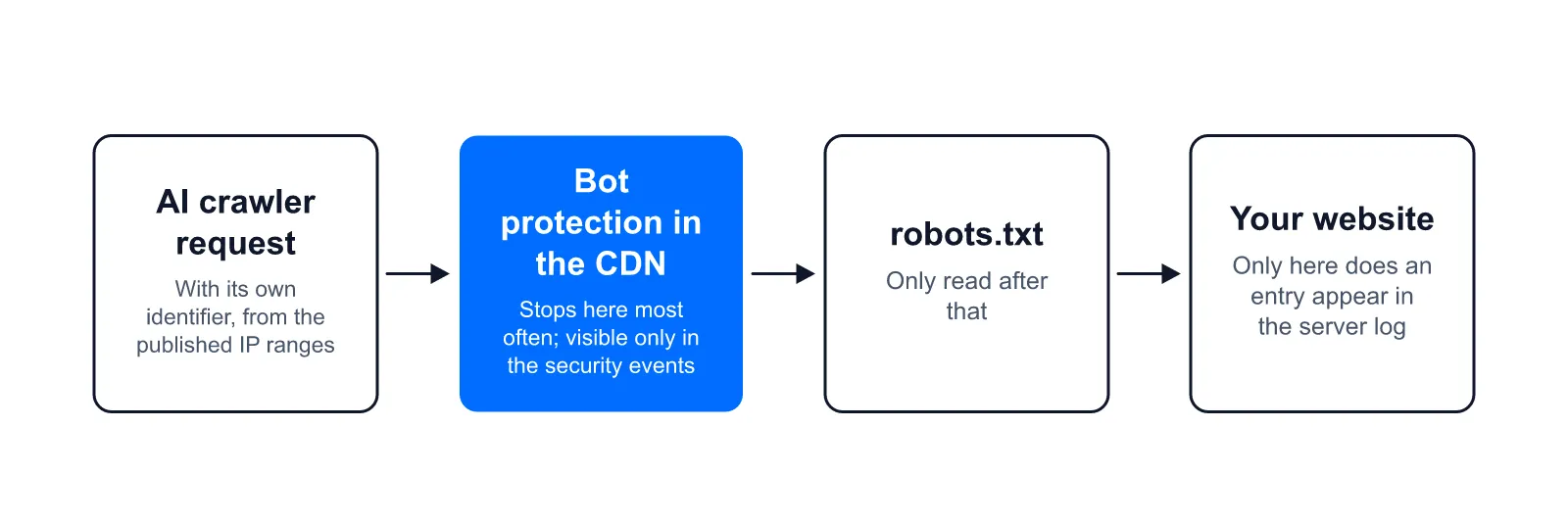
Three settings trigger the block almost every time: the general bot protection (at Cloudflare, Bot Fight Mode and Super Bot Fight Mode with their categories for automated traffic), the option to block AI bots across the board (at Cloudflare, “Block AI bots” until September 15, 2026, since then the three categories Search, Agent and Training), and a custom firewall rule on the user agent. Then there is the managed robots.txt the provider writes for you. If you want to lift the block, look there first.
What it costs: The whole case. Your page wins people over in the meeting and does not exist for the answer engine.
2. Your content is not visible to a plain fetch
Most AI crawlers do not execute JavaScript. An analysis of more than 500 million GPTBot fetches found not a single JavaScript execution; GPTBot and ClaudeBot load JavaScript files but never run them (published December 17, 2024). Exceptions are Google Gemini, which uses Google’s rendering infrastructure, and Applebot. Whatever appears in the document only after JavaScript execution does not exist for ChatGPT, Claude and Perplexity. The same applies to core statements that live only in a PDF, an image or a slider.
How to check it: The second step of the 60-second test, extended: search the source of your service page for three to five words each from three statements that are visible on the page, namely your value proposition, your target group and your price information. Whatever you cannot find there, a crawler cannot find either.
What it costs: Your place in the shortlist. Your page can rank first on Google and still be empty for the answer engine.
Group 2: The systems find you but cannot tell for certain that it is you. Here the evidence exists and fails at attribution.
3. Your company details are inconsistent
Company name, legal form, address, phone number and UID differ between the website, the legal notice (Impressum), the commercial register, directories and LinkedIn. To a human, it is obviously the same company. To a model, it is two candidates, and neither one has enough evidence attached to it to build trust. Then there are companies with the same name, which pull the attribution toward themselves. Where it is uncertain, a system prefers not to name you at all.
This is the cause that is most underestimated in practice, and its fix is the cheapest in the catalog; it appears in almost no marketing plan because it looks like administration. We went through it ourselves: our website was already running under the new name while the old name lived on in Google titles and in the LinkedIn profile. Two names for the same company, and neither one had enough evidence behind it. Our measurement on August 14, 2026, across eight purchase-intent questions in our own category showed zero mentions, with a technically flawless website.
How to check it: Put five windows side by side: your legal notice, your commercial register entry on Zefix, your LinkedIn company profile, your most important directory entry and your invoice template. Compare five fields: exact company name with legal form, address, phone number, UID, website address. Every difference counts, including an abbreviation or a missing suffix. If you run a sole proprietorship that is not in the commercial register, compare the legal notice, the UID register and your profiles instead.
| Field | Your binding version | Matches in |
|---|---|---|
| Exact company name with legal form | Legal notice ☐ · Zefix ☐ · LinkedIn ☐ · Directory ☐ · Invoice ☐ | |
| Address | Legal notice ☐ · Zefix ☐ · LinkedIn ☐ · Directory ☐ · Invoice ☐ | |
| Phone number | Legal notice ☐ · Zefix ☐ · LinkedIn ☐ · Directory ☐ · Invoice ☐ | |
| UID | Legal notice ☐ · Zefix ☐ · LinkedIn ☐ · Directory ☐ · Invoice ☐ | |
| Website address | Legal notice ☐ · Zefix ☐ · LinkedIn ☐ · Directory ☐ · Invoice ☐ |
Worksheet for the check: enter the binding version per field and compare the five sources against it. A sole proprietorship that is not in the commercial register replaces Zefix with the UID register.
What it costs: The whole case. As long as the attribution is unclear, later evidence does not count either, because it is attributed to the wrong company.
4. Outdated signals overwrite your current state
Old company name, old address, old phone number, discontinued services: as long as they are somewhere online and look more current than your new website, they are the description the answer uses. For sources fetched live, that can change within days to weeks once the entry is corrected and read again. Whatever sits in a model’s training data stays there until the next training run, regardless of what you correct today.
How to check it: Ask an AI assistant for a short profile of your company: “What does [company name] offer, since when has the company existed, how big is it, where is it based, how can it be reached?” Compare every detail with today’s state. Repeat this with a second system so you can rule out a fluke.
What it costs: The unnoticed loss. Your name appears, but the inquiry still never arrives, because the service named is no longer the one you want to sell.
Group 3: Only your own website writes about you. The slowest part of the fix.
5. You are not in the directories and industry lists of your category
In response to a provider question, a system retrieves directories, industry and association lists and comparison portals. If your entry is missing there or contains wrong details, you are not in the candidate pool: the selection happens before anyone looks at your website. Which lists these are varies by industry. It has been measured for two: for the Zurich fiduciary inquiries they are comparison portals and local.ch; for Swiss IT service providers, no directory or comparison portal is among the six most-cited sources: all six are providers’ own websites. A manufacturer’s partner directory also counts as third-party evidence: the page does not belong to you, and getting listed requires passing a review. For regulated industries, add the official registers and association lists, by the same rule: for an insurance broker the public FINMA register of insurance intermediaries, for a law firm the cantonal register of attorneys and the attorney search of the cantonal bar association. For locally bound services, the map services, local.ch and the member list of the local trade association count.
How to check it: Ask an AI assistant your own category question and then open every source linked under the answer. Note on which of these pages you have an entry and on which you do not. That is your gap list, and it is usually longer than expected.
What it costs: Your place in the shortlist. You are not rejected; you simply never come up in the selection process.
6. There are no independent mentions
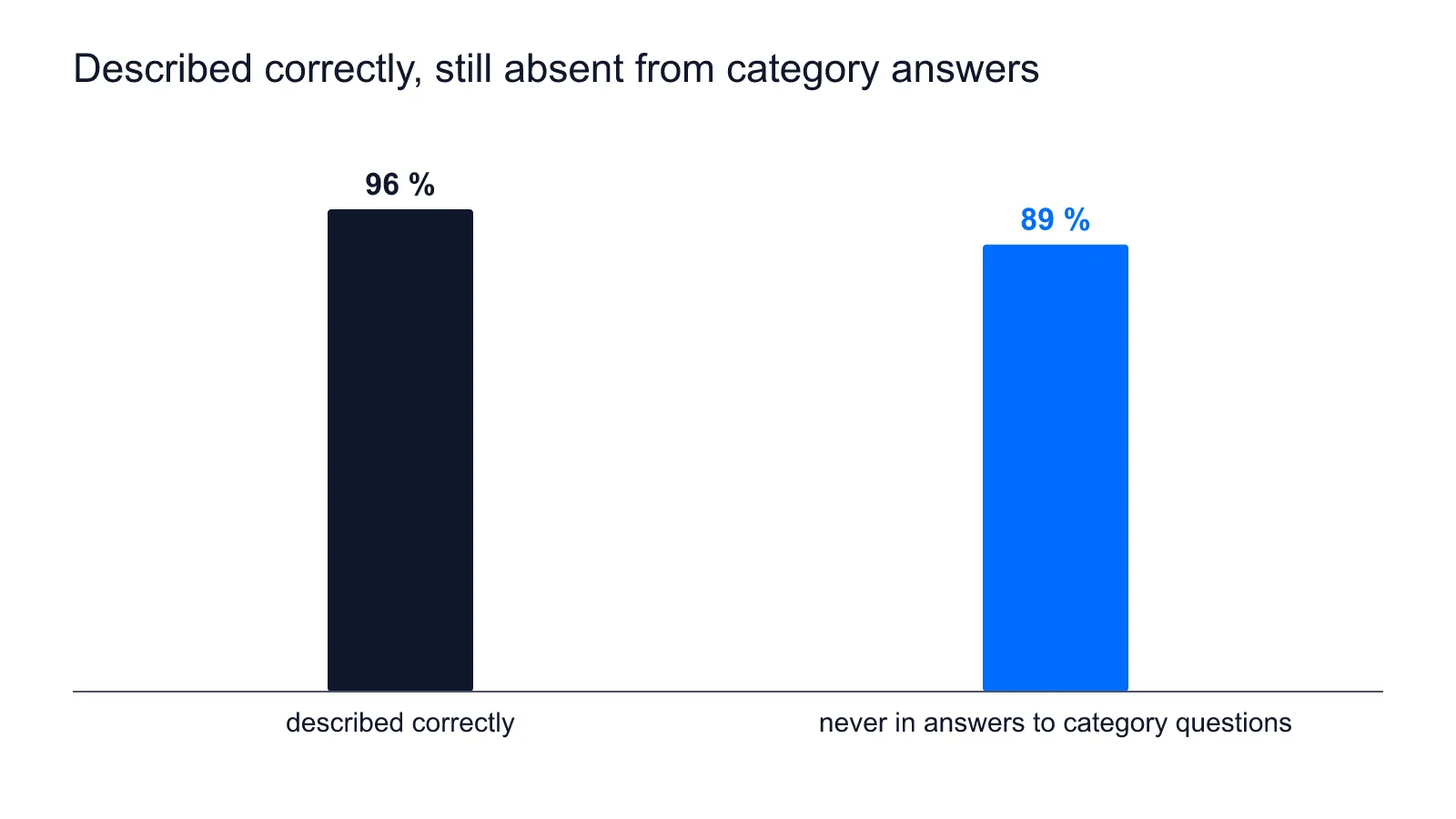
If every statement about your company comes from you, there is none of the outside confirmation the systems go by. The brand survey cited above found that brands with mentions on fewer than 2,000 indexed pages were named in AI answers in only 3 percent of cases; 96 percent of the brands checked were described correctly, and 89 percent still never appeared in answers to category questions. The systems know who these brands are. They just do not suggest them. Third-party evidence comes from trade media, association publications, partner sites, forums and industry portals.
How to check it: Search your company name in quotation marks on Google and count through the first thirty results: how many of them are on a domain you do not own and did not pay? If the number is in the low single digits, this is your cause.
What it costs: Your place in the shortlist. On your own page you can write what you like; without outside confirmation, the answer names the providers third parties write about.
7. There are no reviews, or too few
A profile without reviews contributes nothing to the selection. A logged answer from the index shows how heavily the systems rely on them: asked “I’m unhappy with my fiduciary, who in Zurich would you recommend?” (in German), ChatGPT justified each of its three recommendations in the published excerpt with the rating, for instance “4.8/5 from 28 reviews” (September 2026 edition). The effect hits service providers whose clients are satisfied but were never asked to say so publicly.
How to check it: Open the two or three review platforms that are common for your industry in Switzerland and search for your company. Note three things: is there a profile, how many reviews does it have, and how old is the most recent one? A profile with two reviews from 2023 is worth barely more than no profile.
What it costs: Your place in the shortlist as soon as the buyer asks for “good,” “recommended” or “reliable.” When the buyer only asks who exists, you are still in; when the buyer asks who is good, you are out.
Group 4: Your content does not answer the buying question. The systems find you and can identify you, but cannot use you as an answer.
8. Your content is built on keywords, not on complete buyer questions
In an AI assistant, buyers often describe their problem in full sentences: “We’re a 30-person company, our bookkeeping still runs on Excel, who can take that over in German-speaking Switzerland?” instead of “accountant Zurich.” Content built only around single keywords does not answer this question, so the page is not recognized as a relevant source when the real question is broken down.
How to check it: Write down the five sentences your last five clients used to describe their problem in the first conversation. Search your website for the substance of these sentences. If none of them is answered, your site addresses different questions than the ones being asked. The systematic way to collect such sentences is the work on buyer questions for the measurement.
What it costs: Part of the questions, the ones closest to a purchase. For the general category question you may stay visible. You disappear where the buyer describes the problem and is closest to buying.
9. Your claims cannot be verified
An answer that suggests a provider needs a concrete feature to hang the suggestion on. “Leading,” “tailored” and “personal” are not features. Without a clear profile of services, region and target group, without figures and without any form of price information, there is nothing left for a system to cite in an answer.
How to check it: Take your service page and strike every sentence that could just as easily be said by your competitor. What is left is what a system can use to describe you. If less than a paragraph is left, you have found the cause.
What it costs: Part of the questions. For the general provider question you may get through; for every question with a criterion (“for an SME with 30 employees,” “in eastern Switzerland,” “with experience in contract manufacturing”) you disappear.
The more expensive case: named, but described wrongly
If you are not named, you notice at some point. If you are described incorrectly, you almost never notice, and that is why it is the more expensive case. Your name is in the answer, but the inquiry still goes to someone else, because the description does not match what the buyer is looking for.
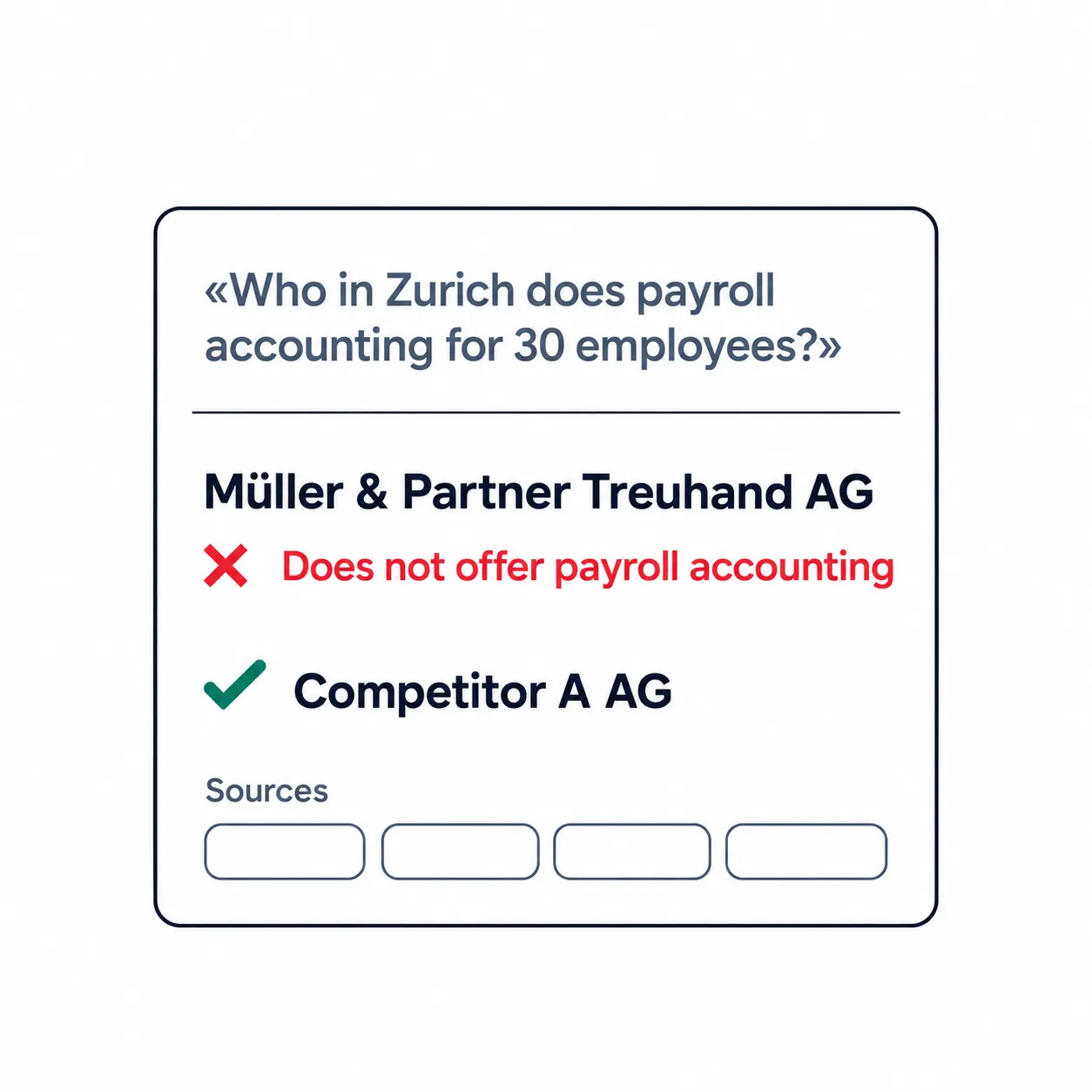
It is well documented that AI answers get facts wrong. A BBC study had ChatGPT, Copilot, Gemini and Perplexity answer 100 questions on current news with BBC articles as the source and found significant problems in 51 percent of all answers. That measures news questions, not company profiles, so it is not direct evidence for your industry, but it shows how error-prone the process is. OpenAI says the same in its own privacy policy: the models predict the likely next word, and that need not be the factually correct one.
In our work, three types of error come up:
- Outdated details kept alive by old sources. Discontinued services, old address, old company name.
- Confusion with companies of the same or a similar name. In the fiduciary sector this is systematic, because family names as company names are the rule there.
- Invented precision. A headcount or founding year that appears in no source and still turns up in the answer.
How does something like this come to light? Almost never on its own. No company makes a habit of asking the machine about itself. In every case we know of, the error surfaced in a measurement and not in daily business. That is the real point: the false statement has been in the answers for months, and nobody at the company knows about it.
It can be corrected, but not in the model. The privacy organization noyb has documented that OpenAI cannot selectively correct a false fact in the model, only filter or block it; for false statements about a person, OpenAI accepts correction requests at privacy.openai.com. The reliable route is through the sources: you correct the entry the statement comes from and get it crawled again, and that is exactly the work we offer as AI reputation protection.
What is different in Switzerland
None of the causes is limited to Switzerland. The check and the fix are. Four points you will not find in an international guide, and that matter all the more if you moved your company here from abroad.
The commercial register and the UID are the unambiguous key. Switzerland has a public, official register entry: the commercial register is the official basis for company data, Zefix makes the entries of the cantonal registers centrally searchable, and the UID, the standardized business identification number, identifies a company across systems. Many directories and portals draw on this data; a contradiction between the legal notice, the register entry and the directories can be checked in minutes, and if it is not, it spreads rather than evening out. The index measures against the register too: the 1,086 Zurich fiduciary firms in the September 2026 edition come from the commercial register. Sole proprietorships below the registration threshold are not required to register; for them the check starts with the legal notice, the UID register and contact details.
{
  "@context": "https://schema.org",
  "@type": "Organization",
  "name": "Example Fiduciary",
  "legalName": "Example Fiduciary AG",
  "url": "https://example-fiduciary.ch/",
  "identifier": { "@type": "PropertyValue", "propertyID": "UID", "value": "CHE-123.456.789" },
  "address": {
    "@type": "PostalAddress",
    "streetAddress": "Bahnhofstrasse 1",
    "postalCode": "8001",
    "addressLocality": "Zürich",
    "addressCountry": "CH"
  },
  "telephone": "+41 44 123 45 67",
  "sameAs": [
    "https://www.zefix.ch/en/search/entity/list/firm/000000",
    "https://www.linkedin.com/company/example-fiduciary/",
    "https://www.local.ch/en/d/zuerich/8001/fiduciary/example-fiduciary-ag"
  ]
}
The Google Business Profile even without a storefront. A service provider without walk-in customers can maintain a profile with a service area and a hidden address. It is one of the places where reviews live and where company details get cross-checked.
local.ch and search.ch. A basic entry through localsearch covers both directories, and local.ch measurably appears in the answers: in the Zurich fiduciary view, the site is cited in 19.2 percent of answers. Add Bing Places (Copilot answers from the Bing index), Apple Business Connect and the lists of the cantonal and industry associations.
.ch domain and language signals. A .ch domain, clean language markup for Swiss German and content in Swiss Standard German tell a reader and a model which market you serve. We know of no measurement in which the domain extension alone moved a recommendation. What counts is whether Swiss sources name you, and whether your details there match the register.
Three explanations that are usually wrong
“We rank first on Google, so we must show up in ChatGPT too.” This is the misconception we hear most often in an initial call; almost everyone looks for the cause on their own website first. The link between the two is weaker than expected: an Ahrefs analysis of 15,000 search queries found that for ChatGPT, Gemini and Copilot only about 8 percent of cited URLs are in Google’s top 10, 12 percent across all four systems checked, and that more than 80 percent of their citations come from pages that do not appear at all in the Google results for the question asked (vendor survey, August 2025). There is evidence pointing the other way: BrightEdge measures a rising overlap over 16 months, from 32.3 to 54.5 percent, between the sources of Google’s AI summaries and the organic ranking, and an analysis of 362,000 US desktop search queries finds that 94 percent of AI summaries cite at least one source from the first 20 organic results (both vendor surveys, September and October 2025). A good Google position gets you into the candidate pool. It does not decide the selection.
| Survey | What was measured | Result |
|---|---|---|
| Ahrefs, vendor survey, August 2025, 15,000 search queries | Share of cited URLs that are in Google’s top 10 | About 8 percent for ChatGPT, Gemini and Copilot; 12 percent across all four systems checked |
| BrightEdge, vendor survey 2025, 16 months | Overlap between the sources of Google’s AI summaries and the organic ranking | Risen from 32.3 to 54.5 percent |
| seoClarity, vendor survey 2025, 362,000 US desktop search queries | Share of AI summaries with at least one source from the first 20 organic results | 94 percent |
The three measure different things: the share of cited URLs, the change in overlap over time, the hit rate per answer. All three are vendor surveys.
“We need an llms.txt.” To date there is no evidence that it has any effect. We have laid out why an llms.txt does nothing for your visibility today. The file is not in this catalog of causes because not having one is not one of the nine causes.
“Once we add structured data, we’re in.” Structured data based on schema.org helps the systems understand content and identify a company cleanly; it is useful for cause 3. There is no peer-reviewed study demonstrating an independent effect on citations. If you add it and then expect your share of citations to shift, you will be disappointed.
Frequently asked questions
What do I do if ChatGPT says something wrong about my company?
Correct the source, not the model. Find the entry the false statement comes from, usually a directory, an old profile or an old media article, and have it corrected. For false statements about you as a person, OpenAI also accepts correction requests at privacy.openai.com, but it cannot selectively overwrite a false fact in the model.
How many companies does an AI answer typically name?
In our measurements, three to five; the available vendor surveys arrive at four to nine depending on the system and question type, with ChatGPT at the lower end. Think in terms of a recommendation rate, the share of answers in which your company is recommended as an option, rather than a position. Why there is no ranking in ChatGPT explains why 100 percent mentions are impossible and which rate is realistic.
Does the index measure my industry?
Today it measures four industries in Zurich, Zug and Switzerland: fiduciary services, IT service providers, property management and web agencies, split into 18 views. Further regions and industries follow. If your industry is not in it, use the index as a template rather than a measurement: the methodology is published, so you ask your own buyer questions several times following the same pattern and log which names come back. The sources listed under each answer tell you which sources count in your industry.
Our website is in English only. Is that why we are missing?
Not on the evidence we have. We know of no measurement in which the language of the website or the domain ending alone moved a recommendation. What counts is whether Swiss sources name a company and whether its details there match the commercial register; that is where the causes above sit, whatever language your site is in. One limit to keep in mind: the index asks its buyer questions in German, so it measures how the assistants answer Swiss buyers who ask in German, not how visible you are when the question is asked in English.
Is this worth it for an SME with 20 employees?
Headcount does not decide that; what a single new client is worth to you does, along with whether your buyers do their research before they first get in touch. A 20-person business with a high deal value benefits more than a larger one with many small orders. Carigiet GEO takes on companies from 11 employees upward.
Where do you stand today?
The catalog is only useful once you know which of the causes apply to you. For that you need a measurement, not a guess. The first step does not even ask for your email address: the company lookup in the Swiss AI Recommendation Index shows, for the industries measured, whether your company is recommended in the logged answers and who appears instead. The next step is free and carries no obligation: the AI visibility analysis checks in ChatGPT whether you are named, which providers appear instead and which statements about you are false; the report usually arrives by email within 15 to 30 minutes. In the 15-minute call we open ChatGPT live, ask your own buyer question and look at the sources under the answer together. No sales pitch, no slides.
Nobody can seriously promise you a guaranteed mention. A documented baseline, a named cause and an order in which to work through them: those you can have.
Related posts

llms.txt: Do You Need One? The Honest Answer (2026)

Check Your AI Visibility Yourself: Test in 30 Minutes Whether ChatGPT Recommends You (2026)