

An AI assistant mentions your company when your name appears somewhere in its answer. It recommends your company when it puts you forward to the person asking as a suitable choice, usually with a reason. A mention alone does not get you onto the shortlist a buyer picks from, so the number to measure is the recommendation rate: the share of answers to a fixed set of buyer questions in which your company is recommended. At Carigiet GEO we classify every company mention this way for the Schweizer KI-Empfehlungsindex (Swiss AI Recommendation Index). In its October 2026 edition, 21 out of every 100 company mentions were not recommendations.
Key takeaways
- Mentioned: your name is in the answer. Recommended: the AI suggests you.
- Index, October 2026: 21 out of 100 mentions came without a recommendation, 55 out of 100 for keyword queries about cost.
- A link among the sources is not a recommendation.
- Measure the recommendation rate with questions that omit your name.
- One answer proves nothing: in a repeat test, ChatGPT never gave the same shortlist three times.
Carigiet GEO is a consultancy in Uetikon am See, canton of Zurich, for Swiss B2B companies that want AI assistants to recommend them. Every month, Carigiet GEO publishes the Schweizer KI-Empfehlungsindex, which measures which companies six AI assistants recommend in answer to real buyer questions. The index figures in this article come from the October 2026 edition, read on October 12, 2026: 408 buyer questions put to ChatGPT, Claude, Copilot, Gemini, AI Overviews (the AI summaries in Google Search) and Perplexity from September 28 to 30, 2026, with 3,472 scored answers. Rankings and company counts combine up to three monthly rounds of measurement. The index is published in German, and the questions and answers quoted below were asked and given in German; the translations are ours.
Is a mention in ChatGPT enough?
No. A mention shows that ChatGPT knows your company. You only make a buyer’s shortlist when ChatGPT puts you forward as a choice in answer to a question that does not contain your name. The index calls the weaker state “genannt” (mentioned): the assistant brings the company up as an example, as a source or as background, but not as an option the person asking should choose.
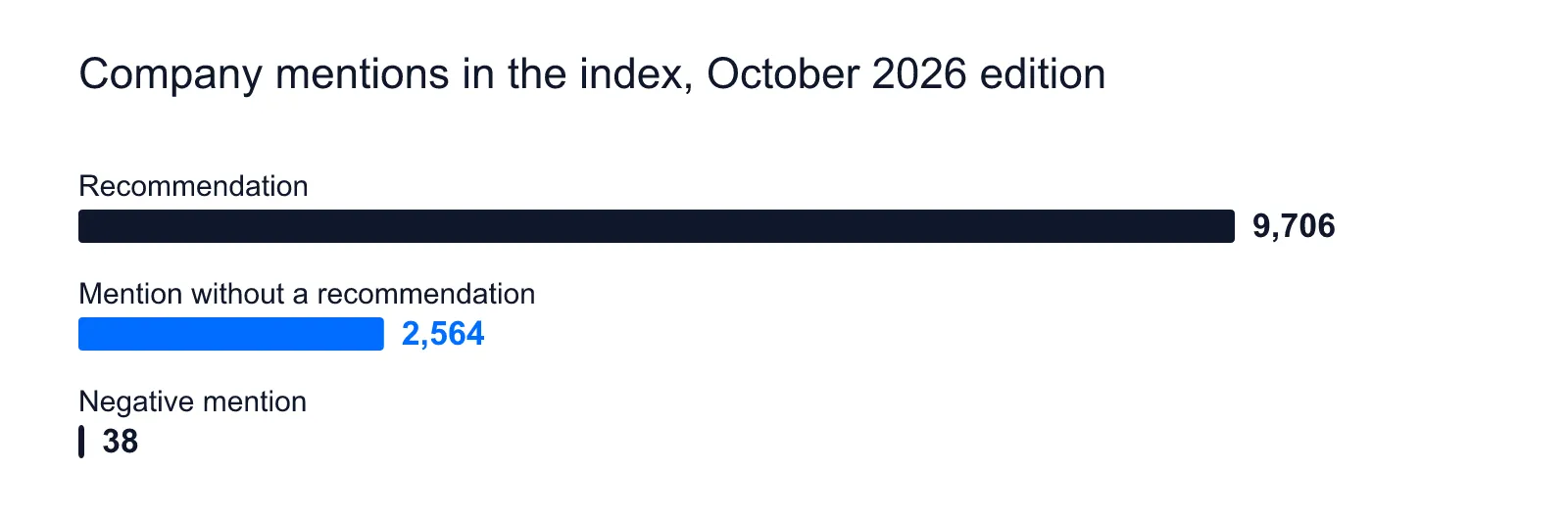
Our own analysis of the October 2026 edition of the Schweizer KI-Empfehlungsindex (in German) shows how often that happens. The six assistants mentioned companies from the Swiss commercial register 12,308 times, counting each company once per answer:
- 9,706 of these mentions were recommendations (79 out of 100).
- 2,564 were mentions without a recommendation (21 out of 100).
- 38 were negative (3 out of 1,000).
Counted by answers, 1,123 of 3,472 answers (32 out of 100) contain at least one company that is mentioned but not recommended. Counted by companies, the assistants mentioned 1,161 companies across the three rounds of this edition, including some outside the industries and regions the index measures, and recommended 1,012 of them at least once (chart KEI-2610-06, in German). That leaves 149 companies that appeared without being recommended a single time. The count leaves out 2,471 names not yet matched to a company in the commercial register, 1,247 names from outside the industries, such as portals, associations and software, and 216 discarded names.
ChatGPT alone has the smallest share: 8 out of 100 of its mentions were not recommendations. When prospects tell us in an initial call that their company shows up in ChatGPT, the mention usually has one of three origins:
- They asked about their own company. “What do you know about [company]?” always puts the company in the answer. That shows the assistant knows it, not that it suggests it to a buyer.
- They tested in their own account. History, memory, location and earlier questions about their own company all feed into the answer. The assistant knows who is asking.
- A report counts visibility. A report that counts every mention and every cited source as visibility adds up what the index keeps apart.
When we open the assistant live and ask the question a buyer in that situation would ask, the company often appears under “other providers”, shows up as the source of a price, or is missing altogether.
So for every figure in a report, ask two things. Which event was counted: a mention, a citation (a link to your website among the sources) or a recommendation? And what is the denominator, meaning what was it divided by: all answers to the questions asked, or only the answers in which your company appears? We have not yet found an independent study that records mentions and recommendations separately and links them to actual inquiries.
How can I tell whether it is being recommended?
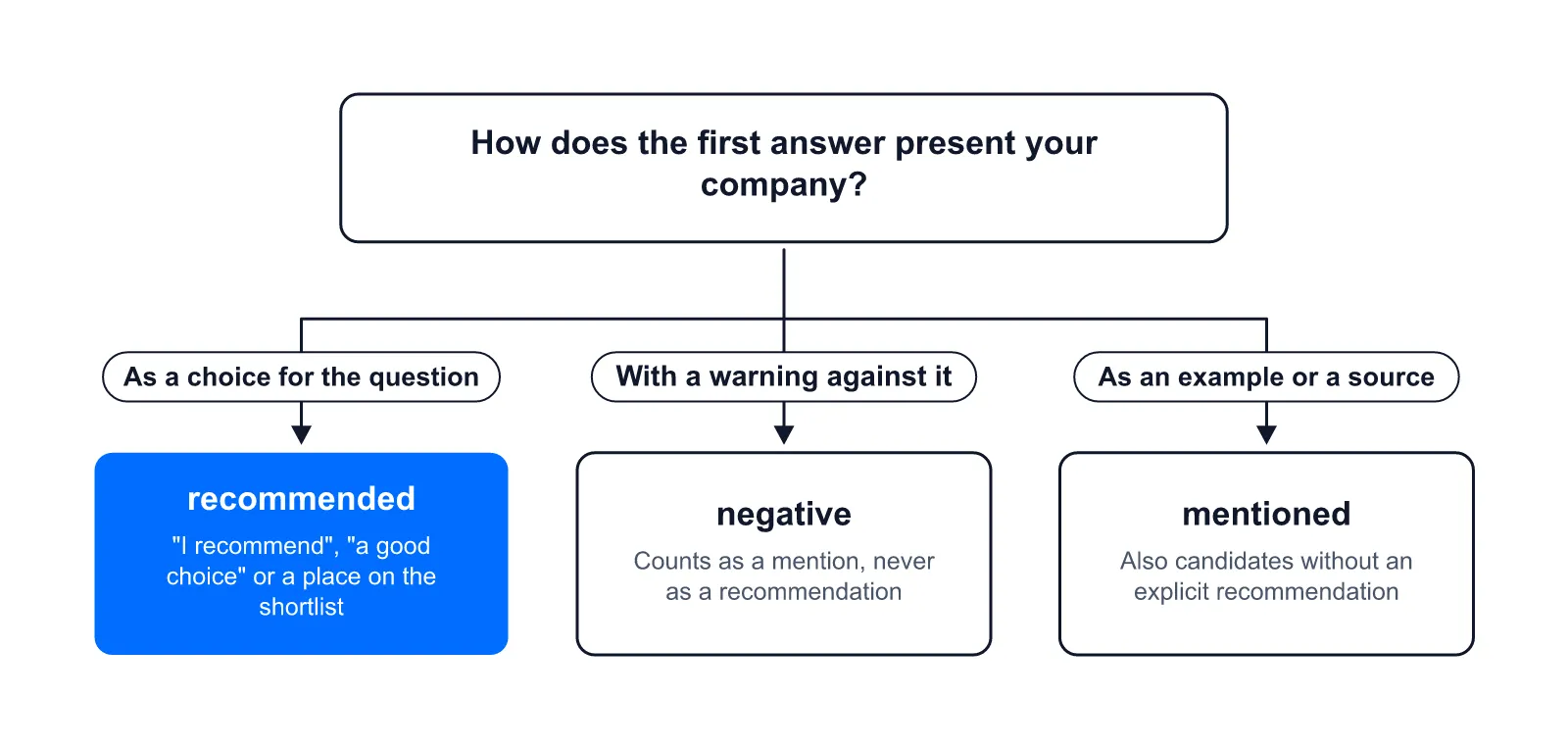
Your company is recommended when the answer presents it as an option the person asking should choose: with phrases such as “I recommend” or “a good choice is”, or as an entry on the shortlist the answer gives in reply to the question. Three checks are enough to classify any answer:
| Level | What you see | How to check it |
|---|---|---|
| Mention | Your company name appears in the answer, in whatever role. | Search the answer text for your name. A negative mention, such as an explicit warning against you, is still a mention and never a recommendation. |
| Citation | The answer lists your website as a source. | Open the answer’s list of sources and look for your website’s address. A citation is not a recommendation. |
| Recommendation | The assistant puts your company forward as a choice for this question. | Your company is on the shortlist that answers the question, or the answer says “I recommend” or “a good choice”, usually with a reason. |
Here is an example from the index’s answer log. On September 28, 2026, Perplexity was asked: “Which fiduciary firm in Zurich do you think is best for an SME’s ongoing bookkeeping?” Fiduciary firms (Treuhand in German) are the Swiss accounting and tax firms that keep the books for many SMEs. The answer recommended a digital fiduciary firm from Glattbrugg first, then three Zurich firms. An international audit firm appeared as well, but only as a mention: “Larger, international provider: [audit firm] offers fiduciary and corporate support services in Zurich, but is usually of more interest for larger or more complex cases.” The audit firm is not on the shortlist, and the sentence says whom it suits: larger or more complex cases. A small company that needs its books kept is not one of them.
The pattern holds beyond this one answer. In October, the Big Four audit firms were mentioned without a recommendation almost as often as they were recommended; one of them was recommended 49 times and mentioned without a recommendation 43 times.
Here is how the index handles the borderline cases that come up most often:
- A long list without reasons: recommended, if the list is the answer to the question. We record the position in the list as well.
- Candidates named together with an explicit refusal to recommend: mentioned. On September 28, 2026, Claude answered “Who handles payroll reliably in Zug, who would you recommend?” with “I can’t in good conscience recommend any firm to you as the ‘most reliable’” and then named five candidates. All five count as mentioned.
- A recommendation with a reservation: the question is whether the company is offered as a choice to this particular person. If Perplexity calls a firm “rather oversized” for the VAT work of a simple SME, in answer to a question from an SME in Zug, the firm counts as mentioned.
- A company as an example of a category or as the source of a price range: mentioned.
- Portals, directories and associations: not counted at all, because they do not provide the service in question.
If a company appears several times in the same answer, it counts once, with its strongest classification: recommended outranks negative, and negative outranks mentioned. The full rules are in the index methodology (in German).
A citation looks like a sign of trust, which is why it is easily mistaken for a recommendation. In the main ranking for fiduciary firms in Zurich (the ranking the index shows first for each industry and region), one firm is cited as a source in 29.1 percent of answers but recommended in 16.1 percent (chart KEI-2610-11, in German; 370 answers to 24 questions, weighted by the assistants’ reach in Switzerland). Across all eight main rankings, citations and recommendations largely go together, yet 206 of 519 companies with a verified website are cited more often than they are recommended (chart KEI-2610-05, in German).
There is no agreed standard for when an answer counts as a recommendation. The guideline “Measuring Visibility in the AI Era”, published on August 3, 2026 by the IAB (Interactive Advertising Bureau, the US trade association for digital advertising), separates mentions, citations and recommendation strength, but explicitly leaves the exact line to the measurement vendors. That is why Carigiet GEO publishes the rules of its index.
Why do some assistants mention companies without recommending them?
Some assistants would rather list candidates than make a choice, and that is why the share of mentions without a recommendation varies so widely from one assistant to the next. In the index, October 2026 edition:
| Assistant | Mentions without a recommendation |
|---|---|
| Claude | 38 out of 100 |
| Copilot | 32 out of 100 |
| AI Overviews | 24 out of 100 |
| Gemini | 16 out of 100 |
| Perplexity | 12 out of 100 |
| ChatGPT | 8 out of 100 |
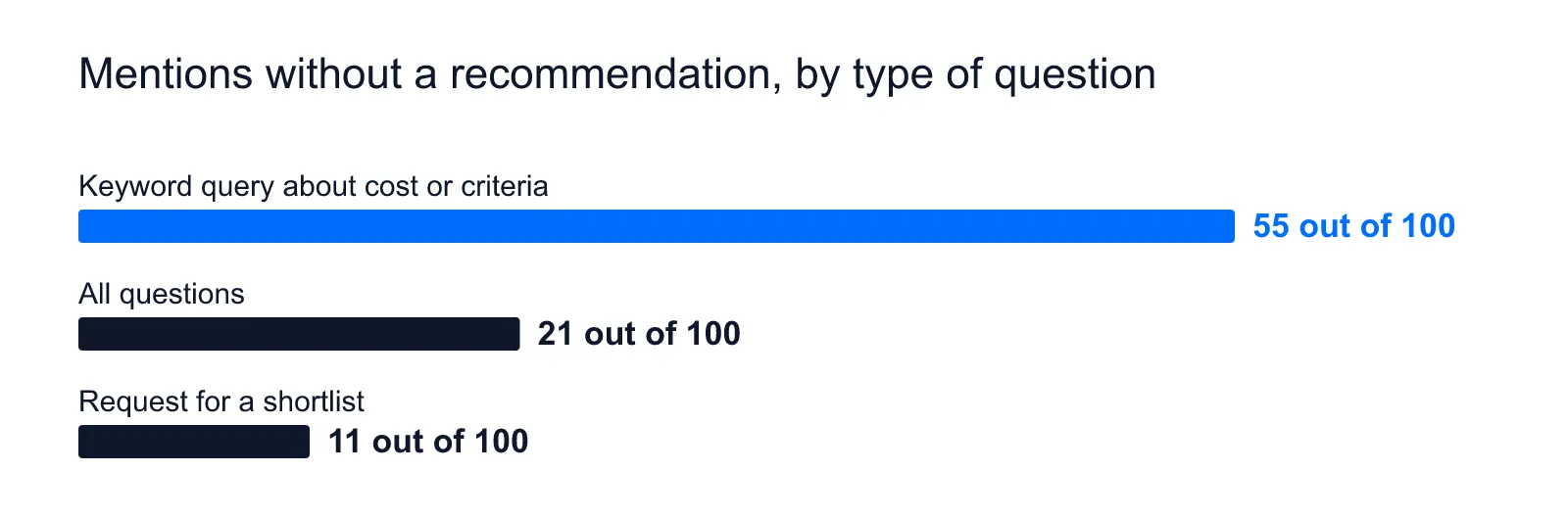
Claude comes first because it often declines outright to recommend anyone and names candidates instead. The form of the question shifts the share as well. For keyword queries about cost or criteria, along the lines of “occupational pension advice SME Zurich cost”, 55 out of 100 mentions were not recommendations. When the question asked for a shortlist (“Name three providers …”), it was 11 out of 100.
How do you measure the difference?
You measure the difference by putting the same questions to several assistants several times, classifying every answer and calculating two rates.
- Define a set of questions that leave out your company name. Word them the way buyers ask: as full questions in more than one style and as short search terms, with a place and a situation (“fiduciary firm Zurich bookkeeping for a small company”). A question that contains your name measures what the assistant knows about you, not whether it recommends you. As a benchmark, the IAB guideline classes a measurement program with fewer than 50 queries as exploratory. The index asks 408 questions, but only 24 per ranking, so by that standard a single ranking is exploratory.
- Ask every question in a new session. No login, no history, no memory. Where an assistant requires an account, such as Claude, set up a separate account used only for measuring and switch off its memory. The index measures the default answer the same way: new session, no history, no personalization, first answer. It collects the answers of ChatGPT, Claude, Copilot and Gemini through their web interfaces, AI Overviews through Google Search, and Perplexity through its API, meaning by software rather than through the website. OpenAI states in its help article on ChatGPT search that saved memories and your approximate location can change search results. The index does not measure how much that changes the shortlist in real use. A company cannot control it; all it can do is make sure its description fits the situations it wants to be chosen for.
- Measure several assistants and evaluate each one separately. In October, 38 out of 100 company mentions by Claude were not recommendations, against 8 out of 100 by ChatGPT. An average across all assistants hides that.
- Ask every question several times, on different days. Starting with the November 2026 edition, the index asks every question three times, on three days, each time in a new session. Many questions matter more than many repeats, because the answers to one question are related to each other. A statistical paper by Evan Miller (2024) on evaluating large language models (the technology behind ChatGPT and similar assistants) makes the same point. It has not been peer reviewed, and we are applying it to recommendation rates: adding questions is the simplest way to reduce the margin of error, meaning how far the measured rate can be from the true one.
- Classify every answer. Recommended, mentioned, negative or not mentioned; record citations separately. Only an answer that explicitly and positively presents the company as a choice counts as a recommendation: “I recommend”, “a good choice” or a place on the shortlist that answers the question. A recommendation that only comes after you ask a follow-up question does not count.
- Calculate two rates. Every rate uses the same denominator: all scored answers to your questions, including the ones in which no company appears at all.
- Mention rate = answers in which your company appears (recommended, mentioned or negative), divided by all scored answers.
- Recommendation rate = answers in which your company is recommended, divided by all scored answers.
- Citation rate (optional) = answers whose sources link to your website, divided by all scored answers.
- Allow for the margin of error before you compare. As a rule of thumb, the margin of error of a rate is at most plus or minus 1 divided by the square root of the number of answers (at 95 percent confidence), as long as the answers are independent and unweighted. Weighting and repeats of the same question tend to make it larger. With 100 answers that is up to 10 percentage points, with 400 answers up to 5. For rates around 15 to 20 percent, it is 7 to 8 points at 100 answers and about 4 points at 370 answers. In the index, a ranking needs 100 scored answers; below that it stays visible but carries the label “Basis im Aufbau” (base still building).
Every recommendation is also a mention, but not every mention is a recommendation. The difference between your mention rate and your recommendation rate is your gap: the share of answers in which you appear without being chosen.
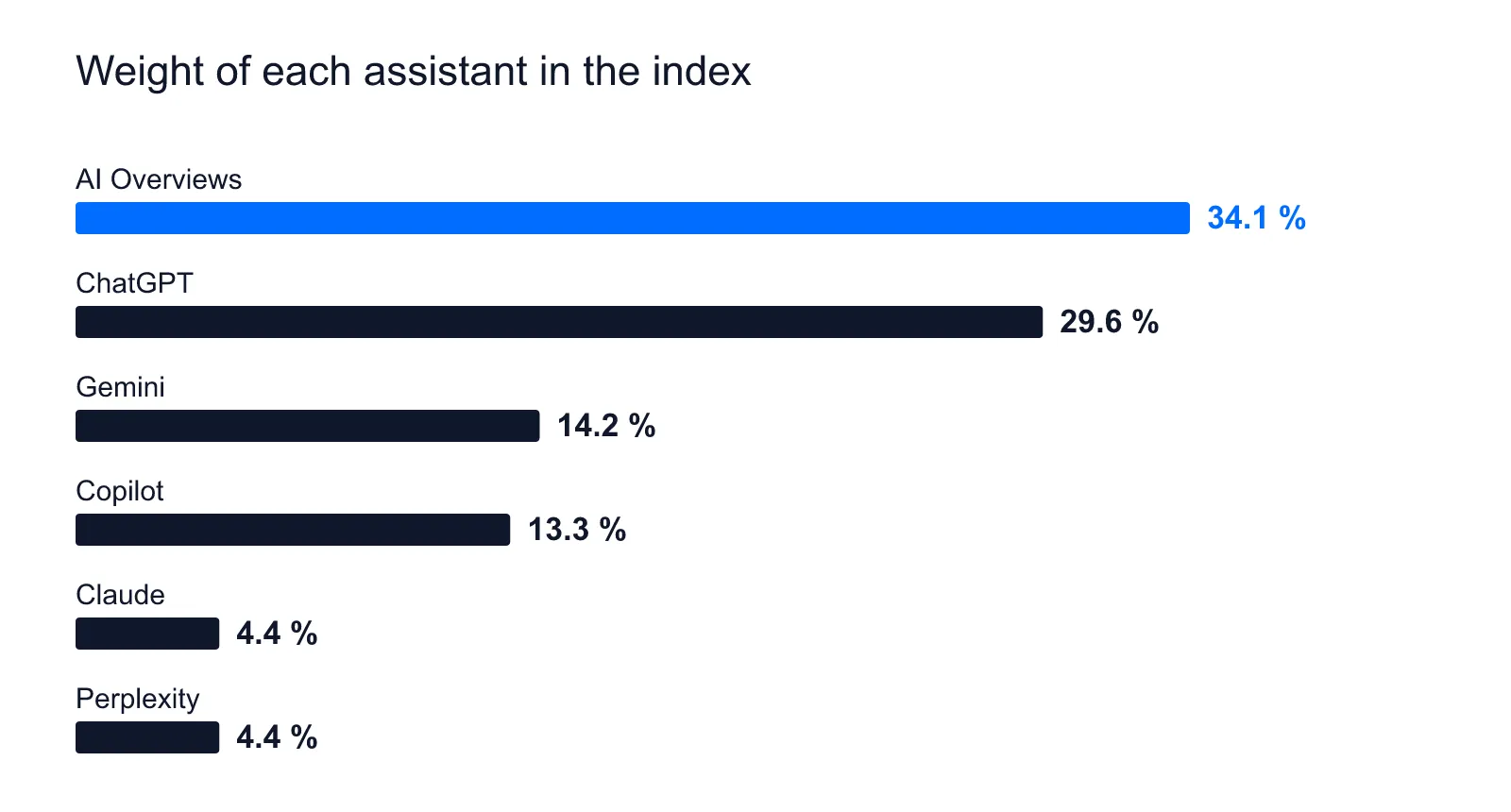
The index differs from your own measurement in one respect: Carigiet GEO weights the recommendation rate by each assistant’s reach in Switzerland, meaning how many people in Switzerland use it (IGEM-Digimonitor 2026, in German; a survey of 1,957 internet users aged 15 to 75, carried out in March and April 2026). AI Overviews carries 34.1 percent of the weight, ChatGPT 29.6, Gemini 14.2, Copilot 13.3, and Claude and Perplexity 4.4 each. The weight for AI Overviews is a provisional placeholder, because the study reports no separate figure for it. A rate you calculate yourself is unweighted.
Our guide to checking your AI visibility yourself in 30 minutes shows how to run this measurement for your own company.
Why does a single answer prove nothing?
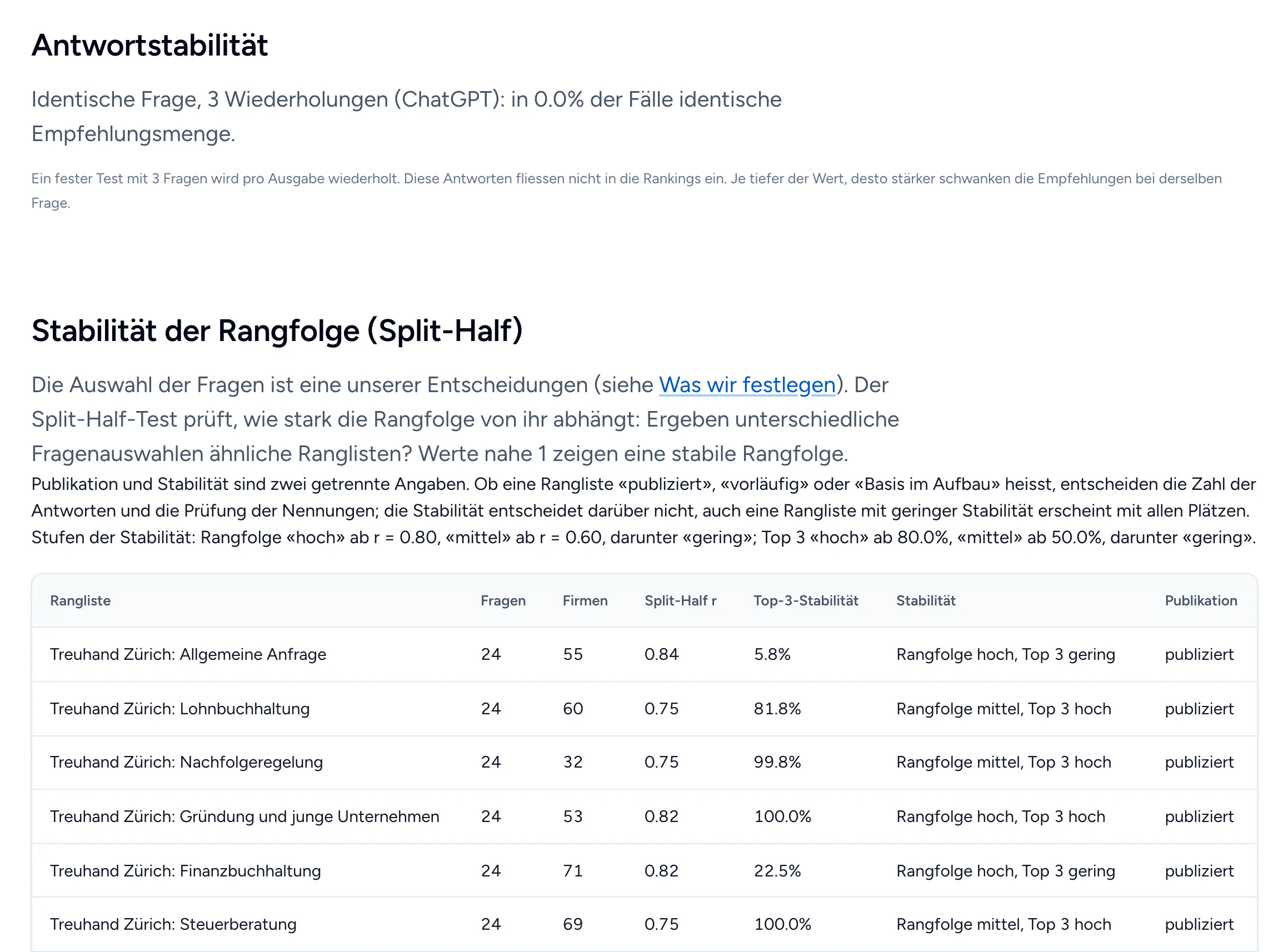
The same question returns a different set of companies almost every time it is asked. In the index’s fixed repeat test (three questions, each put to ChatGPT three times), the set of recommended companies was never the same across all three repeats. These test answers do not feed into the rankings.
Even a ranking built from many answers is uncertain at the top. The index checks this with a split-half test: the questions behind a ranking are split at random into two halves, and each half produces its own ranking.
- Fiduciary firms in Zurich, general inquiry: The order of the whole list is stable (r = 0.84, rated “high”; r measures how closely the orders of the two halves agree, and 1 would mean the same order). But in only about 6 out of 100 splits (5.8 percent) do both halves share at least two of their top three firms. The recommendation rates of the top three firms are 18.0, 17.7 and 17.6 percent, which is within the margin of error.
- IT service providers in Switzerland, AI integration: Here even the order is not very stable (r = 0.32, rated “low”).
Other studies confirm the variation:
- SparkToro (January 2026): The chance that ChatGPT or Google’s AI returns the same list of brands twice in 100 runs is below 1 in 100; for the same order, it is closer to 1 in 1,000. The basis: 12 recommendation questions, from chef’s knives to digital marketing consultants, and 2,961 runs by volunteers on the ChatGPT, Claude and Google interfaces in November and December 2025, 60 to 100 runs per question. The participants’ country was not specified; SparkToro picked the three services as the most widely used in the US. Every brand on a list was counted, with no distinction between mention and recommendation. The data was collected together with a vendor of measurement tools and has not been peer reviewed (SparkToro).
- University of St. Gallen (April 2026): Using Swiss servers and German-language questions to four AI search systems, the brands named in two runs within 24 hours overlapped by only 33 to 48 percent on average. Mentions were counted with a word list, not recommendations; the paper is a preprint that has not yet been peer reviewed, and its first author is affiliated with a vendor of measurement tools (arXiv 2604.07585).
- Microsoft acknowledges for Copilot that using the same prompt (the request you type) several times can produce different responses (Microsoft Support).
Only the rate across many questions and runs settles down, which is also why there is no fixed ranking in ChatGPT. Under the IAB guideline, monthly measurement is good enough for tracking trends; for decisions, the guideline calls for weekly measurement that states its uncertainty. By that classification, the monthly index from Carigiet GEO counts as trend monitoring too.
What does it mean if your company is often mentioned but rarely recommended?
In our experience it usually means the assistant knows your company but cannot match it to the situation of the person asking. Read together, the two rates produce five typical findings:
| Finding | What it usually means | Next step |
|---|---|---|
| Often mentioned, rarely recommended | The assistant knows you but does not match you to the situation being asked about. | Make your description more specific (see below) |
| Rarely mentioned, but recommended when it is | Where the assistant finds you, your description fits; for most questions it does not find you. | Check which questions you are missing from and who is recommended there |
| Cited but not recommended | Your website supplies facts, such as prices, but your company is not offered as a choice. | Make your description more specific |
| Never mentioned | The assistant does not know your company for these questions. | Why your company doesn’t show up in ChatGPT |
| Mentioned negatively or described wrongly | A source gives the assistant a wrong or unfavorable picture. | AI reputation protection |
At Carigiet GEO, work on “often mentioned, rarely recommended” starts with a single step: rewriting the one sentence that says what the company does, for whom and where, until it is exact. That sentence then reads the same everywhere: on the home page, on the service pages, in the Google Business Profile and in directories. A recommendation is a match. The person asking brings their situation (“We’re a small company in Zug with no in-house bookkeeper”), and the assistant recommends the company whose description fits it. It only mentions the others it knows.
You can see this in the answers. In the fiduciary example, Perplexity gave the firm’s own description as the reason for its recommendation: “The company explicitly describes itself as a digital fiduciary firm in Zurich-Glattbrugg for bookkeeping, taxes and payroll administration for SMEs throughout Switzerland.” What, for whom, where: all three are in one sentence. A mention without a recommendation often falls short on one of the three. The audit firm fell short on “for whom”. A fiduciary firm from Aadorf in the canton of Thurgau fell short on “where”: on September 28, 2026, Claude mentioned it as the source of the price ranges in an answer about costs in Zug and, in the same answer, recommended four other firms.
Frequently asked questions
Does it count as a mention if the AI warns people against my company?
Yes. A warning is a mention too, but never a recommendation. The index records it as a classification of its own, “negative”; in the October 2026 edition, 38 of 12,308 company mentions were negative, or 3 out of 1,000.
Is a citation the same as a recommendation?
No. A link among the sources only shows that the answer uses your website as a source. In the October 2026 edition, 206 of the 519 companies with a verified website in the main rankings are cited more often than they are recommended.
Should the prompts I track include my company name?
No. A prompt that contains your company name measures what the assistant knows about you, not whether it suggests you to a buyer. Ask “What do you know about [company]?” and your company will always be in the answer.
Is AI share of voice the same as a recommendation rate?
No. Share of voice is your brand’s mentions as a share of all brand mentions in a defined competitive category, as defined by the IAB, the US trade association for digital advertising. Unless the report separates mentions from recommendations, a mention as the source of a price counts as much as a recommendation. Ask which event was counted and what the denominator is.
Does a recommendation count if it only comes after a follow-up question?
No. What is measured is the first answer in a new session. If an assistant offers to give “a short top-3 recommendation by type of SME” next, that does not change the classification.
Does first place in an answer count for more?
Not in the recommendation rate: every place on the shortlist counts the same. The index reports the first position separately as a stricter count (first mention), but the order varies more than the shortlist itself.
What does ChatGPT say about your company today?
Our free AI visibility analysis gives you a first finding for your own company: you enter your website address, and the report usually arrives by email within 15 to 30 minutes. It shows whether ChatGPT mentions your company, which providers appear instead, which statements about your company are wrong, and who is recommended for the buyer questions you are missing from. The analysis tests ChatGPT only, so it does not replace repeated measurement across several assistants. There is no obligation.
Related posts

Why Doesn't Your Company Show Up in ChatGPT? 9 Causes and What They Cost (2026)

llms.txt: Do You Need One? The Honest Answer (2026)