

You can check your AI visibility yourself in about 30 minutes: with a browser and no login, six to ten questions phrased the way your customers would ask them, and a simple table for the results. This guide takes you through the test in five steps: write the prompts, neutralize the test environment, run every question several times, document the results, and read them correctly. It also gives you copy-ready prompt templates in four categories.
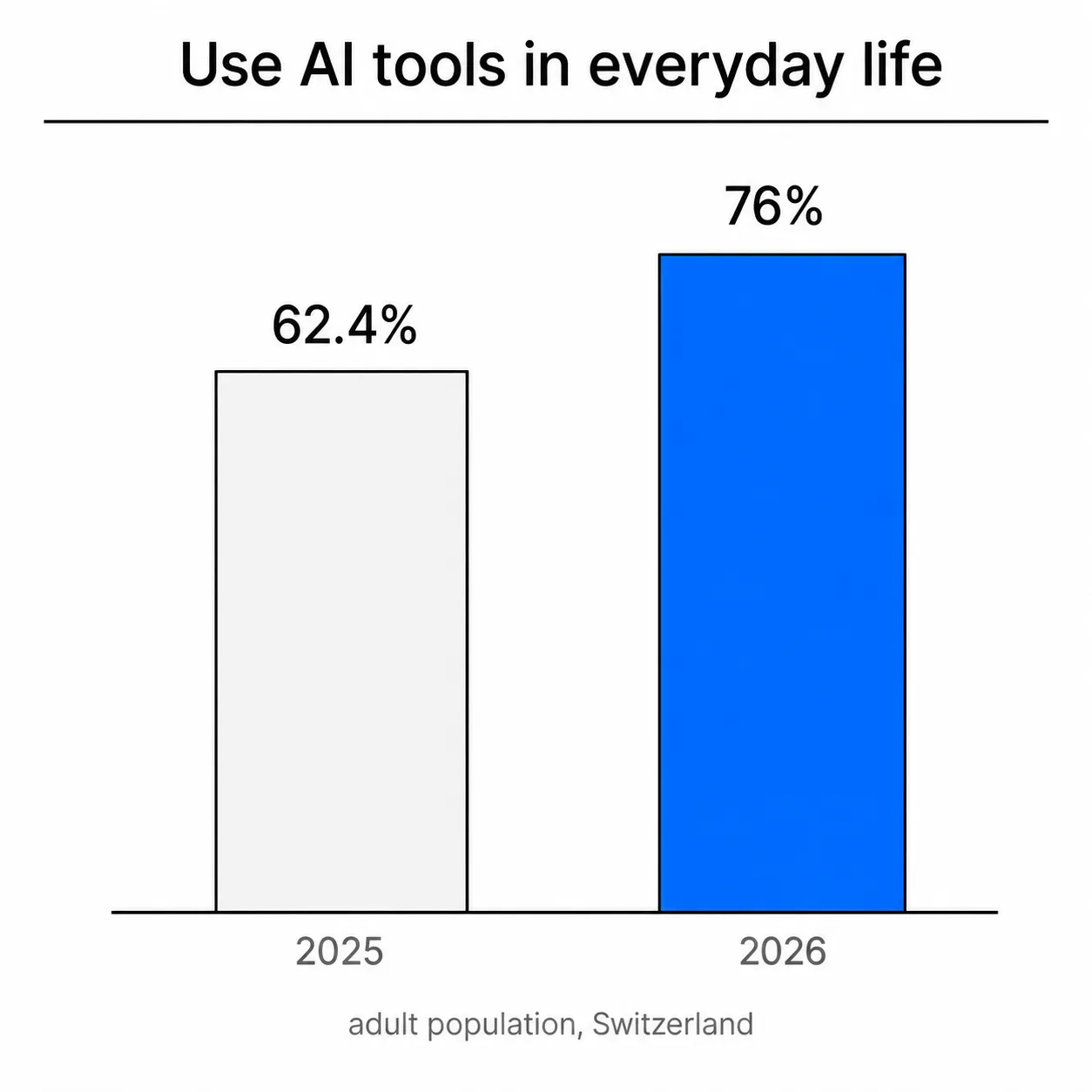
The test is worth the half hour because provider selection increasingly happens inside AI answers. According to a Comparis survey conducted by Innofact in March 2026 among 1,035 people, more than three quarters of adults in Switzerland (76%) use AI tools in their daily lives; a year earlier the figure was 62.4%. The most common use is internet search as a replacement for a conventional search engine, at 41.6%. At Carigiet GEO we measure the AI visibility of Swiss SMEs daily with the same method you are about to apply: neutral queries without a login, three to five repeats per question, documented results instead of single impressions. The discipline behind it is called Generative Engine Optimization; what the term covers is explained in our guide What is Generative Engine Optimization (GEO)?
Key takeaways
- Test logged out or in a temporary chat, so that memory, history, and account settings do not distort the result.
- Write six to ten complete buyer questions in four categories: recommendation questions, comparison questions, problem questions, and control questions about your own company.
- Ask every question three to five times in a fresh chat, and count how often your company is named.
- Separate “mentioned” from “recommended.” Only the recommendation brings inquiries.
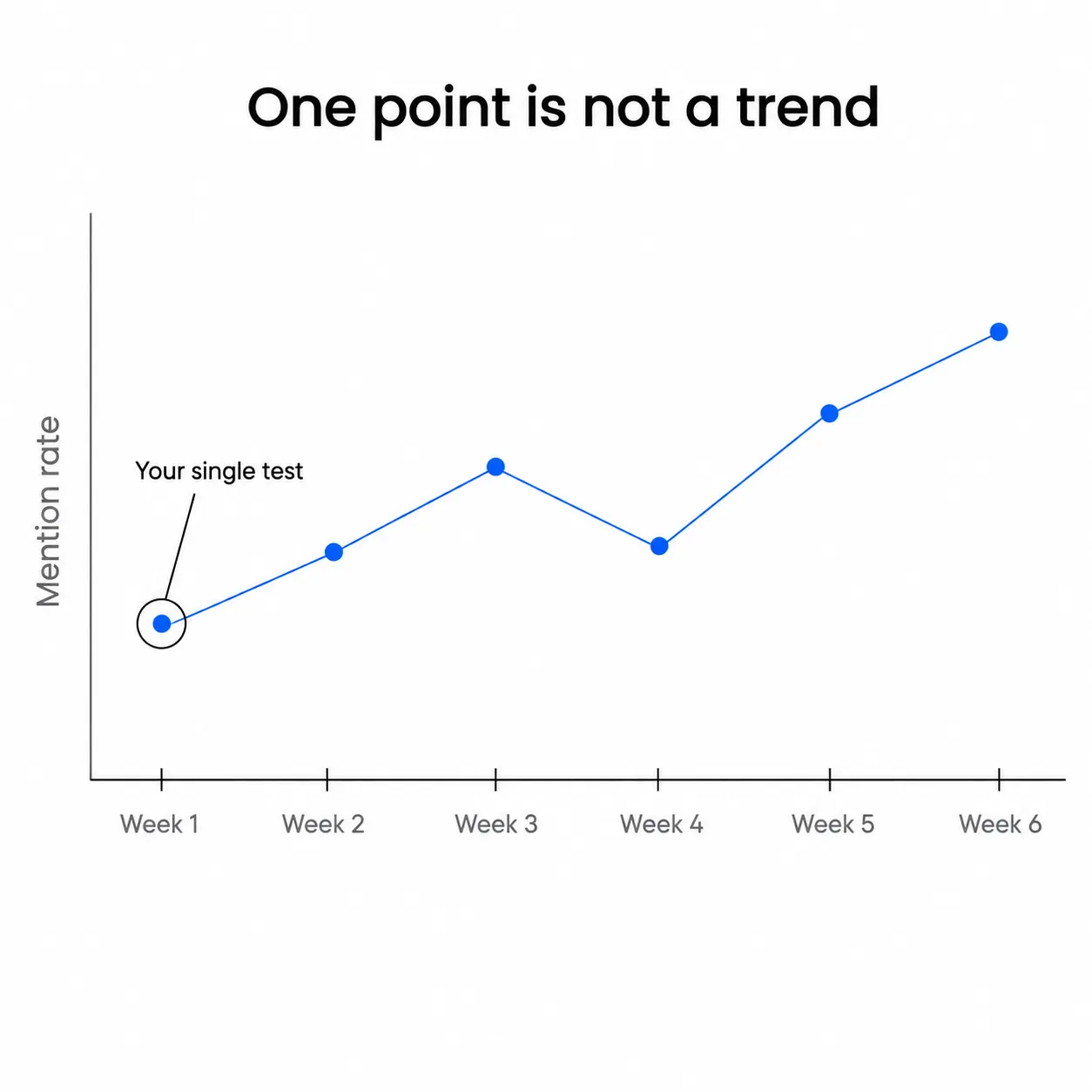
- A single test is a snapshot. Only a trend over weeks holds up.
Why should you test your AI visibility?
Because a growing share of your potential customers begins the search for a provider directly inside an AI system. The study “KMU Digital Pulse 2025” by localsearch and the Lucerne University of Applied Sciences and Arts found that 13% of the Swiss population start their search for an SME directly with AI tools such as ChatGPT or Copilot (localsearch/HSLU, 2025, study page in German). Just under 20% used AI in the past twelve months to inform themselves about SME services, and 78% of those who have already used it that way plan to do so more often.
There is a second reason: AI answers have very little room. Academic work puts the order of magnitude at around five cited sources per answer (Li and Sinnamon, 2024), and at roughly two to six recommended products per answer in a study of investment recommendations, where the spread was wide depending on the system and the asset class (Zhi et al., 2025). No exact, neutrally sourced figure exists for general provider questions. The order of magnitude is enough for the decisive point: you are in or you are out. There is nothing in between.
Mentioned or recommended: what is the difference?
Mentioned means your company name appears in the answer, for example in a list of several providers. Recommended means the system actively points to you, gives a reason for the choice, or clearly puts you first. For inquiries, the recommendation counts, not the bare mention.
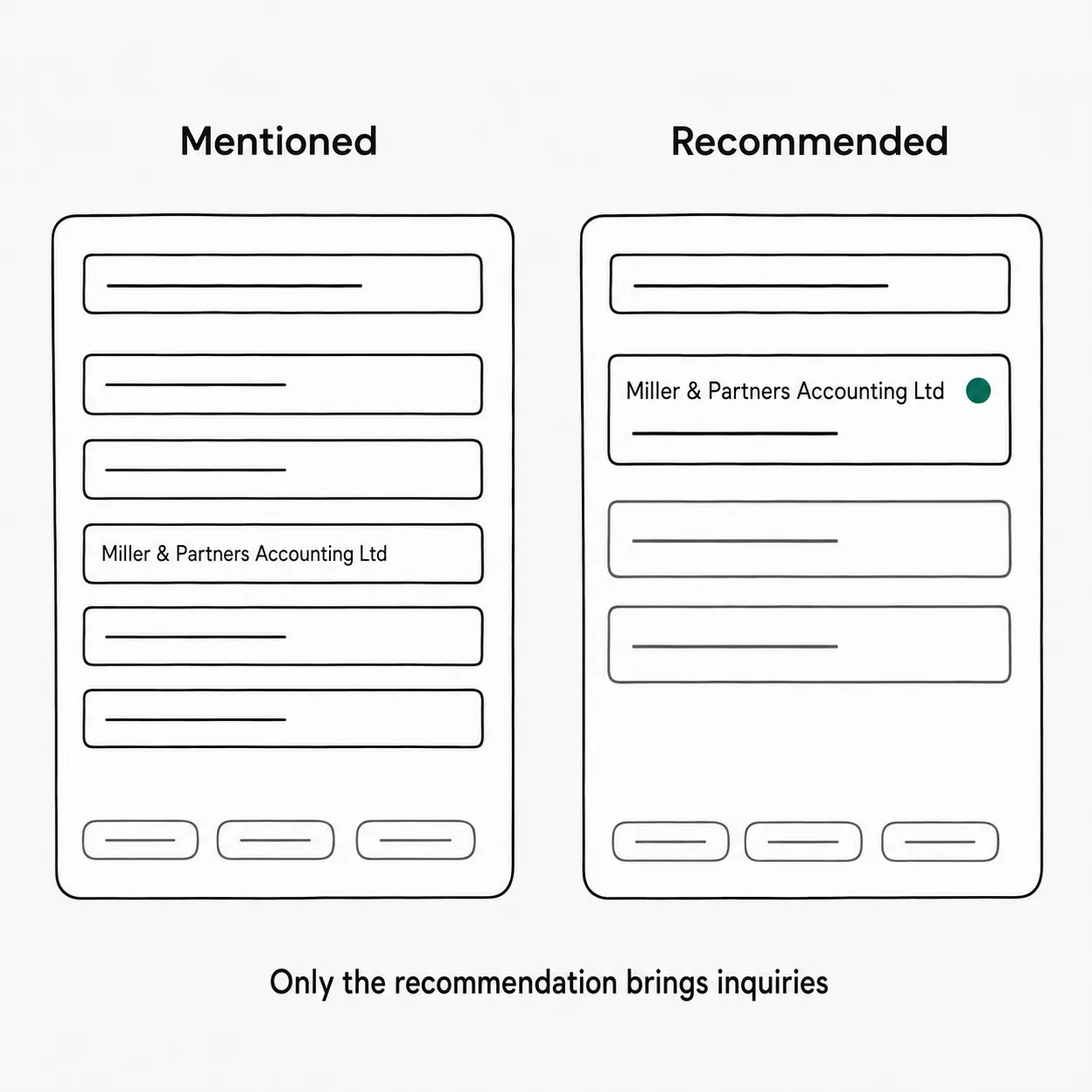
This distinction is the lens for the whole test. A company that is mentioned regularly but never recommended is findable for the AI systems but has no clear profile: the evidence for who it is the right choice for is missing. Note both separately on every run. In our daily measurement at Carigiet GEO we work with a recommendation rate as the target metric: 30% to 40% is a realistically good level for established companies, and no one reaches 100%.
Step 1: Write your prompts as complete buyer questions
Test with complete questions, not with keywords. Your customers do not type search terms into ChatGPT. They describe a situation or ask a question. Even a plain input gets enriched by the system and fanned out into several sub-queries. Google documents this technique officially as “query fan-out”: AI answers are built from multiple related searches across subtopics and data sources (Google Search Central). ChatGPT likewise rewrites your question into one or more targeted search queries when it searches the web (OpenAI documentation). A keyword test therefore measures past the reality.
Six to ten prompts from four categories are enough for the self-test. Replace the placeholders with your industry, your region, and your company:
Provider and recommendation questions (the core category):
- “Which accounting firm in the [city] area would you recommend for an SME with 20 employees?”
- “I am looking for an IT service provider for a company with 30 employees in German-speaking Switzerland. Who should I consider?”
Comparison questions:
- “Which providers of [service] in [region] are worth considering, and how do they differ?”
- “What are the advantages and disadvantages of the best-known [industry] providers for SMEs in [region]?”
Problem and situation questions (this is how many customers actually ask):
- “Our bookkeeping costs us several days every month. Who in the [city] area can take that off our hands?”
- “We are unhappy with our IT support and are looking for a reliable partner in [region]. How should we go about it, and which providers are worth a look?”
Control questions about your own company (the fact check):
- “What do you know about [company name] in [city]?”
- “What services does [company name] offer, and who is the company a good fit for?”
The control questions do not check whether you are found. They check what the systems claim about you. Outdated addresses, wrong service descriptions, or invented details cost trust before a conversation ever takes place. What a test of this kind looks like for one single industry is shown in our article on AI visibility for fiduciary firms.
Step 2: Neutralize the test environment
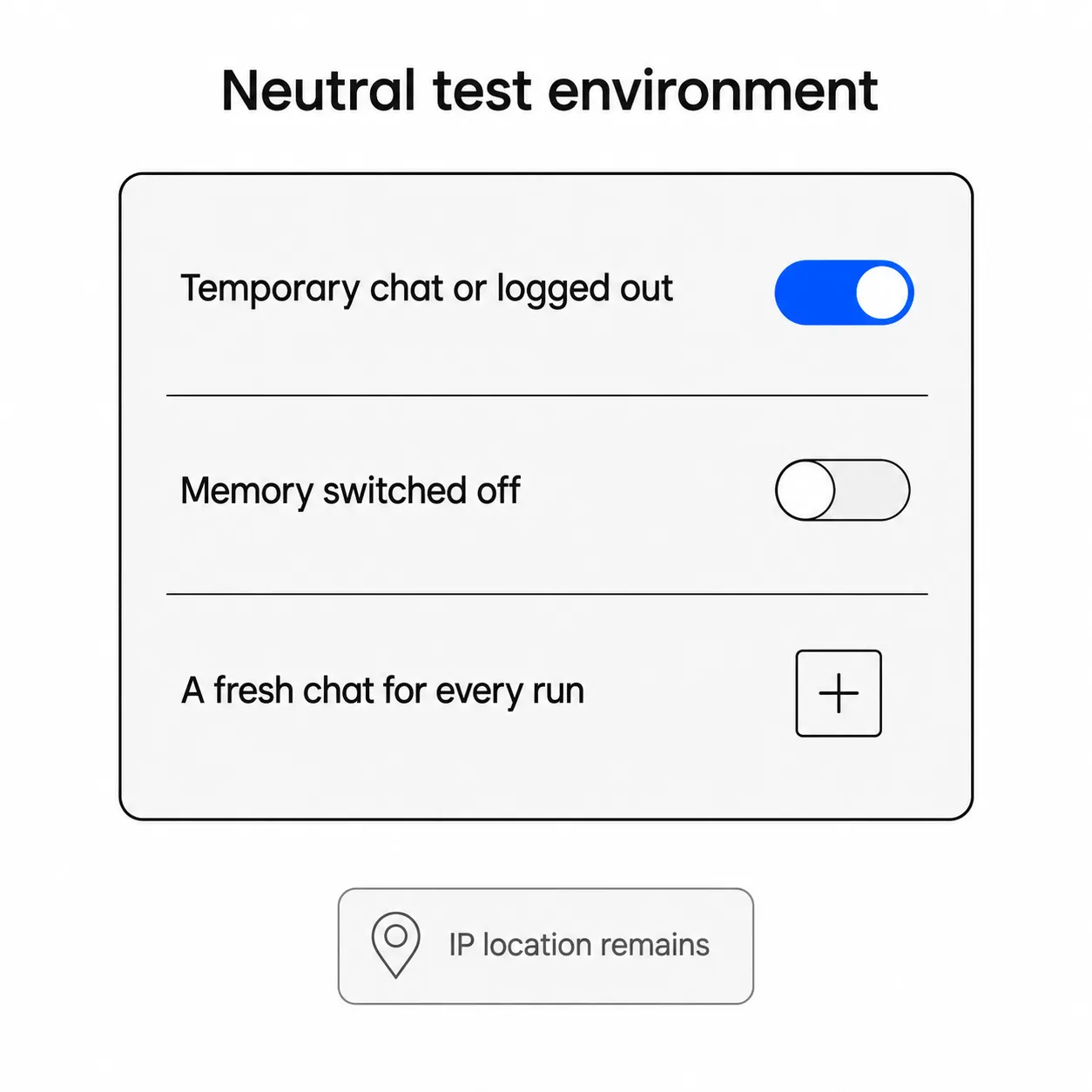
Test logged out or in a temporary chat, and switch the memory function off. Otherwise you are not measuring your visibility, you are measuring your own chat history.
The reason is personalization. With the memory function, ChatGPT stores information about you and builds new conversations on top of it; saved memories do not disappear when you delete a chat. Anyone who asks about their own company every day teaches the system to name it, and gets a flattered result back. Temporary chats, according to the OpenAI documentation, use no existing memories and create no new ones, which makes them the simplest neutral test environment.
Here is how to proceed:
- Use a logged-out browser window or a temporary chat.
- If you test while logged in: switch off the memory function in the settings, and switch off any custom instructions stored in your profile.
- Every test run belongs in a fresh chat. Never ask about your company several times in a row inside the same chat.
One limitation remains even then: ChatGPT derives an approximate location from your IP address and can rewrite the query accordingly, even without a login. Your test from Zurich is therefore regionally colored. That is not a flaw in your method, it is a property of the systems. Simply note it as a condition of the test.
Step 3: Ask every question three to five times
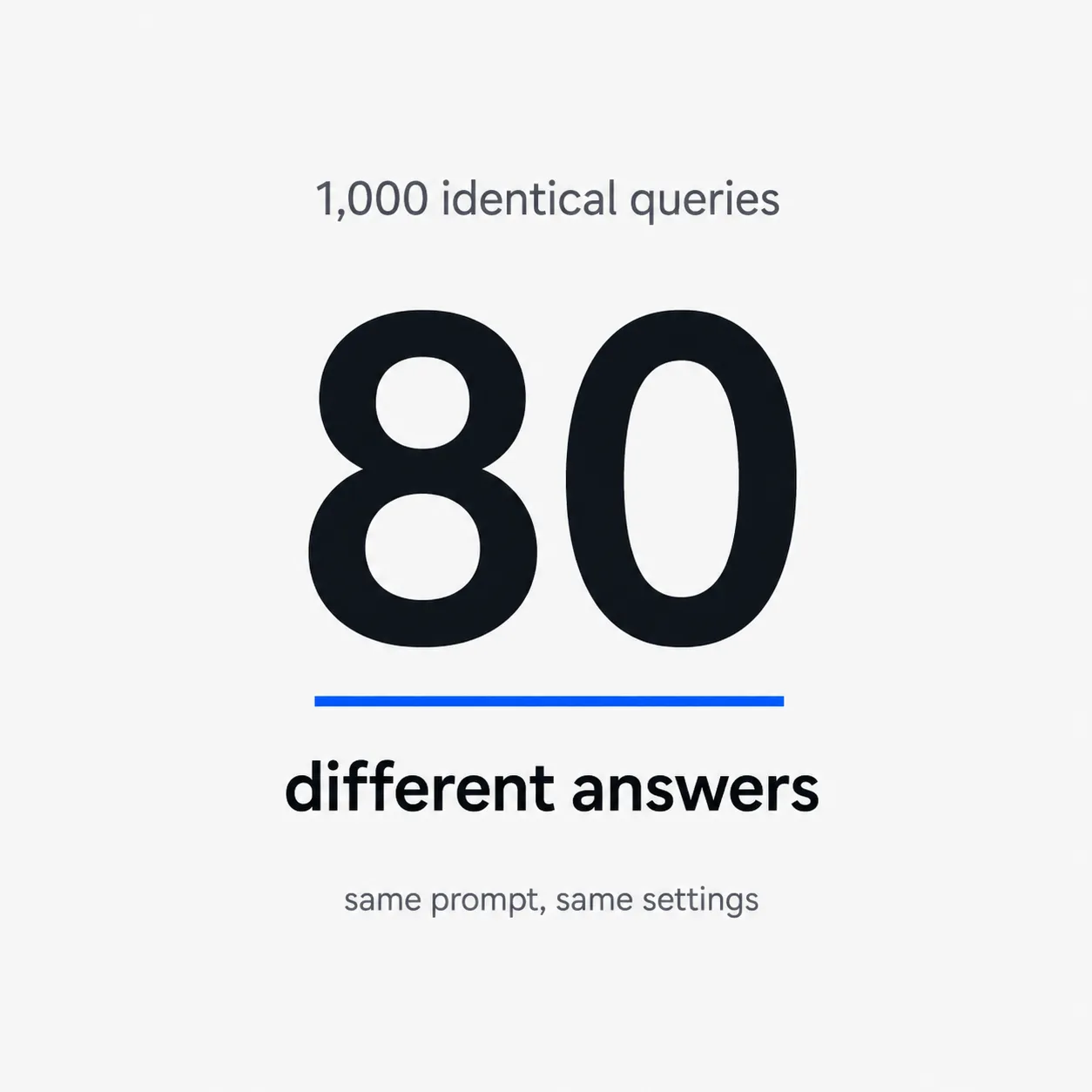
A single run per prompt says almost nothing. The same question can return a different answer the next time: AI answers are produced statistically, not deterministically. How large the spread is was shown by the research lab Thinking Machines: the same query returned 80 different answers across 1,000 runs, although the settings should have forced identical results (Thinking Machines Lab, 2025).
Ask every prompt three to five times therefore, each time in a fresh chat, and count:
- Mention rate: in how many runs is your company named at all?
- Recommendation rate: in how many runs is it actively recommended?
Professional measurement works with repeats and rates too, never with single hits; the protocol we use is described under how we measure AI visibility. Anyone who believes a single query is celebrating a lucky hit or panicking over a random miss.
Step 4: Document the results
Record every run immediately, otherwise the impressions blur. A simple table is enough:
| Prompt | Run | Mentioned? | Recommended? | Providers named instead | Anomalies and false statements |
|---|---|---|---|---|---|
| Recommendation question, accounting, [city] | 1 of 5 | No | No | Provider A, B, C | none |
| Recommendation question, accounting, [city] | 2 of 5 | Yes | No | Provider A, B | company named only, no reason given |
| Control question, own company | 1 of 3 | Yes | n/a | n/a | outdated address given |
Note in addition which sources the answers cite: directories, trade portals, blogs, media. That source list is later the most valuable part of your documentation, because it shows where the systems get their picture of your industry from. Whoever does not appear in those sources does not exist in the answer.
Step 5: Read the results correctly
Your test result says something about your source base above all, not about the quality of your work. This is how to read the typical findings:
| Finding | How to read it | Sensible next step |
|---|---|---|
| Not mentioned in any run | The systems find too few solid sources about your company | Check your source base: directory entries, consistent company data, citable content |
| Mentioned occasionally (about 1 in 5) | You are at the threshold of visibility, and the result is still unstable | Watch whether the rate moves over weeks; build out content and sources deliberately |
| Mentioned regularly, rarely recommended | Findable, but without a clear profile: it is unclear who you are the best choice for | Sharpen the positioning: audience, services, and evidence |
| False statements in the control questions | The systems rely on outdated or incorrect sources | Find the origin of the false statement and correct it there |
Two qualifications belong to any serious interpretation. First: there is no fixed ranking that you reach and then keep. Answers are generated fresh on every query and fluctuate statistically; why that is so is explained in our article ChatGPT Ranking: Does It Exist? Second: your self-test is a snapshot. The statement only holds up once you repeat the same questions over weeks and see a trend. That is exactly why we measure daily in our engagements and compare weekly, instead of trusting a single measurement.
What the self-test cannot do
The self-test answers the question “where do I stand today?” Four things it cannot do:
- Neutrality is only approximated. Even logged out, the test stays regionally colored through your IP address, and three to five repeats give a rough indication of stability, not statistical certainty.
- It shows no trend. Whether your visibility is rising or falling only becomes visible with repeated measurements over weeks.
- It is tied to the current model. AI providers swap their models out continuously; a result from today can look different after a model change.
- It delivers no root-cause analysis and no correction. The test shows that a false statement exists, but not which source it comes from or how it gets corrected there.
Visibility can be influenced, and that has by now been studied academically: content with clear figures, source references, and quotations became up to 40 percent more visible in generative answers in the study “GEO: Generative Engine Optimization” (Aggarwal et al., KDD 2024); that is a ceiling under laboratory conditions, not an average. The first step, however, is always to establish where you stand. If you would rather have the check run automatically and on a broader basis: our free AI Visibility Analysis covers exactly the dimensions of this self-test automatically, with a GEO score, shortlist visibility, factual accuracy, and questions answered directly. The report arrives by email, usually within 15 to 30 minutes.
Frequently asked questions about the AI visibility self-test
How many prompts do I need for a meaningful self-test?
Six to ten prompts are enough for a first reading, provided all four categories are represented. For comparison: in a professional measurement we work with around 50 buyer questions, developed together during onboarding and refined as we go.
Why does ChatGPT show different people different results?
Because answers are personalized and generated statistically. Memory, chat history, and the location derived from your IP address change the result per person; on top of that, the same question can return different answers even under identical conditions. That is why you test neutrally and with repeats.
Should I run the test in English or in German?
Run it in the language your buyers use. The point of the test is to reproduce how your customers actually ask, so a Swiss SME whose clients write in German learns very little from an English-only test, and the reverse holds for a company selling to English-speaking clients. If your market is split, test the same core questions in both languages and record them as two separate sets: the answers, and the sources behind them, often differ.
Is a one-time test enough?
As a reading of where you stand, yes. As a basis for decisions, no. A single test is a snapshot of the current model at the current moment. Only a trend holds up: the same questions, repeated over weeks, with documented rates.
What does it mean if I am mentioned but not recommended?
You are findable for the systems, but your profile is not sharp enough for an active recommendation. Usually the evidence for who you are the right choice for is missing: precise service descriptions, consistent company data, and third-party sources that confirm your specialization.
Do I have to test every AI system, or is ChatGPT enough?
For the self-test, ChatGPT is enough as the most widely used system. Bear in mind, though: the systems disagree with each other; a company named in ChatGPT can be absent from Gemini or Perplexity. If you can invest 15 minutes more, check two or three of your core questions in Google AI Overviews and Perplexity as well.
Find out where you stand today
Run the self-test, and in 30 minutes you will know whether ChatGPT names you, whether it recommends you, and what it claims about you. If you then want the automated view: the free AI Visibility Analysis sends you the report by email. And if you want to make sense of the results, book a 15-minute initial consultation: no sales pitch, no slides. We open ChatGPT live, check together where your company appears today and which competitors are named instead, and you leave the conversation with two or three actionable levers. No obligation.
Related posts

Why Doesn't Your Company Show Up in ChatGPT? 9 Causes and What They Cost (2026)

llms.txt: Do You Need One? The Honest Answer (2026)