

You judge a GEO agency by what it documents before the work starts and by what it demonstrably changes afterwards. The eight criteria in this article test exactly that: how the measurement is set up, what actually changes, who does the work, what the price covers, and where the engagement ends. You can check every one of them yourself, in a first call or in a written proposal, with no technical background.
The yardstick is the measurement. At Carigiet GEO we record a baseline before the first action and then repeat every buyer question three to five times, because a single AI answer proves nothing. A provider who cannot show you a documented starting point cannot prove an improvement later. That is the difference between a measurement and a claim.
Key takeaways
These eight points separate documented work from expensive reporting:
- Measurement setup and baseline: which buyer questions are measured, how often, on which AI systems? And does the starting point exist before the first action?
- An honest timeline: a fixed date or a promised placement ends the review.
- Evidence: in a field with no multi-year results, the documented method is the evidence.
- Execution instead of monitoring: does the provider change sources, content, profiles and technical foundations, or does it hand you a dashboard?
- Content: who writes, who checks the facts, who approves?
- Division of tasks: the list of exclusions is what counts. What does the provider explicitly not do, and what do you have to supply yourself?
- Price and scope: what does the monthly fee cover, and what triggers a surcharge?
- Who works, and who stands behind it: one named contact or rotating generalists? And can the company be verified in the public registers?
What a GEO agency actually does
Generative Engine Optimization makes AI systems know your company, describe it correctly, and name it in their answers when someone asks for a provider of your kind. The work has three parts: presence on the sources these systems demonstrably cite for your topic, content on your own site that yields an answer directly, and the correction of false statements about your company. The basics are here: what Generative Engine Optimization is.
The market for this work is new. The user behavior behind it is not. According to a Comparis survey conducted by Innofact in March 2026 among 1,035 people, more than three quarters of adults in Switzerland (76%) use AI tools in their daily lives; a year earlier two thirds had already used ChatGPT or Gemini. Demand pulls providers in, and some of them have never set up a measurement themselves.
1. How does the provider measure your AI visibility before the work starts?
A defensible measurement setup exists before the first action. Without a documented starting point, nobody can prove later that anything improved.
Ask for these six things, and ask for the answers in writing:
- Which buyer questions are measured, and how were they derived?
- How many are there, and which service area do they cover?
- How often is the same question repeated?
- Which AI systems are measured?
- At what cadence: daily, weekly or monthly?
- Does the measurement run with a logged-in account or without one?
The last point decides how clean the whole measurement is. Measuring while logged in means measuring your own usage history along with it. Our monitoring queries therefore run without a login and without stored memories, so that the measurement does not influence itself.
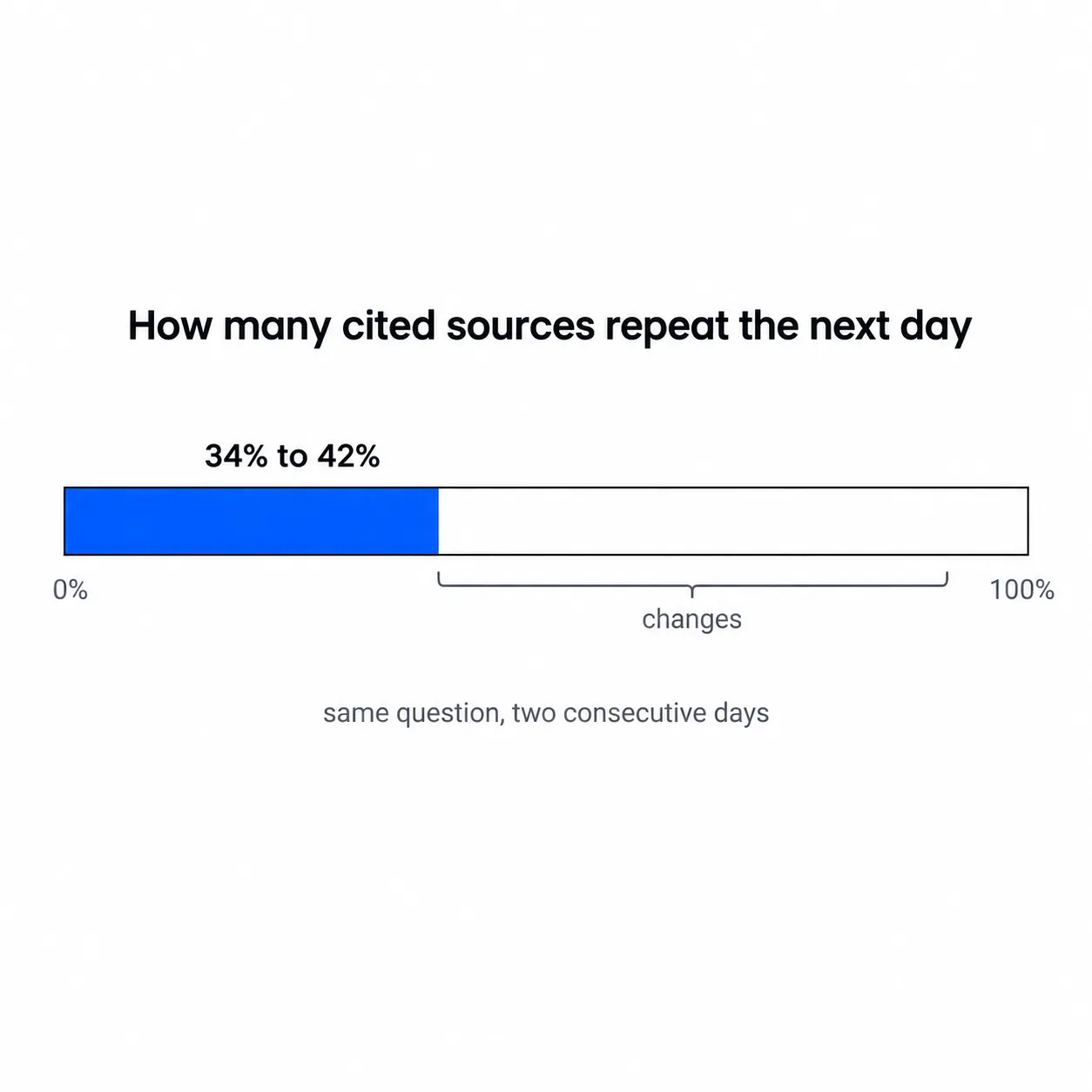
How many repeats it takes has been studied. A paper from the University of St. Gallen using Swiss data (arXiv preprint, April 2026, not yet peer reviewed) measured four industries across four AI search systems over roughly 45 days. The result: the cited sources overlap by only 34% to 42% on average between two consecutive days. The authors recommend at least seven runs per question per day for brand visibility, and eight as soon as source coverage matters. A provider who takes one reading a month is measuring noise.
How such a measurement is built is described in two pieces of our own: how AI visibility is measured reliably and how buyer questions for the measurement are developed.
2. Does the provider name a fixed date or a promised placement?
If so, the review ends here. This is the strongest single disqualifier in this market.
AI answers are statistical, not deterministic. The same question does not return exactly the same result twice, the systems disagree with each other, and the models keep changing. A company named in ChatGPT can be missing from Gemini or Claude. A provider who still gives you a date either does not understand the mechanics or is selling you something.
“What guarantees do you give?” comes up in first calls more often than any other question. Our answer stays the same: the outcome depends on many factors, a provider has to keep testing what works in each individual system, and anyone issuing a guarantee of success is selling something nobody can deliver.
There is a legal side to this. The Swiss Commission for Fairness (Schweizerische Lauterkeitskommission) states in its principles on fairness in commercial communication (in German, version of January 2025) that advertisers must be able to prove that their advertising claims are correct. A promise such as “in ChatGPT within 30 days” would therefore have to be provable. Given the volatility measured above, it is not.
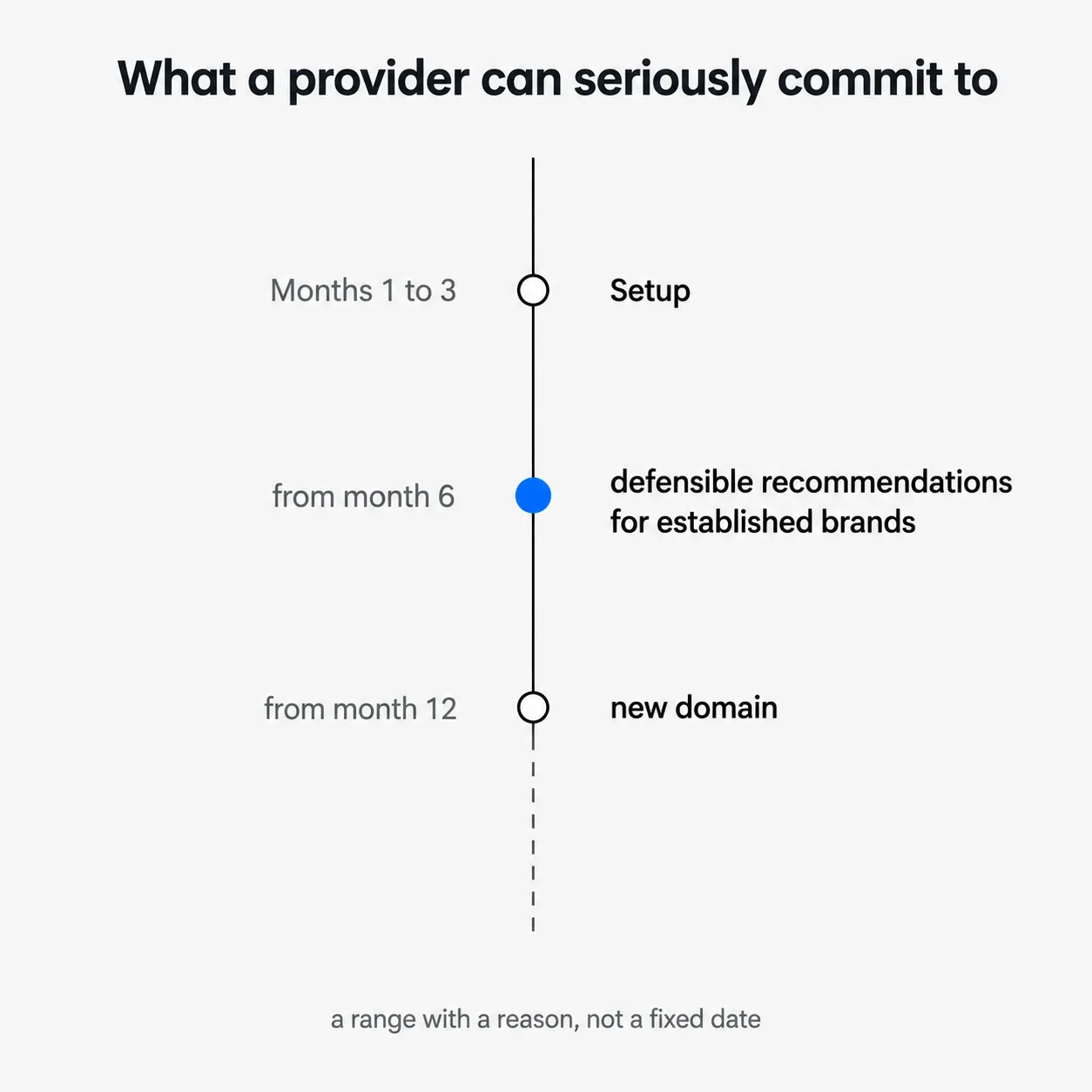
What a serious provider names instead is a typical range with a reason. Ours reads: about three months of setup, then first movement, defensible recommendations for established brands after 3 to 6 months, after 6 to 12 months or longer for a new domain. The mechanics behind that are set out here: how long it takes to become visible in AI answers.
3. What proof can a provider show in a field this young?
Ask for method, not success stories. The discipline is a few years old, nobody can show multi-year results, and anyone pretending otherwise has a credibility problem.
What counts as evidence:
- a documented measurement method you can follow
- before-and-after figures at the level of the individual AI system, not one overall grade
- the full prompt set the measurement ran against
- an open statement about which questions did not move
What does not count as evidence: a screenshot of a single AI answer. It proves nothing, because the answer depends on the account, the location and the moment. OpenAI documents that ChatGPT personalizes answers using stored memories. Perplexity states that with no location set in the profile, answers are based on your network location. And how much the moment alone matters is exactly what the St. Gallen measurement above shows. A screenshot is a snapshot from someone else’s account, in a particular place, at a particular hour.
The research base is also more modest than it sounds in proposals. The most cited study on the subject (Aggarwal et al., KDD 2024) puts the effect in these words: “GEO can boost visibility by up to 40% in generative engine responses”, and explicitly notes that effectiveness varies across domains. “Up to 40%” is a ceiling under laboratory conditions, not an average and certainly not a commitment. Anyone presenting that number to you as an expected result has not read the source.
The realistic picture looks different. With repeated measurement, a good recommendation rate sits at 30% to 40% of runs. Not at 100%.
4. Does the provider change anything, or does it just deliver a report?
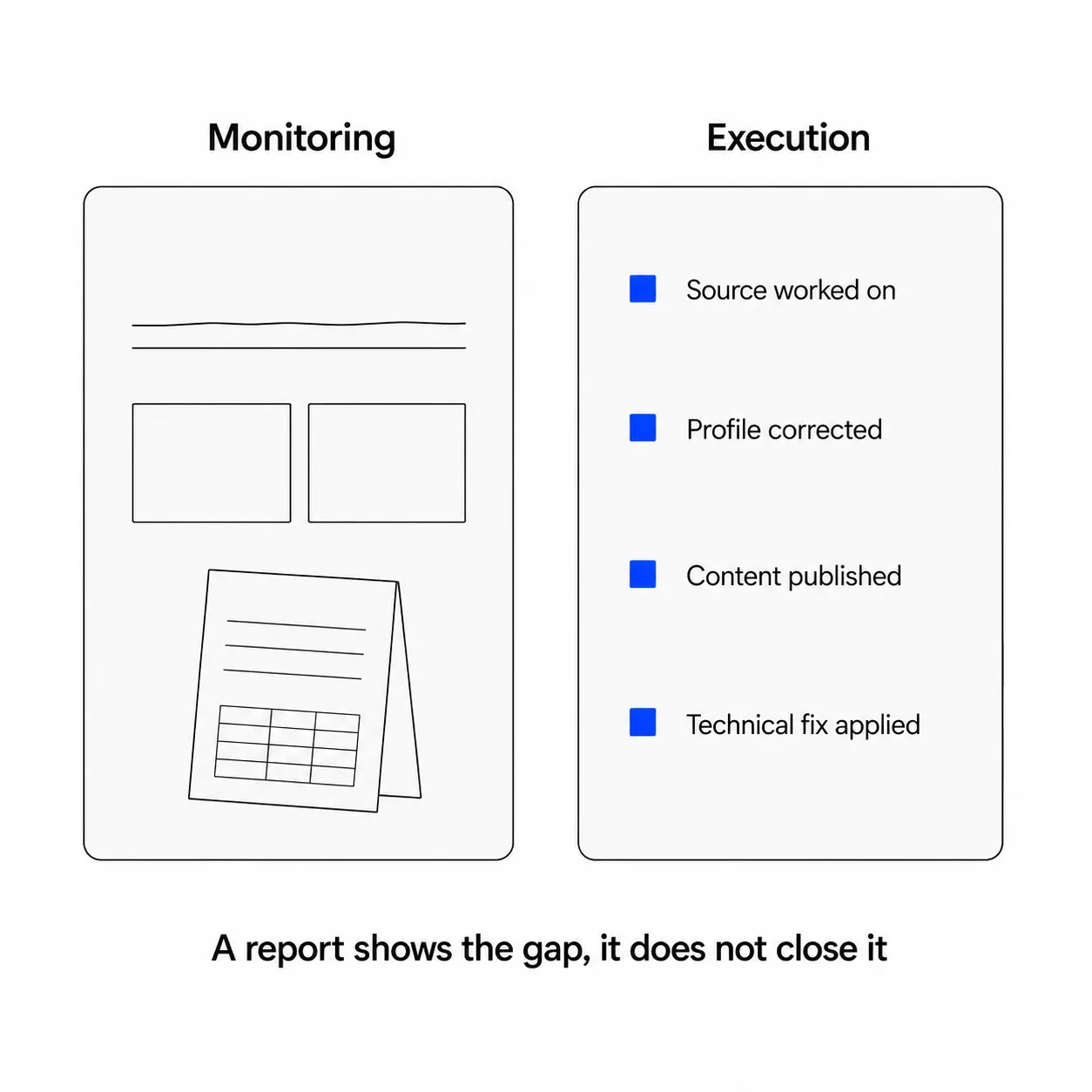
A tool shows you that you are not being named. It changes nothing about it. This is the most common confusion in the market: monitoring gets sold as an engagement, and the client pays monthly to watch their own invisibility.
So ask to be shown, concretely, what was changed in the last cycles: which source was worked on, which profile corrected, which content published, which technical foundation adjusted. A provider who answers that question by talking about dashboards is changing nothing.
For us, the daily measurement is the early warning system for execution, not the product. We measure daily across all providers in order to see how your visibility develops relative to your competitors. If a new source suddenly appears with several competitors cited in it, we go after that citation as well. What happens on your own site is described here: what ChatGPT optimization actually covers.
5. Who writes the content, who checks the facts, and who approves it?
It is published under your name, not the agency’s. So the final approval has to sit with you, and the factual check needs a person who can be named.
For regulated industries this is the most important question in the whole list. A law firm, an asset manager, an insurance broker or a dental practice is liable for what stands on its own website, no matter who wrote the text. What that looks like in one industry is shown here: AI visibility for fiduciary firms.
So ask without dressing it up:
- How much of the text is produced with AI tools?
- Who owns quality assurance, by name?
- At which point in the process does your factual approval sit?
- Who is liable if a statement is factually wrong?
A provider who dodges the first question is not credible today. Almost everyone works with AI tools; the only question is who checks afterwards. We say it openly: first drafts come out of our pipeline, I take personal responsibility for the quality assurance of every single piece, and the factual approval is yours.
Put the ownership of the content in writing as well. Under Swiss copyright law the author is always the natural person who created the work, and without an explicit agreement only the rights of use required by the purpose of the contract pass to you. Article 16 paragraph 2 of the Copyright Act states that the assignment of one right contained in the copyright does not include the assignment of other partial rights unless that was agreed. Payment alone does not automatically transfer everything.
6. What does the provider explicitly not do, and what do you have to supply?
A provider with no answer to this has not thought the scope through. Ask for the list of exclusions before you ask for the list of services.
Settle these four points before you sign:
- Access: which systems does the provider need: CMS, analytics, Search Console, directory profiles?
- Subject-matter input: how much of your time is planned in, in hours per month?
- Approvals: who approves on your side, and within what deadline?
- Technical implementation: does the provider change the website itself, or does it hand the specification to your web agency?
The last point is the most common source of friction in practice. If the GEO provider specifies and a third party implements, that interface belongs in the contract, otherwise each side waits for the other. Our own division of tasks, including that boundary, is published on the page Offer and division of tasks.
7. What does the price cover, and what triggers a surcharge?
A number without a defined scope is not comparable. Two proposals with the same monthly figure can contain completely different work.
Ask for four things in writing: what is included in the monthly price, what triggers a surcharge, what has to be paid on top of the retainer (advertising budgets, paid placements, licenses), and how termination works.
One point about minimum terms that is rarely made in this market. Under Swiss agency law a mandate “may be revoked or terminated at any time by either party” (Article 404 of the Code of Obligations). The Federal Supreme Court has consistently held this right to be mandatory, even where a fixed contract term was agreed, as the federal government’s explanatory report on agency law records (in German). A hard twelve-month minimum term therefore stands on weak ground. A provider who works without a minimum term is following the law, not doing you a favor.
8. Who works on your mandate, and who stands behind the company?
Ask who does the work operationally, then check the company. A named contact with professional leadership is something different from a rotating team of generalists for whom GEO is one add-on service among many.
The Swiss check takes five minutes:
- Open the legal notice (Impressum). The company name, the address and an email address have to be there, and a contact form does not replace the email address. That is not a courtesy but a requirement of the Federal Act against Unfair Competition (Article 3 paragraph 1 letter s UCA) for offers made online.
- Call the number listed. Reachability is a fact, not a promise.
- Look the company up in Zefix, the central business name index of the Swiss commercial registers, and in the UID register. Both show the company name, the registered office and the signatory powers.
A .ch domain or a place name in the company name proves no Swiss presence. Both are set up in half an hour.
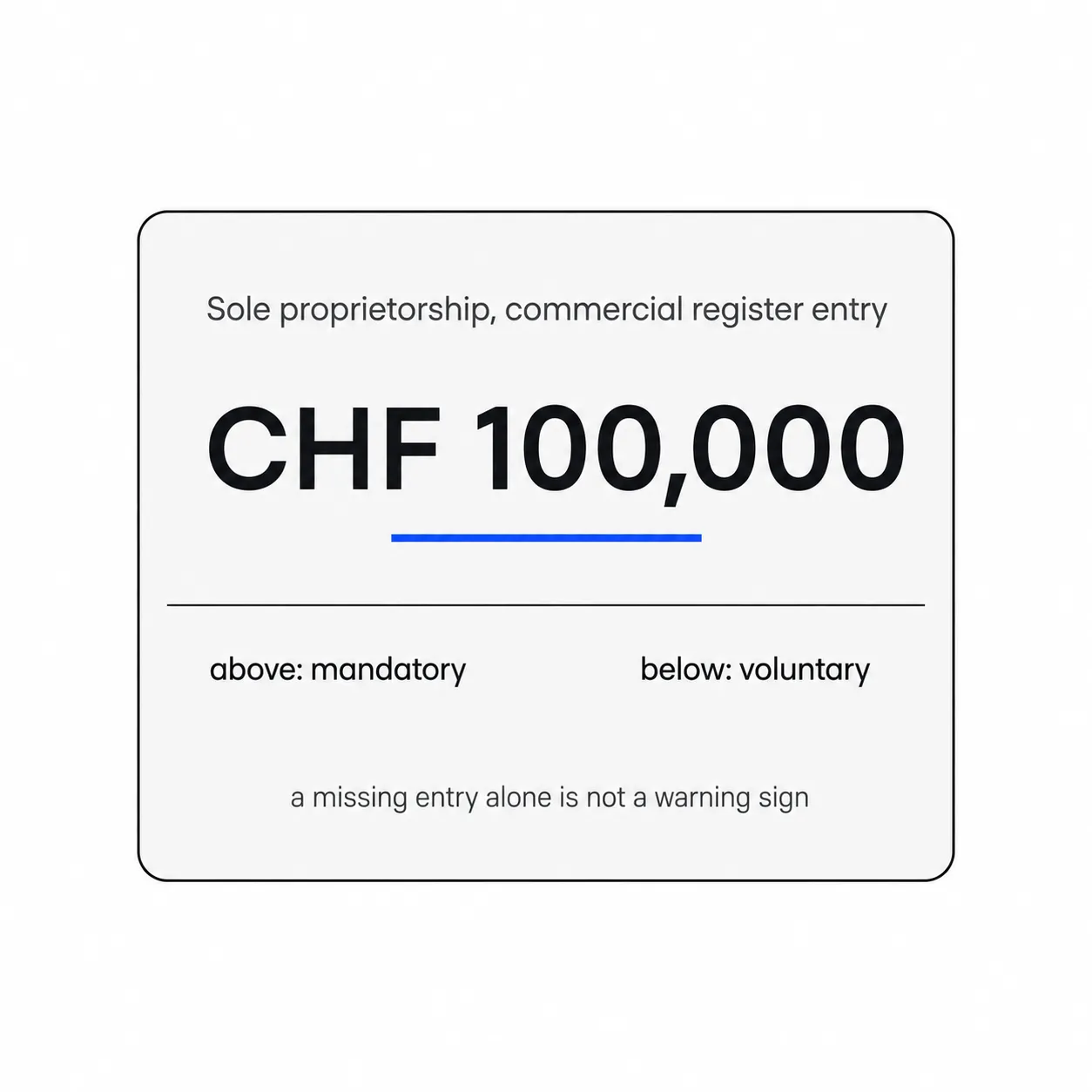
The counter-check matters. A missing commercial register entry is not by itself a warning sign. Under Article 931 paragraph 1 of the Code of Obligations, a sole proprietorship only has to be entered once it has achieved revenues of at least 100,000 francs in a financial year; below that, the entry is voluntary. A small, specialized sole proprietorship can work entirely legally without one. The warning signs are different: a missing or untraceable legal notice, an address that does not exist, or a number nobody answers.
Our own working principles and the things we explicitly refuse are published on About us.
The eight criteria at a glance
| What you check | How you recognize it | Warning sign |
|---|---|---|
| Measurement setup and baseline | Documented starting point before the first action, named buyer questions, several repeats per question and day | Measurement starts only with the work, or the provider names no repeat count |
| An honest timeline | Typical range with a reason, staggered by established brand and new domain | Fixed date, promised placement, “guaranteed” mention |
| Evidence | Method, prompt set, before and after per AI system, open naming of what did not work | Screenshot of a single AI answer as proof |
| Execution instead of monitoring | Nameable actions from the last cycles, with place and date | Answers revolve around dashboards and reports |
| Content and approval | Named quality assurance, open AI share, approval with the client | Dodging the question about the AI share |
| Division of tasks | List of exclusions plus the list of what you have to supply | “We do everything”, no interface to the web agency defined |
| Price and scope | Included services, surcharge triggers, termination rule in writing | Price on request, unclear extra costs, hard minimum term |
| Who works and who stands behind it | Named contact, complete legal notice, a number that answers | No legal notice, no address, contact form only |
Red flags that end the review
Seven patterns that come up regularly in this market. Any one of them on its own is reason enough to end the conversation:
- A fixed date. “In ChatGPT within 30 days.” Nobody controls when a model is updated.
- Promised placements or mentions. The systems disagree with each other; a commitment covering all of them cannot be honored.
- A free audit that is the actual product. An automatically generated report is an opener for a conversation, not work. If nothing concrete follows it, the report was the offer.
- A tool subscription sold as an engagement. Monitoring plus a monthly report is software with an invoice, not change.
- “We know the algorithm.” There is no ranking list to optimize your way into. Why that is so is covered here: ChatGPT ranking: does it exist?
- Provider rankings in which the publishing provider comes first. A best-of list published by the company at the top of it is advertising with a table layout.
- Progress figures with no documented starting point. “Plus 300% visibility” without a baseline is not a measurement, it is a claim.
What a GEO agency costs in Switzerland
There is currently no neutral price reference for GEO engagements in Switzerland. Every published GEO price comes from a provider, and most providers in the Swiss market publish no prices at all. A proposal can still be put in context, by way of the specialist hours behind it.
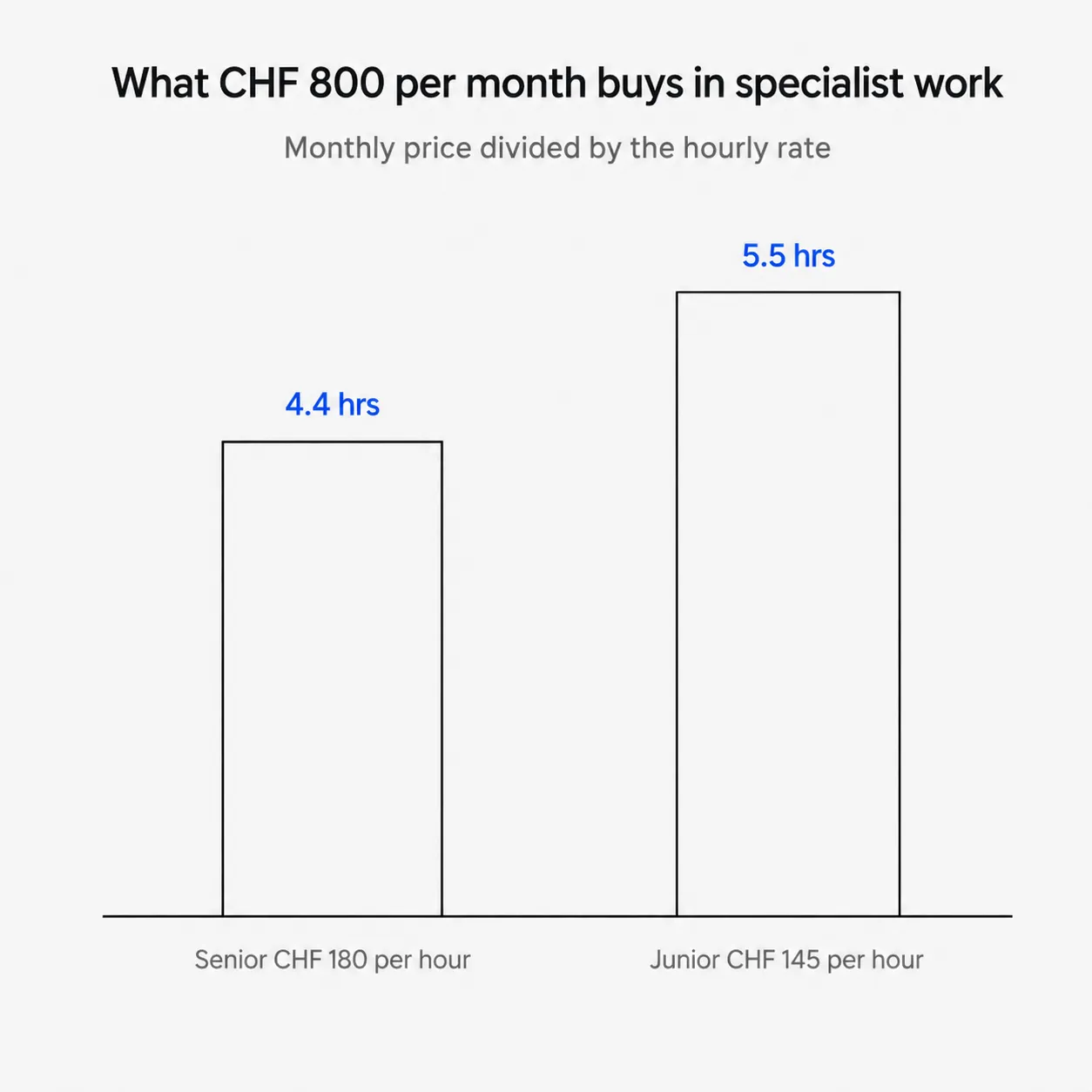
The procurement platform Gryps, which sells no marketing services itself, gives reference prices for ongoing SEO work of CHF 500 to 800 per month for a defined example scenario, together with hourly rates of CHF 145 for junior and CHF 180 for senior specialists (page in German). That gives you a yardstick: the monthly price divided by the hourly rate is the specialist work you are actually buying.
A worked example with those figures: CHF 800 per month, the top of the range, buys between four and a good five hours of specialist work, depending on the seniority level. For daily monitoring, content, source work and corrections, that is not enough. Run that calculation on every proposal once, before you start negotiating the price.
Our own price is published and reads in full: from CHF 2,800 per month plus VAT for a clearly defined service area, no setup fee, no minimum term, terminable with 30 days’ notice to the end of the following month. Each additional service area, with its own competitors and its own content, costs CHF 1,500 per month. You do not have to pay that price. But you can measure every proposal against it, because it is complete.
Question list for the first call
You can take these twelve questions with you unchanged. Each one works on its own, and each one has a checkable answer:
- Which buyer questions will you measure for us, how many are there, and how were they derived?
- How often do you repeat the same question, and on which AI systems?
- Do you measure with a logged-in account or without one?
- What exactly is in the baseline, and on what day does it exist?
- Which three actions did you implement most recently in a comparable mandate, and where are they live?
- How much of the text is produced with AI tools, who checks the factual statements, and who approves?
- What do you explicitly not do, and what do we have to supply ourselves?
- How much of our time do you need per month, in hours?
- What does the monthly price cover, and what triggers a surcharge?
- Who owns the content, the raw data and the access credentials after the contract ends, and in which clause is that written?
- Who works on our mandate operationally, and who do we reach when something is wrong?
- What happens if nothing is measurable after 90 days?
The last question is the most revealing. It forces the provider to talk about a failure before it happens.
When you do not need an agency yet
If you do not know where you stand, you are buying blind. Before you request proposals, you should know whether and where you are missing from AI answers. That takes no engagement: you can check your AI visibility yourself in 30 minutes, or have the starting point put together for you through the free AI visibility analysis.
In four situations an engagement is premature:
- Your offer is not defined. If it is unclear internally who you serve, with what, and at what price, no AI system can reproduce it cleanly. That clarification belongs before the visibility work.
- A relaunch is running and structure and content are not decided. Wait until the structure stands. Otherwise you pay twice for the same page.
- Your domain or your brand is very new. Then solid search engine work comes first. In our experience, new domains need 6 to 12 months or longer before anything defensible arrives in AI answers.
- The budget does not cover at least six months. An engagement that is stopped after three months ends exactly before the period in which something would begin to show.
There is also an honest middle path. GEO and classic search engine optimization overlap heavily, and we say so plainly: around 90% of it is solid SEO.
If you have a competent SEO agency, it can take on part of the work. The difference lies in the ongoing measurement against defined competitors and in the work on third-party sources. For a first impression, an inexpensive monitoring tool is sometimes enough. It will only ever show you that you are missing, though.
How we answer the same eight questions
This section is not a sales pitch but a filled-in template. Hold it next to every proposal you receive, including one from another provider:
- Measurement setup and baseline: about 50 buyer questions per service area, daily across six AI systems, each question repeated three to five times, without a login and without stored memories. Mentions without a link and citations with a link are recorded separately. The baseline exists within seven days of the access credentials being granted and the onboarding call.
- An honest timeline: setup in the first three months, defensible recommendations for established brands after 3 to 6 months, after 6 to 12 months or longer for new domains. No fixed date, no commitment on particular mentions.
- Evidence: a published measurement method and a weekly comparison of the same AI answers. What we do not have is a multi-year case study, because nobody in this field can have one yet.
- Execution instead of monitoring: three levers, source authority, answer integrity and corrected facts, with one prioritized improvement per cycle.
- Content: first drafts from our pipeline, quality assurance personally, factual approval with you.
- Division of tasks: published on the Offer page, including the boundary: technical specification and verification with us, implementation by your web agency or your internal IT.
- Price and scope: from CHF 2,800 per month plus VAT, no setup fee, no minimum term, 30 days’ notice to the end of the following month, each additional service area CHF 1,500 per month. Everything created belongs to you, including after the contract ends.
- Who works: a named contact with 25 years of software development. GEO is a young discipline in which nobody has long experience; credibility comes from understanding the systems and from a documented measurement method. The six working principles you can hold us to, and the things we explicitly refuse, are on the About us page.
Frequently asked questions
How much does a GEO agency cost in Switzerland?
There are no reliable market figures, because most Swiss providers publish no prices. Our own engagement costs from CHF 2,800 per month plus VAT for a clearly defined service area. As a yardstick for any proposal: the monthly price divided by the hourly rate gives the specialist work you are actually buying.
How long does it take before anything shows up in AI answers?
Expect about three months of setup before a direction becomes visible. For established brands, recommendations become defensible after 3 to 6 months; for a new domain it takes 6 to 12 months or longer. Any earlier date is a guess.
Is GEO worth it for an SME with 20 employees?
That is decided not by headcount but by what a single new customer is worth to you and by whether your customers research before they buy. A 20-person business with high order values benefits more than a larger one with many small jobs.
Can our existing SEO agency take this on?
Partly, yes. The foundations overlap heavily, and a good SEO agency already covers part of the work anyway. What is usually missing is the ongoing measurement against defined competitors across several AI systems, and the work on the third-party sources those systems cite. Ask your agency how it currently measures whether you appear in AI answers.
Do we need a German-speaking provider if our company works in English?
For the Swiss market, yes, at least for the measurement. Your buyers ask AI assistants in the language they do business in, and in Switzerland that is mostly German. We measure the buyer questions in the language of the market, and the content follows the language your customers search in, not the language of your internal communication. If your buyers are international, that changes the question set, not the method.
Who owns the content after the contract ends?
That depends entirely on what is in the contract. Under Swiss copyright law the author remains the person who created the work, and without an explicit provision you receive only the rights of use required by the purpose. Have the rights of use, the raw data and the handover of all access credentials confirmed in writing before you sign.
How do I tell whether a provider is really based in Switzerland?
Through the legal notice and the registers, not through the domain. Check that the company name, the address and an email address appear in the legal notice, call the number, and look the company up in Zefix and the UID register. A .ch domain and a Swiss place name in the company name are not proof.
Where do you stand today?
Before you compare proposals, you need your own starting point. Two routes there cost nothing and commit you to nothing. The AI visibility analysis gives you a first read by email. In the 15-minute call we look together, live, at whether AI systems name you on the questions your customers ask. No sales pitch, no slides. You leave with two or three actionable levers, and whether you pursue them with us or with another provider is your decision afterwards.
Nobody can seriously commit to fixed mentions. A documented starting point and a method you can check: that, yes.
Related posts

ChatGPT Ads for Swiss SMEs: What Applies and How to Run Them

How Long Until Your Company Appears in AI Answers? (2026)