
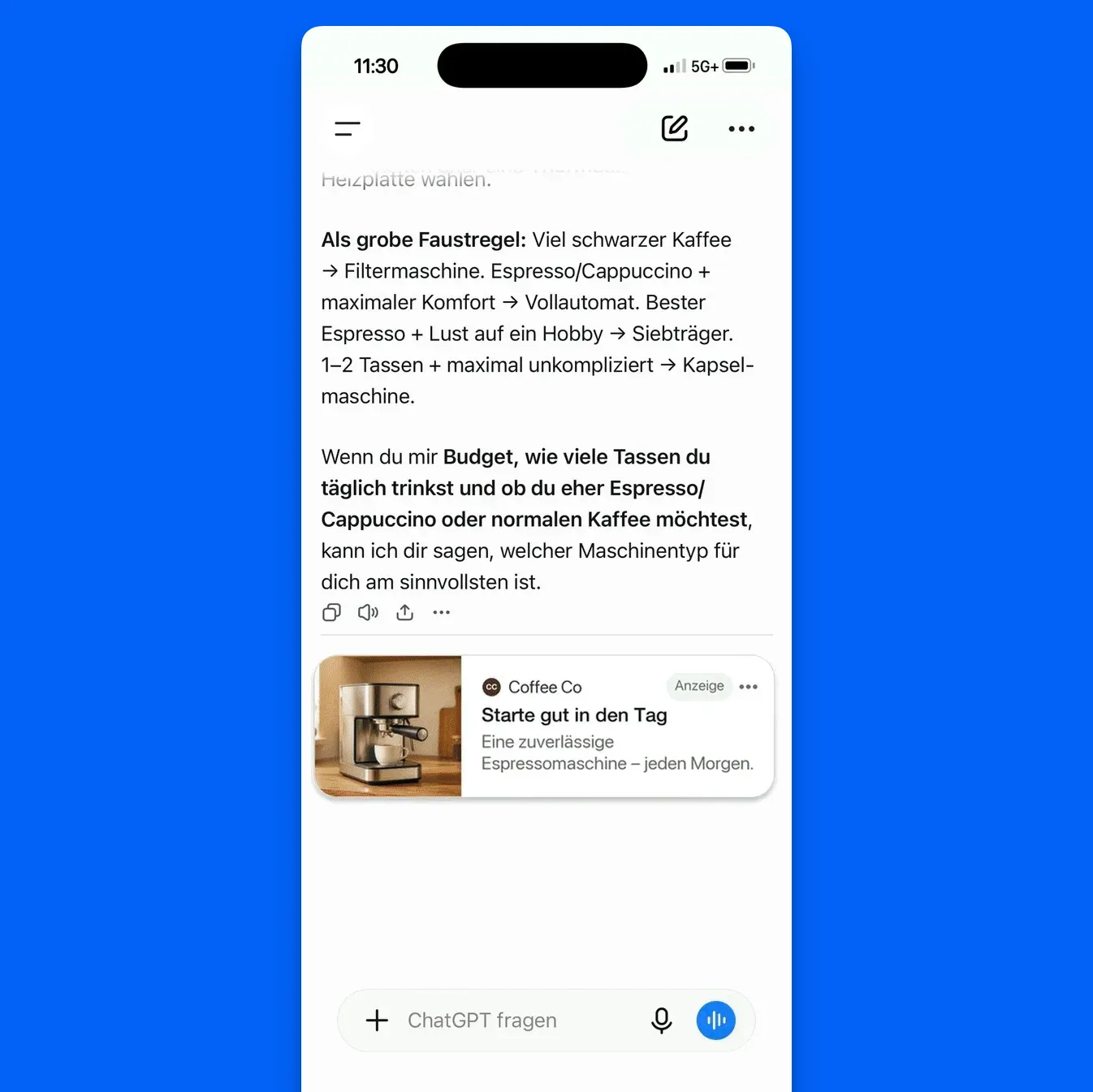
Since Monday, August 24, 2026, ChatGPT has been showing ads in Switzerland as well, visible only to accounts on the Free and Go plans. Swiss companies can now run those ads themselves as well: the Ads Manager is open for Switzerland, and campaigns can be created from a Swiss account. We checked that ourselves on September 1, 2026 in the logged-in Carigiet GEO ad account at ads.openai.com. The detour through OpenAI’s Ads Solutions team and through agency and technology partners is no longer necessary.
Key takeaways
- Launch and visibility: Ads have been running in Switzerland since August 24, 2026, visible only on the Free and Go plans. Plus, Pro, Business, Enterprise and Edu stay ad-free.
- Self-serve buying: Swiss companies can run ads themselves. The Ads Manager is open for Switzerland, checked by us on September 1, 2026 in the logged-in account.
- Personalization: Personalized ads are not available in Switzerland at launch. According to OpenAI, ad selection draws on the topic of the current conversation plus simple context such as approximate location and language.
- Before your first campaign: Verification is manual, and campaigns cannot deliver until the billing profile is fully set up and verified.
- Ad account: Country, currency and time zone are set when the account is opened at ads.openai.com and cannot be changed afterwards.
- Prices: No prices are published for Switzerland. OpenAI sets the minimum daily budget per country, and Switzerland is not in that table yet.
- Ad or recommendation: The ad sits below the answer and is not a recommendation. In an analysis of 50,006 commercial prompts, advertisers also appeared as a cited source in the answer in only 3.63 percent of placements.
What has applied in Switzerland since August 24, 2026
ChatGPT has been showing labeled ads in Switzerland since August 24, 2026. OpenAI announced the expansion on August 18, 2026 and rolled it out a week later across 31 European markets, Switzerland included. That puts the program in roughly 40 markets worldwide; it started on February 9, 2026 as a test in the United States.
The audience is tightly drawn: ads reach the Free plan and the low-cost Go plan, nothing else. Plus, Pro, Business, Enterprise and Edu stay ad-free, and accounts belonging to people under 18 see no advertising either.
The ad appears below the answer, labeled as sponsored and visually set off from the answer. OpenAI’s documentation adds four limits that matter for planning:
- No ads appear in temporary chats.
- No ads appear in the ChatGPT Atlas browser during the test phase.
- No ads are served near sensitive or regulated topics such as personal health, mental health and politics; political advertising is currently not allowed.
- Even on the Free plan there is an ad-free variant with lower usage limits.
All of these points are in OpenAI’s help article “Ads in ChatGPT”.
ChatGPT ads in Switzerland: status, date, what applies
| Status | Date | What applies |
|---|---|---|
| Program starts as a US test | February 9, 2026 | First ads in ChatGPT, initially in the US market only (OpenAI Help Center) |
| European expansion announced | August 18, 2026 | 31 European markets, Switzerland on the Help Center country list (OpenAI) |
| Ads live in Switzerland | August 24, 2026 | Free and Go plans only; Plus, Pro, Business, Enterprise and Edu stay ad-free |
| Personalized ads in Switzerland | no date | “Personalized ads are not initially available in the European Economic Area (EEA) or Switzerland” (OpenAI Help Center) |
| Self-serve buying in Switzerland announced | September 4, 2026 | Notice in the onboarding of the logged-in Ads Manager, read by us on August 30, 2026 |
| Self-serve buying in Switzerland open | checked September 1, 2026 | Switzerland stands on “Available” in the country list, and a campaign can be created in the logged-in account: earlier than announced |
Can Swiss SMEs run ChatGPT ads themselves?
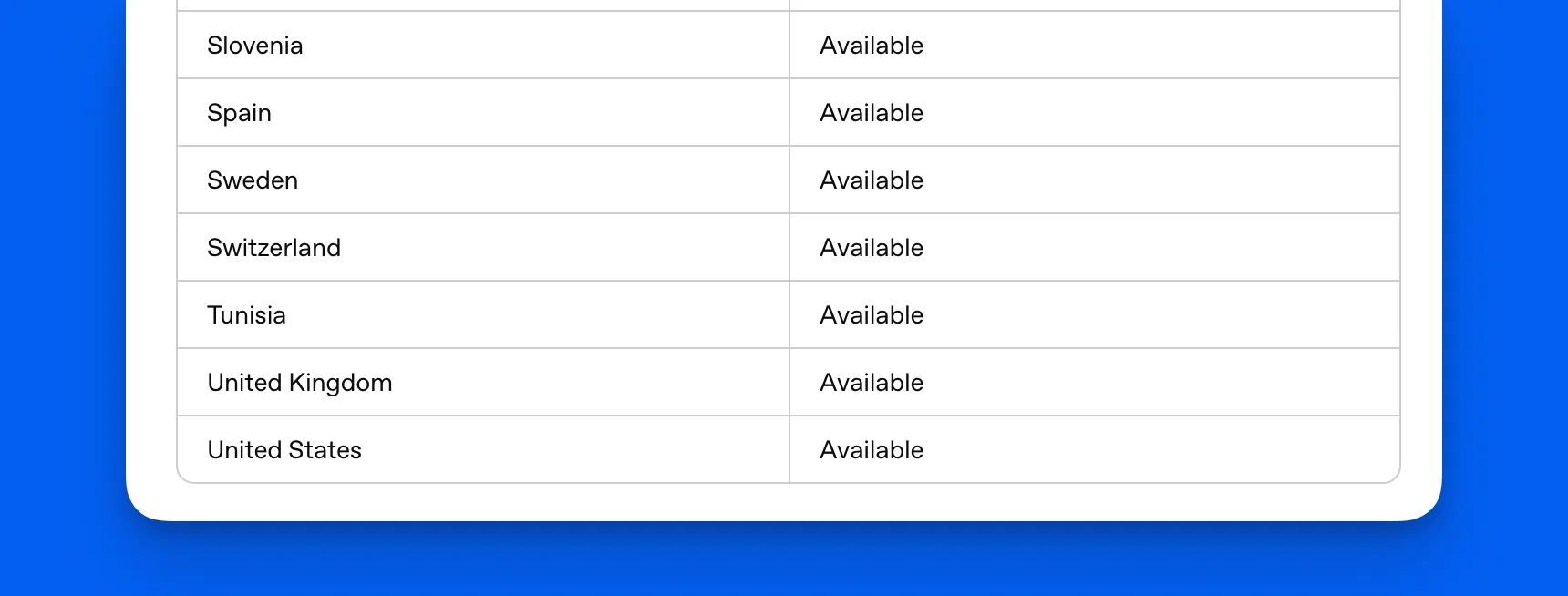
Yes. The Ads Manager is open for Switzerland, and it opened earlier than announced.
The European announcement of August 18, 2026 said only that access would run through agency and technology partners at first, with the Ads Manager to follow later. The onboarding of the logged-in account then named September 4 as the start date. In fact Switzerland already stood on “Available” in OpenAI’s help article “Ads Manager Availability” on September 1, 2026, and in the logged-in account the onboarding runs straight into campaign setup with no country block.
What that means for planning
Account activation and a live ad are two different things. Verification is manual, and campaigns cannot deliver until the billing profile is complete and verified. Starting today therefore means setting the account up first and waiting for approval, rather than running ads straight away.
What OpenAI still does not publish for Switzerland is a price. More on that below.
Why the ads are not personalized in Switzerland
This is the point that separates Switzerland from the American case studies. In the help article “Ads in ChatGPT”, OpenAI states it in so many words: “Personalized ads are not initially available in the European Economic Area (EEA) or Switzerland.”
Ad selection is left with what OpenAI itself lists: the topic of the current conversation plus simple context such as approximate location and language. Behavioral targeting drops out entirely: no chat history, no memory, no interest profiles, no re-targeting of earlier visitors.
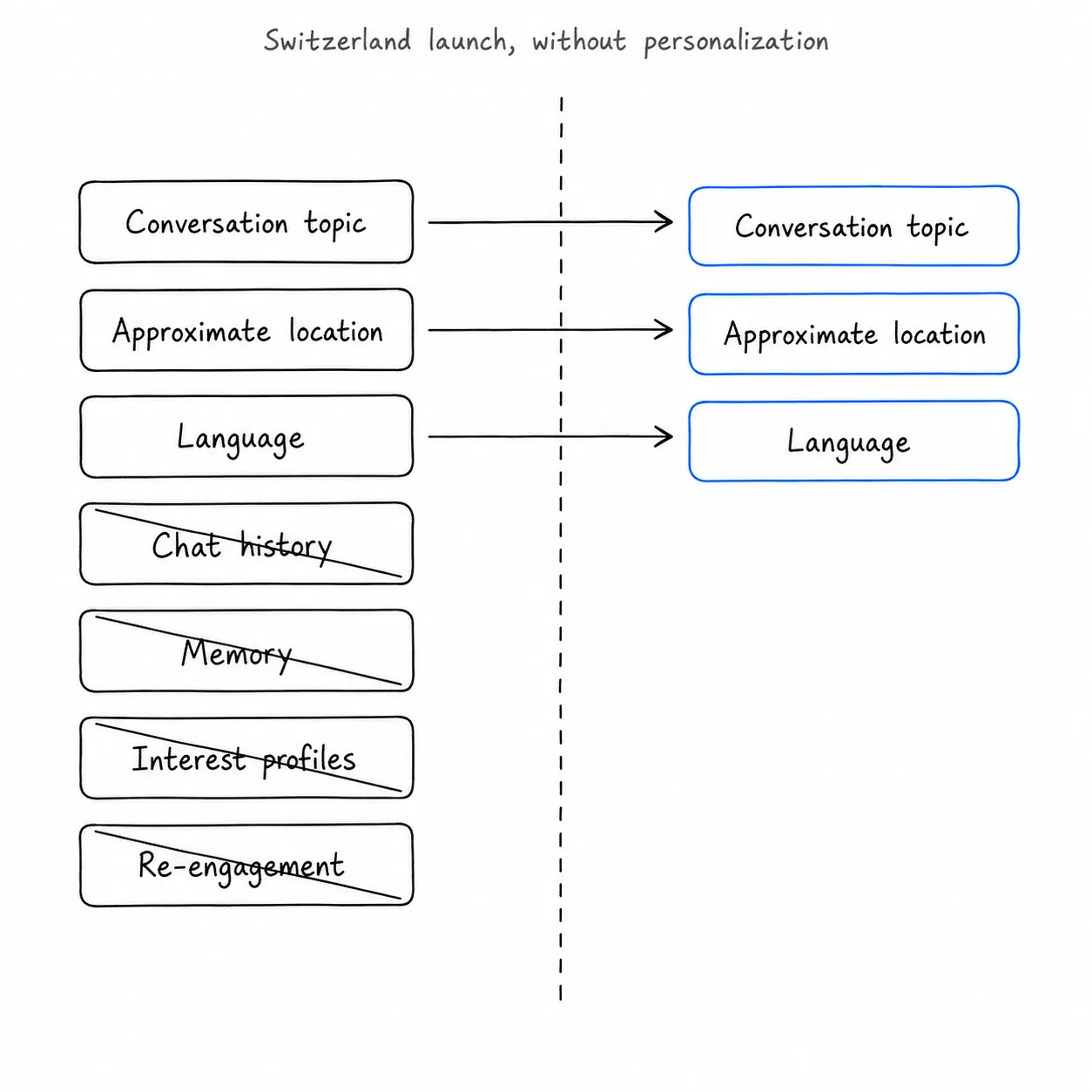
In the United States, personalized advertising is the default case. In Europe, OpenAI bases personalization on the user’s explicit consent. For Swiss users, the launch configuration is therefore the most restrained one OpenAI has rolled out so far.
Two further selection signals, device type and time of day, circulate in secondary sources. They are not on the list of signals OpenAI names for ad selection, so we do not treat them as established. What is controllable at campaign level is the platform: iOS app, Android app or web.
For a Swiss SME’s planning, that has three practical consequences:
- What American case studies say about audience building and retargeting does not apply to Swiss campaigns at launch.
- You can upload your own customer lists, but according to OpenAI an audience needs at least 25,000 matched users before it can be used. For a company with 11 to 50 employees, that threshold is effectively out of reach.
- Targeting runs on topic hints, not on exact-match keywords. OpenAI writes: “These hints help guide ad matching, but they are not exact-match keywords and do not guarantee delivery in specific conversations.”
What a Swiss SME can do now
The detour through OpenAI’s Ads Solutions team and through agency and technology partners falls away. For a company with a four-digit monthly budget it was never a practical option anyway. The direct route is open now, and it still starts with preparation.
| Before your first campaign | In the campaign itself |
|---|---|
| Open an account at ads.openai.com and have it verified | Start a campaign yourself from a Swiss account |
| Lodge the verification and billing documents | Serve ads without an agency or technology partner |
| Set up conversion measurement and the landing page | Calculate with your own click prices from the account |
| Check whether your company is already recommended in the relevant answers | Analyze demand data per conversation topic |
Opening, verifying and billing an account
Account activation and a live ad are two different things. For setup, OpenAI asks for the legal business name, the website, the logo and the industry, plus the account’s country, currency and time zone, a billing profile with a business address and an invoice email address, and a credit card. Verification is manual, and campaigns cannot deliver until billing is fully set up and verified. One point that matters for bookkeeping: country, currency and time zone cannot be changed after confirmation. The details are in the account setup guide.
What the Ads Manager can do
The flow has three steps: create a campaign with a budget and an objective, enter ad details individually or as a bulk import, then launch and optimize against the numbers.
OpenAI’s European announcement lists the feature set: buying by impressions (CPM) and by clicks (CPC), conversion optimization, geographic targeting, custom audience lists, a measurement pixel, an interface for conversion data, and integrations for third-party measurement. Targeting is chosen at country level; places below that, such as regions or postal codes, are available only in individual countries. For audience lists, the caveat above applies: below 25,000 matched people, nothing runs.
What ChatGPT ads cost in Switzerland
There are no published prices for Switzerland. Anyone quoting you a franc amount per click today is guessing. OpenAI sets the minimum daily budget per country and lists it as a table in the campaign creation guide: USD 25 for the United States, GBP 15 for the United Kingdom, CAD 25 for Canada, INR 725 for India. Switzerland is not in that table yet. For CPC campaigns, OpenAI recommends a maximum bid of USD 3 to 5 per click in its advertiser basics. Both apply to other markets and do not transfer to Switzerland: Switzerland is open, but carries no published figure.
| Country | Minimum daily budget per campaign |
|---|---|
| United States | USD 25 |
| United Kingdom | GBP 15 |
| Canada | CAD 25 |
| India | INR 725 |
| Switzerland | not stated, not in the table (as of September 1, 2026) |
Source: OpenAI Help Center, campaign creation guide, retrieved September 1, 2026.
For some companies, one question decides the timing: whether what counts is where the advertising company is based or the country it wants to advertise in. The documentation separates the two. The ad account’s country is set for the company when the account is opened and cannot be changed afterwards; the billing address and payment method have to match it. Where the ads appear is chosen separately, per campaign. For activation, OpenAI writes “access depends on your country”, meaning the country of the account. Nowhere is this stated as a single sentence about eligibility; it follows from three help articles read together.
Ad or recommendation: what you buy and what you do not
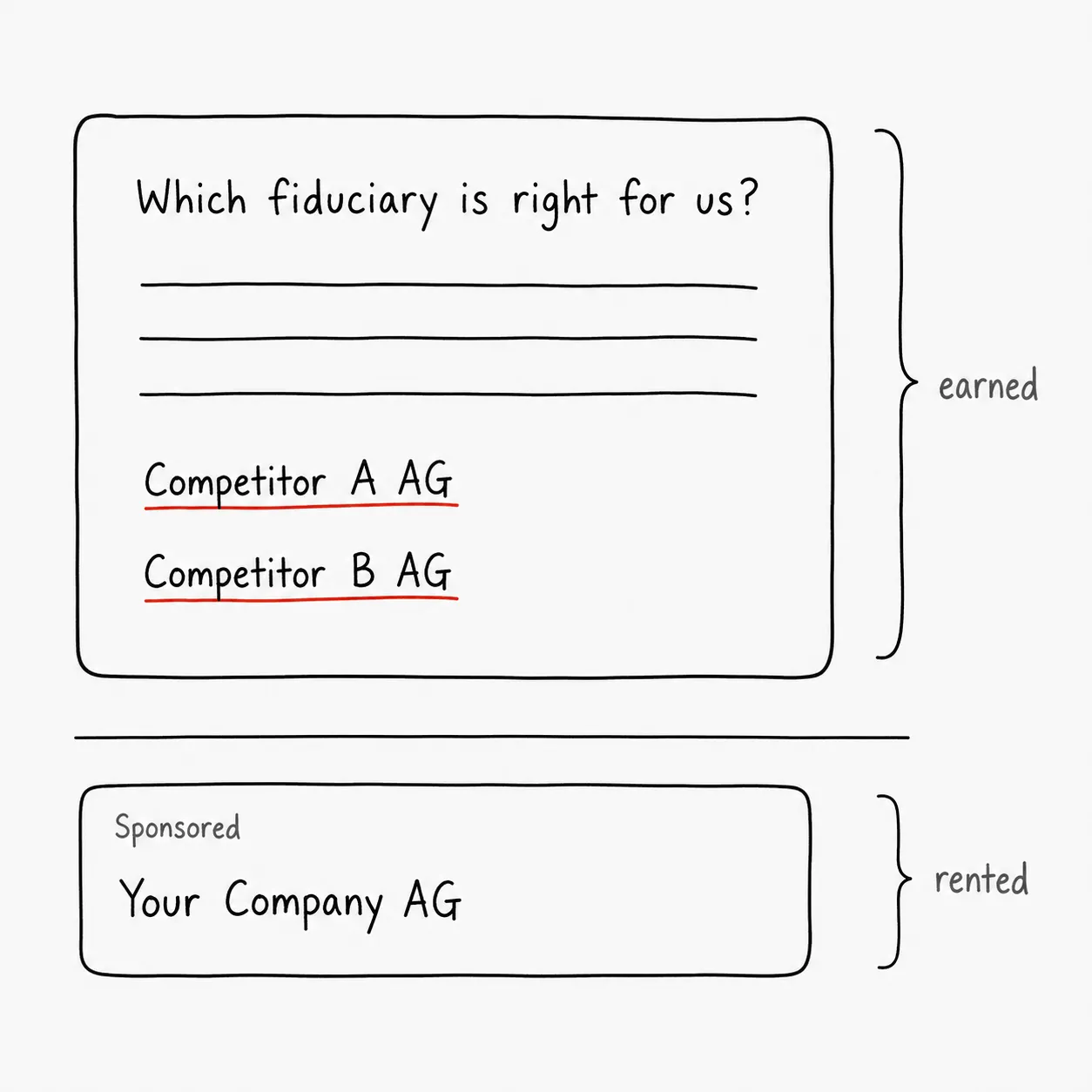
The ad buys the space below the answer. The answer itself is not for sale, and this confusion will cost more money than anything else in the coming months.
When someone asks ChatGPT which fiduciary firm, which software or which service provider fits, the model names providers in the answer. That mention cannot be bought. OpenAI states both parts explicitly: “Ads do not influence ChatGPT’s answers. Ads run on separate systems from our chat model, and advertisers have no ability to shape, rank, or alter ChatGPT’s responses.” And: “Ads are paid placements, and seeing an ad doesn’t mean OpenAI endorses or recommends the advertiser or its products or services.”
Technically that is plausible. Ad serving and the answer model are separate systems that decide at different moments; after 25 years of software development, that is the obvious way to build it. Plausible is not proven. It remains a stated, externally unaudited claim by OpenAI, and a coalition of 42 US state attorneys general has been investigating the company’s advertising and data practices, among other things, since June 2026.
In practice it looks like this: the answer names two of your competitors. Below it sits your paid ad. The reader sees both and knows which one is advice and which one is an advertisement.
An independent analysis shows how far apart the two sit. SE Ranking examined 50,006 commercial prompts across 20 industries in the US market, published on August 11, 2026. Search Engine Land summarizes three findings:
- An ad appeared on 25.94 percent of commercial prompts.
- 14.35 percent of the ads had no topical connection to the prompt.
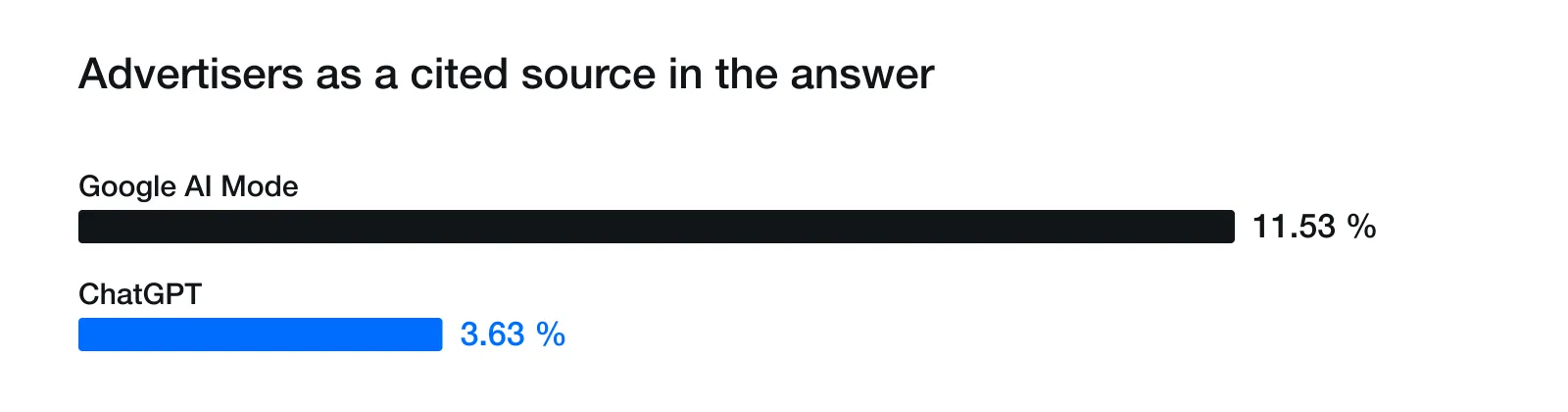
- Advertisers also appeared as a cited source in the answer itself in only 3.63 percent of placements.
In Google AI Mode that share is 11.53 percent, as MediaPost reports from the same analysis.
The study has limits: it covers the US market only, the data set contained just 1,159 different advertisers, and a single comparison platform accounted for more than 13 percent of all ads. The direction is clear all the same. We have explained why there is no purchasable ranking in ChatGPT in the first place in our own article on ranking in ChatGPT.
Advertising is rent. It works as long as the budget runs, and it ends with the budget. The mention in the answer has to be earned with substance: with verifiable statements, a clear position, and sources the systems find and take seriously. What that involves in practice is set out in our overview of ChatGPT optimization. In exchange, that mention keeps working in weeks when not a single franc of ad budget is running, and it works for every user, including the paying ones who never see an ad.
When a test is worth it and when it is not
Before a single franc moves, three things have to be in place. First, measurement: conversion tracking and the measurement pixel are set up, because the data are the actual reason for the test. Second, a concrete buying question with a matching landing page, not an awareness budget. Third, a position check: find out beforehand whether your company is already recommended in the relevant answers. If you are already in there, wait.
For scale: OpenAI’s country table still carries no minimum daily budget for Switzerland. Take the US value of USD 25 per day as a rough guide and four weeks of it work out to a test budget in the mid hundreds of francs, with a fixed end date and an abort criterion defined in advance. An annual budget on a channel with no price data remains a bet.
A test makes sense when:
- Launches and time-critical offers. Mentions in AI answers build up over months; an ad is there immediately. We have backed the length of that build-up with numbers elsewhere.
- No presence in the answers yet. If you do not appear in the relevant buying questions today, advertising can be a bridge until your own substance takes hold.
- E-commerce with clean tracking. Where click, cart and purchase are measurable, the channel can be weighed soberly against Google and Meta.
- Demand data. The most underrated reason of all, more on that below.
A test does not make sense when:
- You are already being recommended. Then you are paying for a slot beneath an answer you are already in. We have described how to check that yourself in 30 minutes, step by step.
- No tracking. Without a pixel and conversion measurement, after three months you will know only what you spent.
- A small budget against unknown prices. Without Swiss click prices, you cannot calculate whether the channel delivers more cheaply than Google or Meta.
One honest finding from our own conversations: since the launch on August 24, not one Swiss SME has asked us a question about ChatGPT ads. The topic comes up as a passing remark at most, along the lines of “so ads are coming to ChatGPT now, that will probably become a thing for us too.” Our answer is the same every time: the ad sits below the answer and runs as long as the budget runs. What decides is whether you are named and recommended in the answer itself, and advertising changes nothing about that.
The data point an ad account delivers
For buying questions in AI assistants there is no equivalent of Google’s Keyword Planner. Nobody knows reliably how often which buying question is asked in ChatGPT, and no official instrument for it exists.
An ad account changes that for the first time. Run campaigns against conversation topics and you see numbers from the system itself: impressions, clicks and conversions per topic. Even a small test budget therefore answers a question nobody could answer seriously before, namely how many of your buyers ask the AI before they contact you. Use the channel for that alone and you have not wasted it.
One limit comes with that: advertisers do not see which prompts triggered their ad. The analysis stays at the level of the topic, not the individual question. Advertisers get aggregated performance figures, meaning impressions and clicks; they do not get chats, conversation histories, memory contents or users’ personal data.
| What advertisers see | What they do not see |
|---|---|
| Impressions and clicks per conversation topic | The individual question that triggered the ad |
| Conversions from their own measurement | Chats and conversation histories |
| Aggregated campaign performance figures | Memory contents and users’ personal data |
Source: OpenAI Help Center, “Ads in ChatGPT”, retrieved August 30, 2026.
What this means for measuring AI visibility
On the Free plan there have been two kinds of presence since August 24: the paid ad below the answer, and the mention in the answer. A measurement that mixes the two can be flattered by budget.
In Carigiet GEO’s measurements, therefore, only one thing counts: who the model names and recommends in the answer itself. Measurement runs on the real surfaces your buyers see, and paid placements are reported separately. In practice that means up to 20 buyer questions per service area, checked daily on the relevant AI systems, among them ChatGPT, Perplexity, Google AI Overviews and AI Mode, Gemini, Copilot and Claude, with a weekly comparison. The method behind it is public: how AI visibility can be measured reliably. Also publicly available is the Swiss AI Recommendation Index, which measures monthly which Swiss providers the major AI assistants name on real buyer questions.
That was already the right approach before August 24. Since the advertising launch, it is the precondition for the numbers meaning anything at all.
What the ad launch says about the value of AI answers
OpenAI has put a price on attention inside AI answers. The fact that a company sells this space confirms what it is worth.
The Swiss demand behind it is measurable. According to the IGEM Digimonitor 2026, published on August 25, 2026, 80 percent of the internet-using population aged 15 to 75 use AI tools; ChatGPT is the most-used platform at 67 percent. For shopping advice, AI platforms reach 39 percent, almost level with YouTube (40 percent) and ahead of social media (36 percent). The figures were collected by Intervista on behalf of IGEM and WEMF among 1,957 people between March and April 2026.
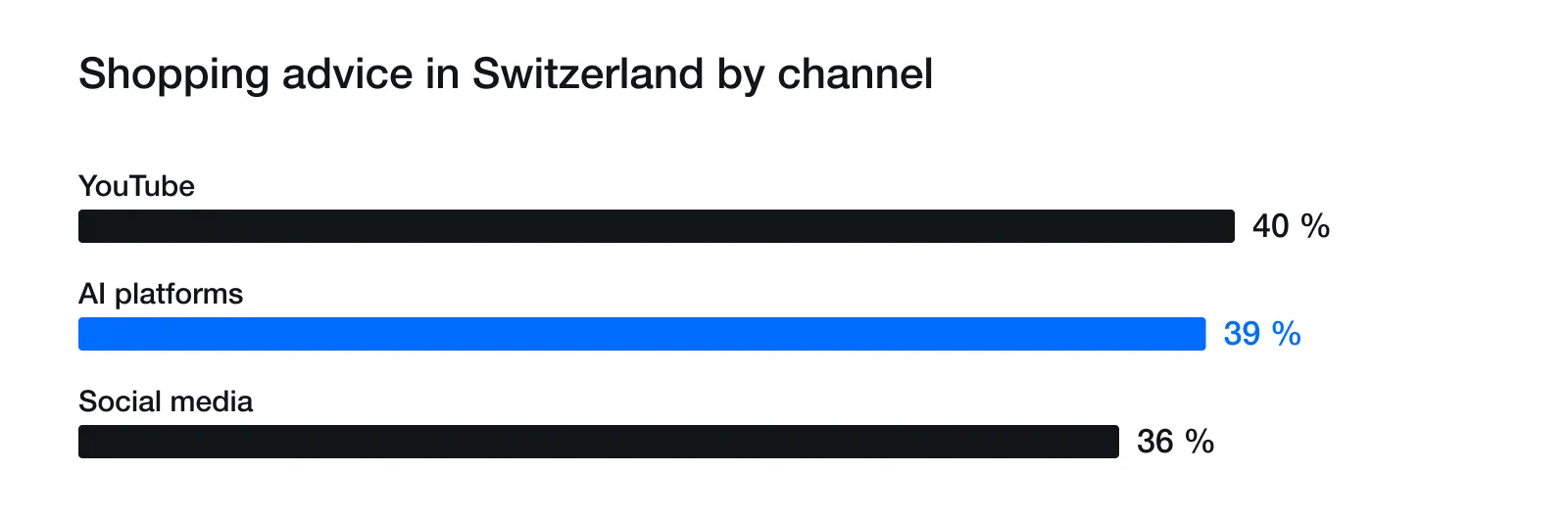
Shopping advice is exactly where advertising space is now being sold.
Full disclosure, since we have a stake in this: Carigiet GEO sells no advertising and runs no campaigns. We earn nothing from a ChatGPT ad budget. What we do is make sure companies appear in the answer itself, and measure daily whether it happens. The edge of the answer can be bought. The middle stays earned.
Frequently asked questions
Who sees ads in ChatGPT in Switzerland?
Only accounts on the Free and Go plans. Plus, Pro, Business, Enterprise and Edu stay ad-free, accounts belonging to people under 18 see no ads, and none appear in temporary chats either.
Are ChatGPT ads personalized in Switzerland?
No. OpenAI states that personalized ads are not initially available in Switzerland. What counts for selection is the topic of the current conversation plus approximate location and language, not the chat history and not memory.
Can a Swiss company run its own ads in ChatGPT?
Yes. The Ads Manager is open for Switzerland, checked on September 1, 2026 in the logged-in account. September 4 was the announced date; the switch was flipped earlier. Access through OpenAI’s Ads Solutions team and through agency and technology partners is no longer necessary.
How much do ChatGPT ads cost in Switzerland?
No prices are published for Switzerland. OpenAI sets the minimum daily budget per country, and Switzerland is not in that table yet. What is documented are values for markets that are already open, for example USD 25 per day for the United States, plus a recommendation of USD 3 to 5 per click for CPC campaigns. Those amounts do not transfer to the Swiss market.
Do ads influence ChatGPT’s answers?
Not according to OpenAI. The company states that ads run on separate systems and that advertisers can neither shape nor reorder answers. That statement is declared, but not externally audited.
Can advertisers see my chats?
No. Advertisers receive aggregated, non-identifying performance figures such as impressions and clicks. They do not receive chats, conversation histories, memory contents or personal data.
Is a test budget worth it for an SME with 20 employees?
Only once three things are in place: conversion measurement, a concrete buying question with a matching landing page, and the certainty that the company is not yet recommended in the relevant answers. If any one of them is missing, the budget is better invested in your own substance.
Before you decide on an advertising budget
Check first whether ChatGPT already recommends your company today. If you do not appear, at least you will know after the check how large the gap is.
We show you that with the free AI visibility analysis: which buyer questions we ask, who the systems name today, and where your competitors stand. If you would rather go through it in conversation, book a 15-minute introductory call. No slides, no obligation.
Related posts
Choosing a GEO Agency: 8 Checks Swiss SMEs Should Run (2026)
How Long Until Your Company Appears in AI Answers? (2026)