

Updated November 20, 2026 · Prices checked on November 20, 2026
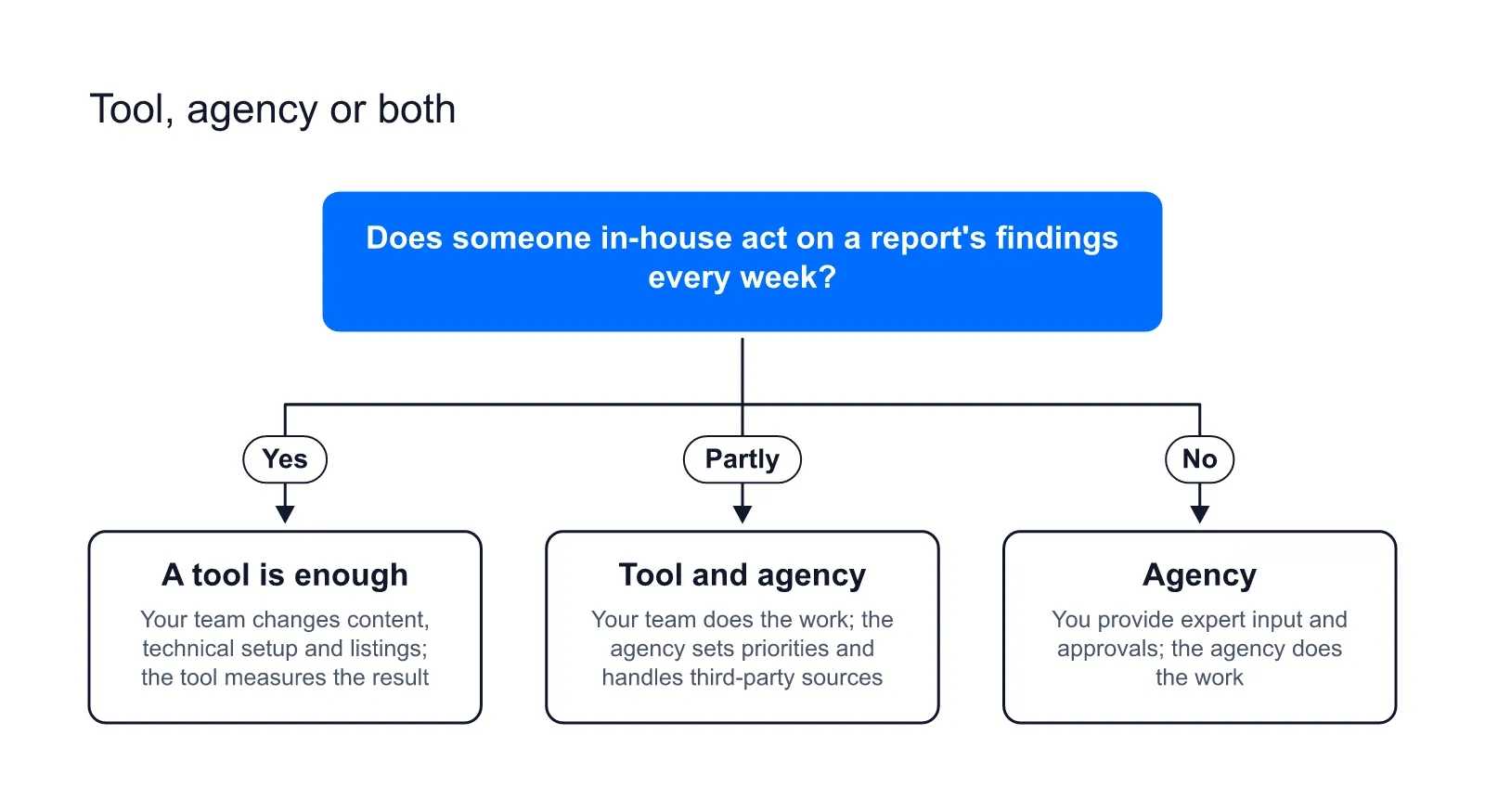
A tool is enough to measure whether ChatGPT, Perplexity and Google AI Overviews (the AI summaries at the top of Google’s results) name your company. Getting recommended takes someone who changes your content, your website’s technical setup and your listings on other websites, so a tool on its own is only enough if your team does that work every week.
Carigiet GEO is a Generative Engine Optimization (GEO) consultancy based in Uetikon am See, in the canton of Zurich, and works across German-speaking Switzerland. Carigiet GEO gets Swiss B2B companies recommended by AI assistants when their buyers ask for a provider, and it publishes the Schweizer KI-Empfehlungsindex (Swiss AI Recommendation Index). In the first four full weeks that we tracked our own visibility, Carigiet GEO appeared in 4, 7, 6 and 10 of roughly 1,030 answers a week, never more than 1 in 100 answers. Measuring by itself changed nothing.
Key takeaways
- A tool counts mentions; changing the answers takes work on content, technical setup and sources.
- A tool is enough if someone in-house does that work weekly.
- Tools we checked start at USD 50 a month, agency retainers with implementation at CHF 490.
- Carigiet GEO puts the work at about 6 hours a week per service, over 3 after eight weeks.
What does a tool show, and what doesn’t it change?
When we asked ChatGPT, in German, whether a tool is enough for AI visibility or whether we would need an agency, its answers said to start with a tool and bring in an agency later if needed. Whether that advice fits your company depends on what a tool actually does and what it leaves to you.
By a tool we mean a monitoring tool: subscription software that regularly puts a fixed list of buyer questions to AI assistants and checks whether your company comes up in the answers. Buyer questions are the questions your buyers ask an assistant, such as “Which accounting firm in Zurich would you recommend for a small business?” Several of the five tools whose pricing pages we checked also suggest what you should change, and one revises 10 pages on its entry plan and writes 10 new ones a month. Someone at your company still has to review, approve and publish that content.
A tool report shows you:
- how often your company comes up for the questions it tracks, per assistant
- which pages and sources the assistants cite
- which competitors appear in the same answers
What actually changes an answer is work the tool doesn’t do:
- content that answers the buyer’s question
- making sure the assistants’ crawlers, the programs ChatGPT, Perplexity and Google use to read websites, can access your site
- company details that are unambiguous and identical wherever they appear
- genuine mentions in sources the assistants read: directories, industry publications, trade association member lists
For Google Search itself, Google spells out what works. According to Google’s guide to optimizing for generative AI features (last updated July 10, 2026), traditional search engine optimization (SEO) still applies to the AI features of Google Search, and many of the popular hacks don’t work. Structured data, meaning machine-readable company details in a website’s code, isn’t required for these features, and there is no special markup for AI that you need to add. About third-party tools, Google says: “No third-party tool has access to our internal ranking or AI systems.” These are the systems that decide what Google shows and in what order.

Mentioned, cited, recommended: what does the report show?
A tool report shows whether your company is mentioned and whether your website is cited. From what we could find, none of the five tools whose pricing pages we checked reports recommendations as a separate metric; they count mentions, sources, visibility scores and the sentiment of the answers.
Mentioned, cited and recommended are three different verdicts on an answer. Mentioned means the assistant names your company without recommending it as an option. Cited means your website serves as a source for the answer. Recommended means the assistant names your company as an option the buyer should choose, and that is the only verdict that puts you on the buyer’s shortlist.
The Schweizer KI-Empfehlungsindex, which Carigiet GEO publishes monthly, shows how rare recommendations are. The six AI assistants it tracks recommend 267 of 3,098 accounting and tax firms in the canton of Zurich (the index’s “fiduciary services” category) at least once, about 9 in 100. Among IT service providers in Switzerland, it is 556 of 17,838, about 3 in 100. All index figures in this section come from the November 2026 edition, as of November 20, 2026.
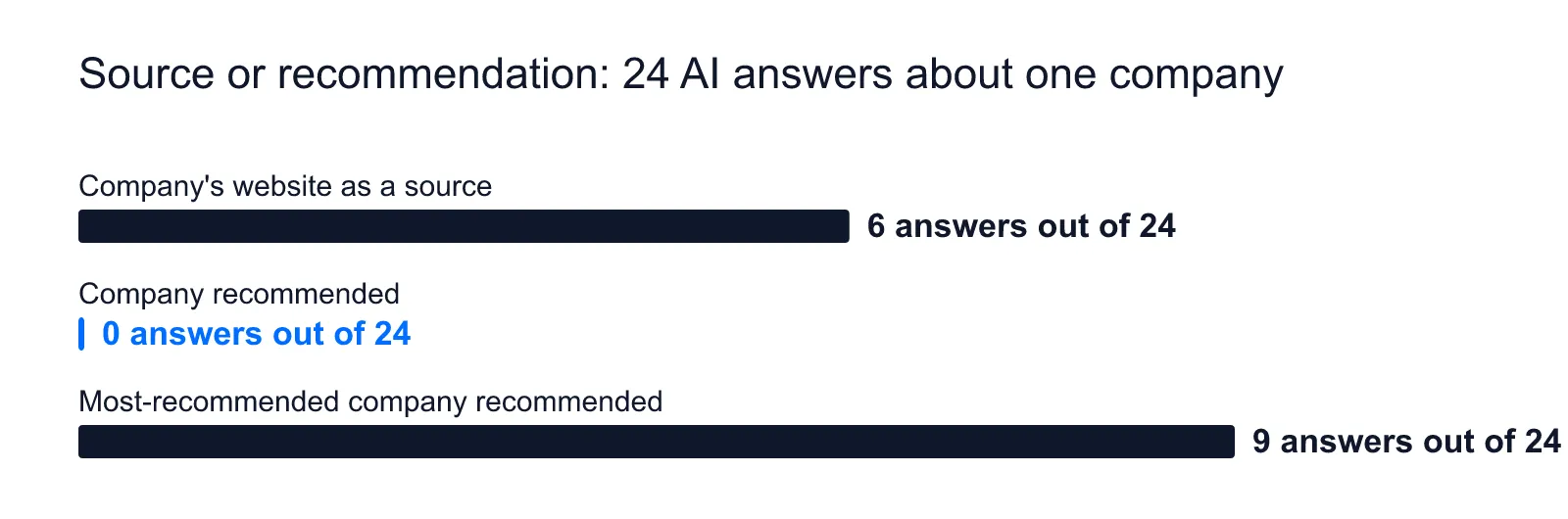
Between mentioned and recommended there is a gap that a simple mention count hides. In our analysis of the same edition, 2,411 companies appear in the answers; 235 of them are never recommended, and another 255 are recommended only outside their own region or industry. A Zurich accounting and tax firm outside the top ten has its website cited in 33 of 1,000 answers and is recommended in 6 of 1,000. For one company we checked in November, its website was a source in 6 of 24 answers; the company itself was recommended in none of them, while the most-recommended company was recommended in 9.
Tools also measure in different ways. One reads the answers the way buyers see them in the app; another mixes them with answers pulled through the provider’s API, the programming interface that queries the AI model directly, some of them without the web search the app uses. So a percentage from one tool and a percentage from another don’t describe the same thing. In the Carigiet GEO retainer, our ongoing monthly engagement, we classify every answer for your company and for each competitor we agree on with you: recommended, mentioned only, or not mentioned.
Does measuring alone change the answers?
Our own tracking says no. The four figures in the introduction come from the first four full weeks that we tracked our own visibility, July 20 to August 16, 2026, with around 1,030 answers a week. We counted whether Carigiet GEO appears, not whether it is recommended. While researching this article, we found no published study showing that monitoring by itself, without any changes, increases mentions for other companies.
A report also doesn’t tell you why a number moves or why a company is missing from the answers. Since September 13, 2026, we have tracked our own visibility daily with 50 questions across five assistants. Between the weeks of October 26 and November 9, the number of answers we appear in fell from 312 to 194. Of the 118 lost answers, 44 are due to a change in our setup: since the week of November 2, our tracking has covered Bing’s AI Mode instead of Copilot. Another 62 were lost on Perplexity. The report shows only the lower number.
A single query in ChatGPT isn’t a measurement either. In a study by SparkToro with the AI tracking company Gumshoe, 600 volunteers put 12 recommendation questions to ChatGPT, Claude and Google AI Overviews 2,961 times in total; for ChatGPT and Google, the same list of brands came back in fewer than 1 in 100 cases. The study was run outside Switzerland in November and December 2025 (SparkToro’s report), and Gumshoe itself sells AI tracking software. What does tell you something is how often a company appears across many repeated runs.
AI visibility tool vs agency: who does which job?
Choosing between a tool and an agency means deciding who does the work behind the measurement every week. The “Both” column describes your own team bringing in an agency for review, prioritization and third-party sources. The costs in the table come from the pricing pages of five tools that Carigiet GEO checked on November 20, 2026 (smallest plan) and from the published list prices of Swiss agencies that do the work (our survey, collected November 6, 2026); the section on costs breaks them down with sources.
| Task | Tool | Agency | Both |
|---|---|---|---|
| Measuring | a fixed list of questions, daily or weekly depending on the plan | the same buyer questions over weeks, against named competitors | the tool measures, the agency helps interpret |
| Analyzing and prioritizing | you read the report and decide | the agency reviews where you stand and decides what to do first | the agency prioritizes, your team does the work |
| Writing and publishing content | your team; some tools supply drafts | the agency writes, you approve | your team writes, the agency reviews |
| Technical setup (crawler access, structured data) | your team or your web agency | the agency makes the changes or gives your IT team the specifications | depending on your team’s capacity |
| Third-party sources (directories, industry publications, association lists) | your team | the agency | usually the agency |
| Cost per month | from USD 50 on the entry plan | CHF 490 to 1,900 and up with implementation | tool and agency combined |
| In-house effort | around 6 hours a week or more at first (estimate, see below) | expert input and approvals | hours for implementation, fewer for analysis |
When is a tool enough?
A tool is enough if these points apply to your company:
- Someone in-house has time set aside every week for content, listings and technical work.
- Your content is written in-house, and that person has the authority to publish.
- You can access your website and its technical setup without waiting on someone else for every change.
- You offer one service in one language and know who your competitors are.
- You already know why you’re missing from AI answers, and you want to see whether the work is paying off.
Many Swiss SMEs don’t have that person. In three out of four SMEs, the owners or management handle digital marketing themselves. In small companies with 10 to 49 employees, this is also the most common arrangement (41 percent); in medium-sized companies with 50 to 249 employees, it is most often handled by an in-house marketing specialist or team (44 percent). These figures come from the SME Digital Pulse 2026 by localsearch and the Lucerne University of Applied Sciences and Arts (HSLU), a survey of 504 marketing decision-makers at Swiss SMEs, weighted by language region and company size (press release, November 18, 2026, in German); localsearch itself sells visibility services to SMEs.
At Carigiet GEO, we base our estimate of the hours on our own workflow. For one service area, which is one line of service with its own buyer questions and its own competitors, we plan for around 6 hours a week in the first eight weeks and a little over 3 after that. That covers four pieces of content a month at about an hour each, a 30-minute weekly call, the work on listings and sources, and a monthly review of the website. The figure is an estimate drawn from the weekly routine of our current retainers in October 2026. We don’t track time yet, and the estimate assumes an established process and our own tools. A team that is still building the process needs more, though we haven’t measured how much more.
When is an agency worth it?
An agency is worth it if one of these points applies:
- Nobody in-house acts on what a report finds.
- The cause is unclear: you can see that you don’t show up in AI answers, but not why.
- You offer several services or languages, each with its own competitors.
- Competitors are recommended regularly, and your company is not.
- AI assistants are getting facts about your company wrong.
An agency gives you no more access to Google’s internal systems than a tool does. What you buy is the work, and the responsibility for getting it done every week.
When do we advise against a retainer?
At Carigiet GEO, we advise against a retainer in these cases:
- You have fewer than 11 employees. In that case, our free AI Visibility Audit lists the first steps you can take yourself, and the index shows where you stand.
- You run an online store, or you are a corporation with more than 500 employees.
- You only want search engine optimization or Google Ads; for those, we refer you to partners.
- Your buyers don’t compare providers before they get in touch.
- Your budget can’t sustain this channel for several months.
- Nobody on your side signs off on changes.
In the initial call, we also run the numbers: if the inquiries that go to competitors instead of you, valued with your company’s own figures, are worth less than CHF 21,600 a year, we advise against a retainer. That is twelve months at the starting price of CHF 1,800.
Who does what when you hire a GEO agency?
With an agency, three parties share the work:
- Tool: tracks a fixed list of questions and shows mentions, cited sources and competitors.
- You: provide expert knowledge and approvals; without an agency, you also write and publish the content and maintain the listings.
- Agency: reviews where you stand, sets priorities, writes and publishes content, makes the technical fixes and corrections, builds mentions in third-party sources and measures again with the same questions.
At Carigiet GEO, the rule is: “You provide expert input and approvals. We build everything else.” We make technical changes wherever we have access; anything that needs a developer goes to your web agency or IT team as a ready-to-file ticket, and we check that it is live. We don’t sell tools; the measurement is the proof of our work. A tool shows you that you are not being named. It does not change that. We make the changes that the tool would then pick up. How to vet an agency before you sign is covered in Choosing a GEO Agency: 8 Checks Swiss SMEs Should Run.
A tool report shows a mention rate and who your competitors are. In our retainer work, the company details are what we fix first. In a current retainer with a language school, the tool showed the company named in around 68 of 100 answers. Even so, on day 23 there were 76 open findings:
- 16 directory listings
- 12 external sources
- 16 pieces of website copy
- 14 technical items, 4 of them urgent
- 18 tasks on our side
Two decisions the company had not yet made, how to spell its name and which main phone number to use, were holding up 23 corrections. The first approved step was therefore to clean up the company details and listings.
A tool shows third-party sources, but it can’t change them. Comparison lists are rankings of providers published on other websites. Our company was on none of the ten comparison lists that the assistants opened most often in our own category from August 28 to September 26, 2026, while one competitor was on seven. Bought or invented mentions are no substitute for this work: according to Google’s guide, seeking inauthentic mentions isn’t as helpful as it might seem.
What do a tool and an agency cost per month?
Costs start at CHF 0, because some ways of measuring are free. Monitoring tools start at USD 50 a month on the smallest plan, and Swiss agencies that do the work list prices of CHF 490 to 1,900 and up a month. Below, we at Carigiet GEO list each price with its source and the date we checked it.

What can you measure without a subscription?
- Google Search Console: since June 3, 2026, the generative AI performance report has shown how often pages of your website appeared in Google AI Overviews and Google’s AI Mode; since August 31, 2026, it has been available for all websites (Google Search Central Blog).
- Bing Webmaster Tools: since February 10, 2026, the AI Performance report has counted how often your website appears as a source in Copilot and in Bing’s AI summaries (Bing Webmaster Blog).
- Web analytics: ChatGPT adds the tag “utm_source=chatgpt.com” to links to your website, so Google Analytics shows you visits from ChatGPT. In October 2026, a bug left the tag off for about a week; ChatGPT has been adding it again since October 15 (Search Engine Roundtable).
- Manual check: you put real buyer questions to the assistants yourself and note who gets recommended. Check Your AI Visibility Yourself explains how to do this in about 30 minutes.
- Free AI Visibility Audit from Carigiet GEO: a one-time check of ChatGPT and Google AI Overviews with a report by email, usually within 15 to 30 minutes. It is a snapshot, not ongoing monitoring.
The reports from Google, Bing and web analytics mainly show your own website, not whether an assistant names or recommends your company without a link. A manual check and the audit show it, but only as a snapshot. None of these methods shows who is recommended instead of you across many repeated runs.
What do monitoring tools cost?
On November 20, 2026, we checked the public pricing pages of five monitoring tools that are available internationally. The figures are for the smallest plan, in the currency of the pricing page and not converted; each row gives the number of brands, projects or domains (web addresses) the plan covers. The pages are not consistent about whether VAT is added. We don’t name the tools, because the point is to compare prices, not to rate any one tool.
| Tool | Entry plan per month | Billing | Scope | Assistants in the plan | Beyond measuring |
|---|---|---|---|---|---|
| A | USD 50, USD 45 billed annually | monthly or annually | 25 questions, more at extra cost | ChatGPT, Gemini, Perplexity | prioritized suggestions |
| B | USD 89, USD 71 billed annually | monthly or annually | 75 questions daily, 5 projects with one location each | ChatGPT, Google AI Overviews, Google’s AI Mode, Gemini, Copilot; Claude only on the USD 399 plan | no implementation stated |
| C | USD 99 per domain | monthly or annually, same price | 25 questions daily, 1 domain | ChatGPT, Google AI, Gemini, Perplexity | website audit for AI readiness |
| D | EUR 99, EUR 84.15 billed annually | monthly or annually | up to 4,800 answers, unlimited questions, 10 brands | 17 or more assistants, some through the app, some through the API | 50 page audits, suggestions |
| E | USD 250 | monthly | 15,000 answers, 1 brand | 8: ChatGPT, Perplexity, Gemini, Google AI Overviews, Google’s AI Mode, Copilot, Grok, Meta AI; Claude only as an add-on on the most expensive plan | 10 pages revised, plus 10 new pages a month |
For USD 50 to USD 250 a month, you get repeated measurement, and with some tools suggestions or drafts on top. None of the five changes your listings on other websites, and you review and publish the drafts yourself.
What do GEO agencies cost?
In our survey of the published prices of 38 Swiss GEO providers, collected on November 6, 2026, advisory services without implementation cost CHF 290 to 1,190 a month (median CHF 640), though that is based on only 4 prices. Agencies that do the work charge CHF 490 to 1,900 and up a month (median CHF 1,230, based on 6 prices). The median is the middle value: half of the prices are below it, half above. The ranges are list prices that providers publish, not fees clients actually paid.
The Carigiet GEO retainer starts at CHF 1,800 per month plus VAT for the first service area; each additional service area costs CHF 1,000 per month (pricing page, checked on November 20, 2026). There is no setup fee and no minimum term; you can cancel at any time, effective at the end of the current retainer month.
Frequently asked questions about tools and agencies
Does Google Search Console show AI Overviews data?
Yes, as impressions: how often pages of your website were shown in Google AI Overviews, in Google’s AI Mode and in Discover, Google’s news feed. You can break the figures down by page, country, device and time period, down to the hour. The report doesn’t show whether your company was recommended or which competitors appear instead of you.
How many prompts should we track for AI visibility?
Enough prompts, meaning buyer questions, to cover every important service at every stage of a purchase: looking for a provider, describing a requirement or a problem, comparing options and making the decision. The entry plans of the five tools we checked allow 25 to 75 questions or an allowance of answers. In the Carigiet GEO retainer, it is up to 20 buyer questions per service area, put daily to ChatGPT, Claude, Perplexity, Gemini, Copilot and Google AI Overviews; the set stays fixed for a quarter so that the weeks remain comparable.
Can anyone guarantee that ChatGPT will recommend my company?
No, neither a tool nor an agency can. The assistants rarely return the same list of providers twice for the same question, and even Google writes in its guide that indexing and serving aren’t guaranteed, even when a page meets every requirement. Anyone who promises you a guaranteed position or a fixed date is selling you something.
Can a tool fix wrong information ChatGPT gives about my company?
No. A tool shows what an assistant claims about your company. The fix has to happen where the claim comes from: on your website, in the directory listing or in the third-party source the assistant cites.
Is a tool enough if we sell in both English and German?
Only if someone in-house does the work in both languages. Each language needs its own set of buyer questions, because buyer questions and competitors differ by language. That’s why offering several services or languages, each with its own competitors, is one of the signs that an agency is worth it. At Carigiet GEO, each additional language counts as a separate service area at CHF 1,000 per month.
Where do you stand today?
Our free AI Visibility Audit shows whether ChatGPT and Google AI Overviews recommend your company today: for which buyer questions you are recommended, who is recommended instead, and which first steps your website and your sources still need. With that report, you can see whether the work that follows fits your team or whether you need help. In a 15-minute initial call, with no obligation, we work out together whether a retainer makes sense for you.
No tool does the work for you. You decide who does it every week.