

Generative Engine Optimization (GEO) comprises all measures ensuring that a company is mentioned, correctly represented, and recommended in the responses of AI systems such as ChatGPT, Perplexity, or Google AI Overviews. Traditional search engine optimization (SEO) fights for positions in a hit list. GEO decides whether your company appears in the finished response that a potential customer reads.
This is no longer a question of the future. According to a Comparis survey from March 2026, 41.6 percent of Swiss citizens who are familiar with AI chatbots are already using them to search for information instead of Google or Bing. At Carigiet GEO, we measure daily which providers AI systems name for typical buyer questions, and we see a recurring pattern: those recommended are present on the sources cited by these systems. This guide explains how AI answers are generated, what distinguishes GEO from SEO, and what you as a Swiss SME can concretely do.
Key takeaways
- GEO ensures that your company is mentioned and recommended in AI responses when potential customers search there for providers, recommendations, or expertise.
- Around 90 percent of the work is solid SEO. What is new are entire buyer questions instead of individual keywords, differences between platforms, and ongoing measurement.
- 76.1 percent of the adult Swiss population use AI chatbots (Comparis, March 2026). Google AI Overviews have been live in Switzerland since March 2025.
- The most well-proven levers are statistics, citations, and clean source attributions in your own content (Aggarwal et al., KDD 2024). Keyword tricks are counterproductive.
- Realistic timeframe: initial measures by day 30, first reliable movement typically between day 60 and 90. No serious provider can promise guaranteed mentions.
What does Generative Engine Optimization mean?
Generative Engine Optimization is the discipline of preparing a company’s content, sources, and facts so that generative AI systems find, understand, and cite them. The term originates from research: the paper “GEO: Generative Engine Optimization” by Aggarwal et al., presented at the KDD 2024 conference, defines generative engines as systems that retrieve relevant documents from the web and use a language model to generate a response with citations.
Other names for the same concept are also in circulation: AEO (Answer Engine Optimization), LLMO (Large Language Model Optimization), or “AI-SEO”. There is no established distinction; the terms are used synonymously in practice. Thus, the industry has not even agreed on a single name. This speaks volumes about the maturity of the discipline. We stick with GEO because the term describes the mechanism most precisely: optimization for systems that generate answers instead of listing links.
How are AI answers generated?
AI answers are generated in two steps: first, the system retrieves relevant sources, and then a language model compiles these into a response with citations. Anyone wishing to influence whether they appear in this response must understand this process. After 25 years of software development, this is my core belief: those who understand how a system generates its answers can influence them.
Training knowledge or live search?
AI systems draw from two sources of knowledge. First, from training data: the frozen world knowledge of the model, which is often many months old. Second, from live web searches: the system retrieves current sources and bases its answer on them; professionals call this “grounding”. ChatGPT uses the Bing index and its own crawlers, among other tools, for this purpose.
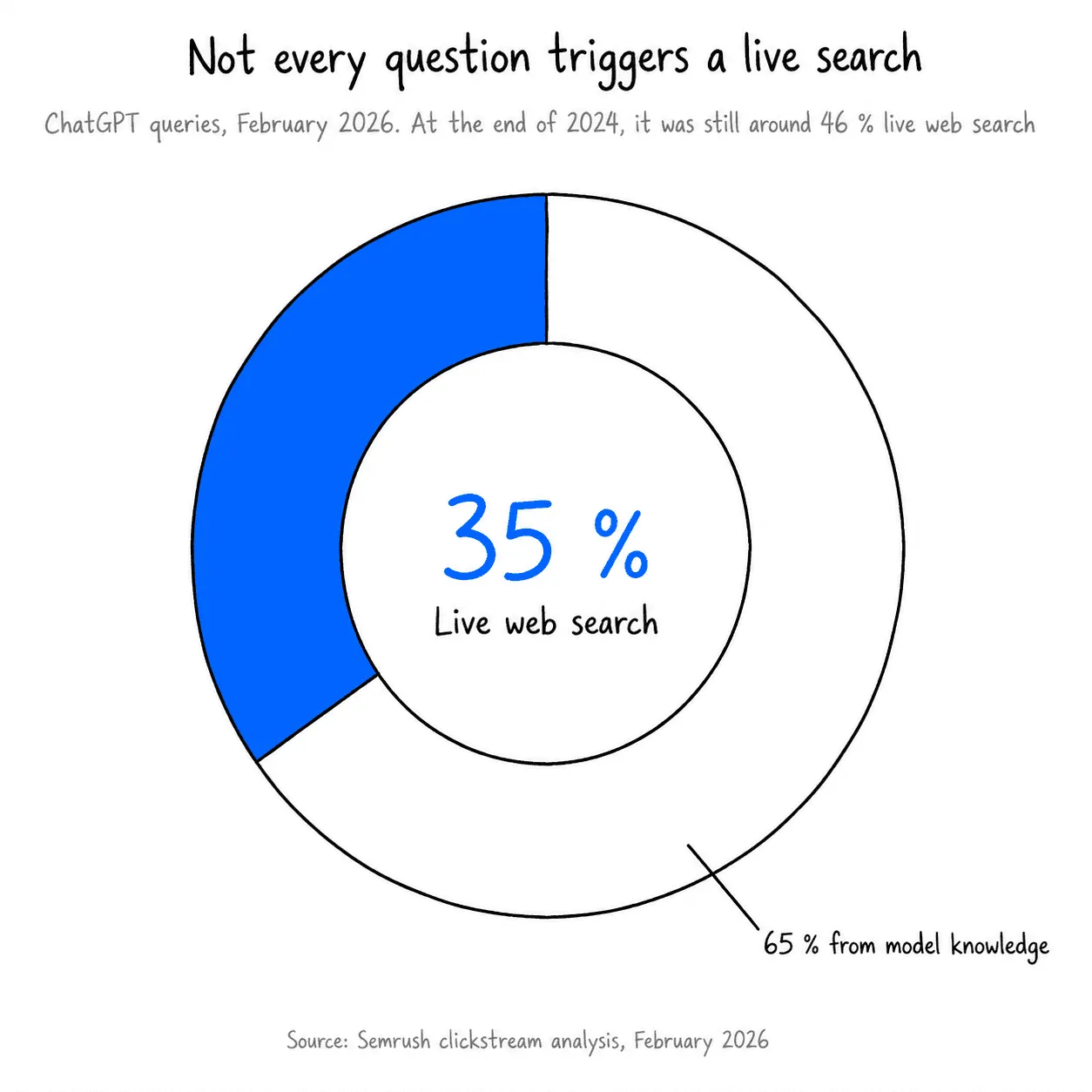
Importantly, by no means does every question trigger a live search. Clickstream analyses by Semrush show that the share of ChatGPT queries with live web search dropped from around 46 percent at the end of 2024 to around 35 percent in February 2026. The rest are answered directly from model knowledge. Both therefore matter: what is permanently and consistently written about you on the web flows into the model knowledge, while what is currently accessible determines the live answer.
Query fan-out: turning one question into many
Google officially documents that AI Overviews and AI Mode work with a “query fan-out” technique: from a user’s question, the system generates multiple related search queries on subtopics and data sources, synthesizing the results into the final answer.
An example from daily Swiss SME business: someone types “I am looking for a fiduciary for my small business in Winterthur”. The system quietly turns this into a bundle of sub-questions: Which fiduciaries specialize in small businesses? What are their rates? How are they rated? Who offers payroll accounting? For each sub-question, it gathers sources and condenses everything into a single recommendation list. We show how this looks for a specific sector in our article on AI visibility for fiduciaries.
How many sources does an AI answer cite?
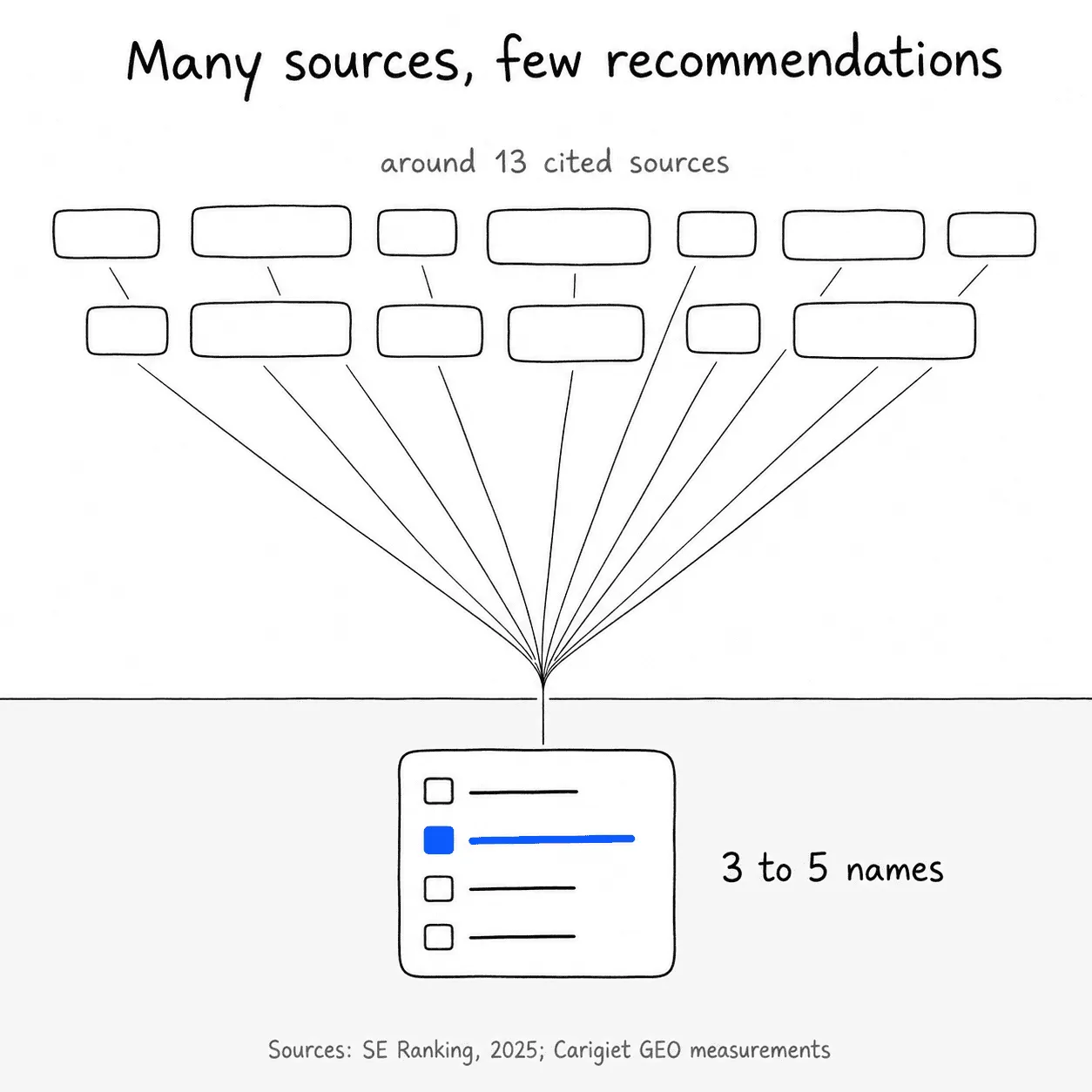
Typically a good dozen. Analyses by SE Ranking count an average of around 12.6 linked URLs per response in Google AI Mode; according to the Pew Research Center, 88 percent of Google AI overviews cite three or more sources. In the end, however, only a few providers are recommended, in our measurements usually three to five names. You are either in or you are out. There is no middle ground.
In addition, the same question does not always yield the same answer. An SE Ranking study of 10,000 search queries in Google AI Mode found only a 9.2 percent exact URL overlap when the same query was submitted three times on the same day. AI answers are statistical, not deterministic. This has direct consequences for how visibility is measured, which will be discussed later.
GEO vs. SEO: What is the difference?
First, a clarification that you might not expect from a GEO agency: around 90 percent of GEO is solid SEO. Google itself notes that AI answers require no special prerequisites, and that the usual search fundamentals apply: crawlable content, clear structure, and structured data that matches the visible content. Anyone selling GEO to you as a secret science is exaggerating.
The differences lie in the approach:
| Aspect | SEO (classic search) | GEO (AI answers) |
|---|---|---|
| Goal | Position in the hit list | Mention and citation in the answer |
| Unit of optimization | Individual keywords | Whole buyer questions and their variations |
| Platforms | Essentially Google | ChatGPT, Perplexity, Gemini, AI Overviews, Copilot, Claude, each with its own logic |
| Performance measurement | Ranking position | Repeated measurement of the same questions over time |
| Stability | Rankings are relatively stable | Answers vary from query to query |
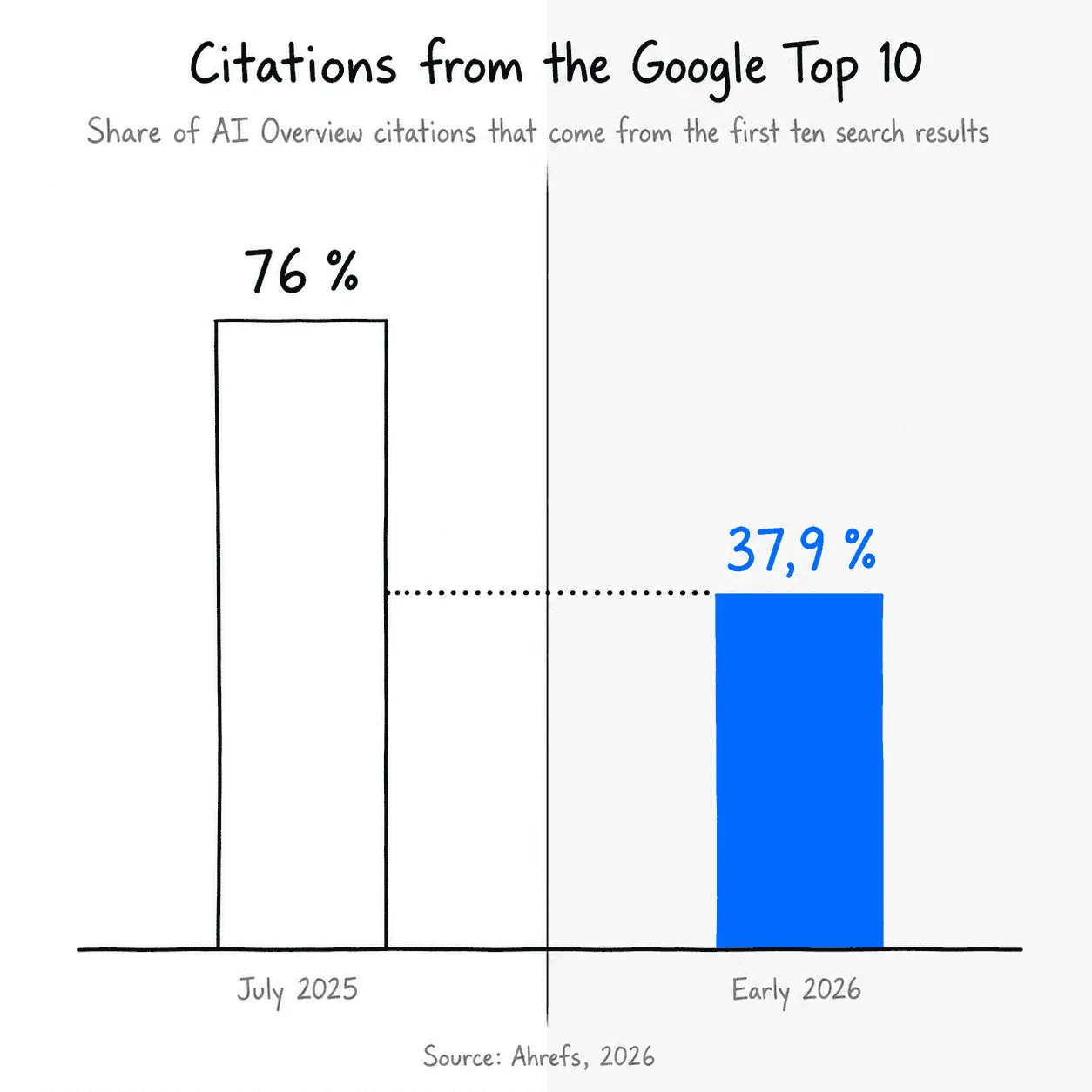
The most important difference is now measurable: a good ranking no longer automatically leads to a citation. An Ahrefs analysis of four million cited URLs (early 2026) found only 37.9 percent of AI Overview citations in the top 10 search results; in July 2025, this figure was around 76 percent. Thus, even ranking first on Google no longer guarantees appearing in the response the buyer reads.
To be honest, there is also another side: experienced SEO professionals and large publishers remain skeptical of grand GEO promises, because no one controls the output of these systems. We share this skepticism. It does not argue against the work, but against any form of guarantees for specific mentions.
Why is this relevant for Swiss SMEs right now?
Because the shift in Switzerland is measurable and accelerating. The key figures:
- 76.1 percent of the adult Swiss population use AI chatbots like ChatGPT or Gemini. In 2024, the figure was 49.7 percent, rising to 62.4 percent in 2025 (Comparis/Innofact, March 2026, 1,035 respondents, representative). Among 18 to 35-year-olds, usage is at 90.1 percent.
- 41.6 percent of those familiar with chatbots now search for information via chatbot instead of Google or Bing; in 2024, this was only 27.2 percent. When asking about products and services, 58 percent prefer the chatbot.
- Google AI Overviews have beenlive in Switzerland since March 26, 2025, in German, French, Italian, and English. AI answers are thus positioned directly above the classic search results that many SMEs have worked hard to achieve.
- ChatGPT countsover 900 million weekly active users worldwide (OpenAI, February 2026).
- Swiss SMEs are increasingly using AI themselves: according to the AXA labor market study (Sotomo, October 2025), 34 percent of SMEs have consciously integrated AI into work processes, up from 22 percent the previous year. The share of SMEs completely abstaining from AI fell from 45 to 29 percent. Your own customer base is just as far ahead when searching for providers.
Important context: the directly measurable flow of visitors from AI answers is still small. A Conductor analysis of 13,770 domains (US data, May to September 2025) quantifies clicks from AI answers at an average of 1.08 percent of web traffic, with 87.4 percent coming from ChatGPT; Similarweb data recently showed 52 percent year-over-year growth for ChatGPT referrals and 388 percent for Gemini referrals (September to November 2025). Furthermore, a large portion of AI-influenced behavior does not appear as such in web analytics because the systems often do not transmit a referrer. Yet the quality is remarkable: Shopify reports from its own data for the first quarter of 2026 that AI-referred sessions convert nearly 50 percent better than organic search, with a 14 percent higher order value. These are provider disclosures and explicitly early signals, but they align with the mechanism: visitors coming from an AI recommendation are pre-filtered.
However, another point is crucial: AI systems learn from what is written and cited about an industry today. The longer the same providers remain in the answers, the more sources, mentions, and corrections are needed to break into this selection. Every AI answer without you is a lead won by someone else.
The three levers: What GEO specifically focuses on
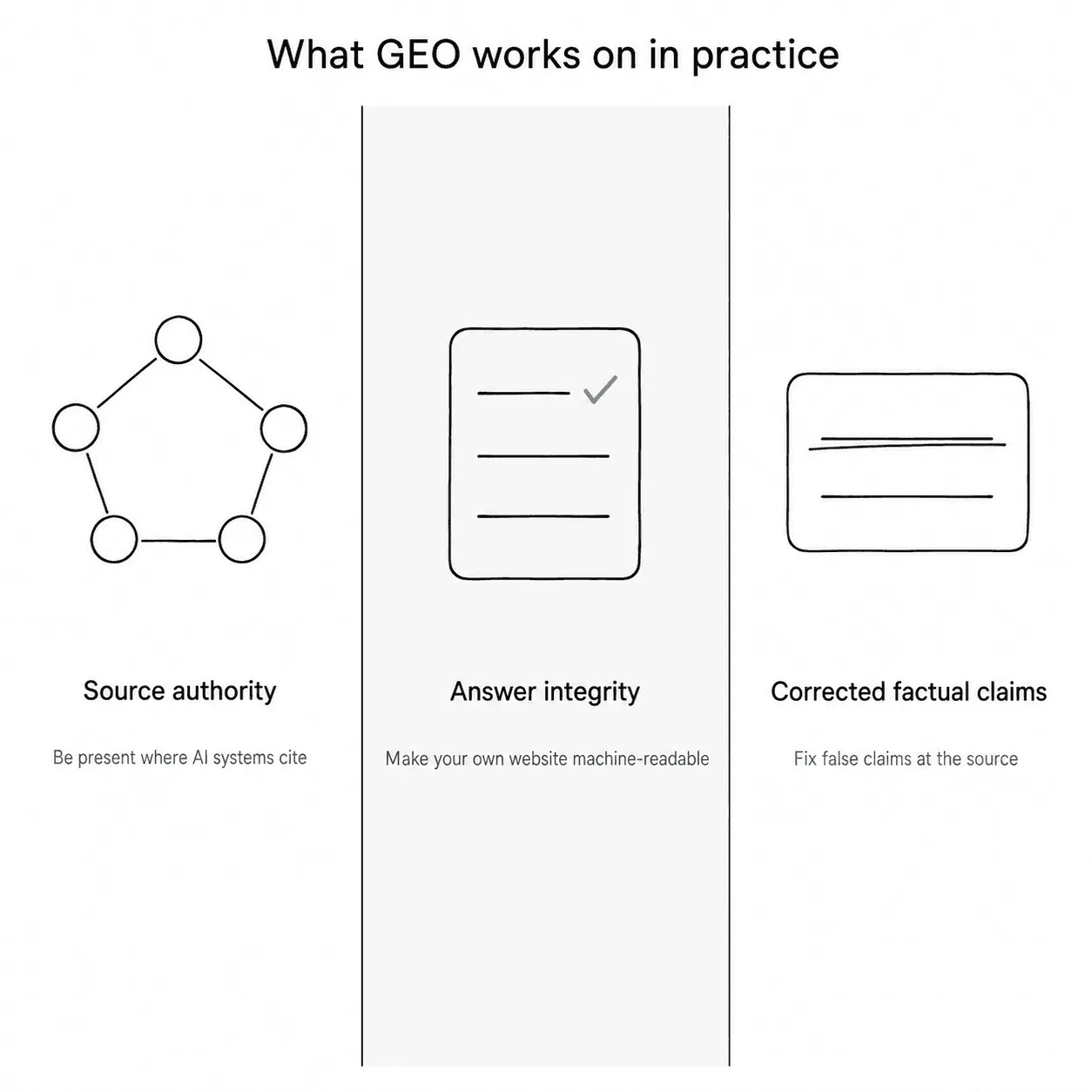
GEO work can be broken down into three levers. In our retainers at Carigiet GEO, we structure every measure along these three levers.
1. Source authority: being present where AI systems cite
AI systems verify the big picture across multiple independent sources; self-promotion on your own website is not enough. Source authority means identifying which directories, specialized media, association sites, and partner pages are demonstrably cited for your topic, and being present there with accurate, consistent information.
Research directly supports this lever: in the GEO paper by Aggarwal et al., statistics, citations, and clean source attributions improved visibility in generative responses by up to 40 percent relative to the baseline; in a validation on Perplexity, the improvement was up to 37 percent. Both figures are ceilings from the lab study, not expected averages. Notably for SMEs: pages that were not already at the top benefited the most. The researchers refer to this as an equalizer effect.
2. Response integrity: making your website machine-readable
Response integrity means that your website answers your customers’ questions so clearly that an AI system can adopt your offering, target audience, and facts without errors. This requires short, direct answers at the top of each page, consistent facts about services, prices, and service areas, and structured data that matches the visible content.
The necessity of this is shown by the systems’ error rates: the Tow Center for Digital Journalism tested eight AI search engines with a total of 1,600 queries and found an average of over 60 percent incorrect citations; ChatGPT Search was at 67 percent, while Perplexity performed best at 37 percent. Meanwhile, user tolerance is low: 62.9 percent of the Swiss population do not forgive an AI for errors any more than they would a human (Comparis/Innofact, March 2026). The clearer and more consistent your factual data, the less room there is for such errors.
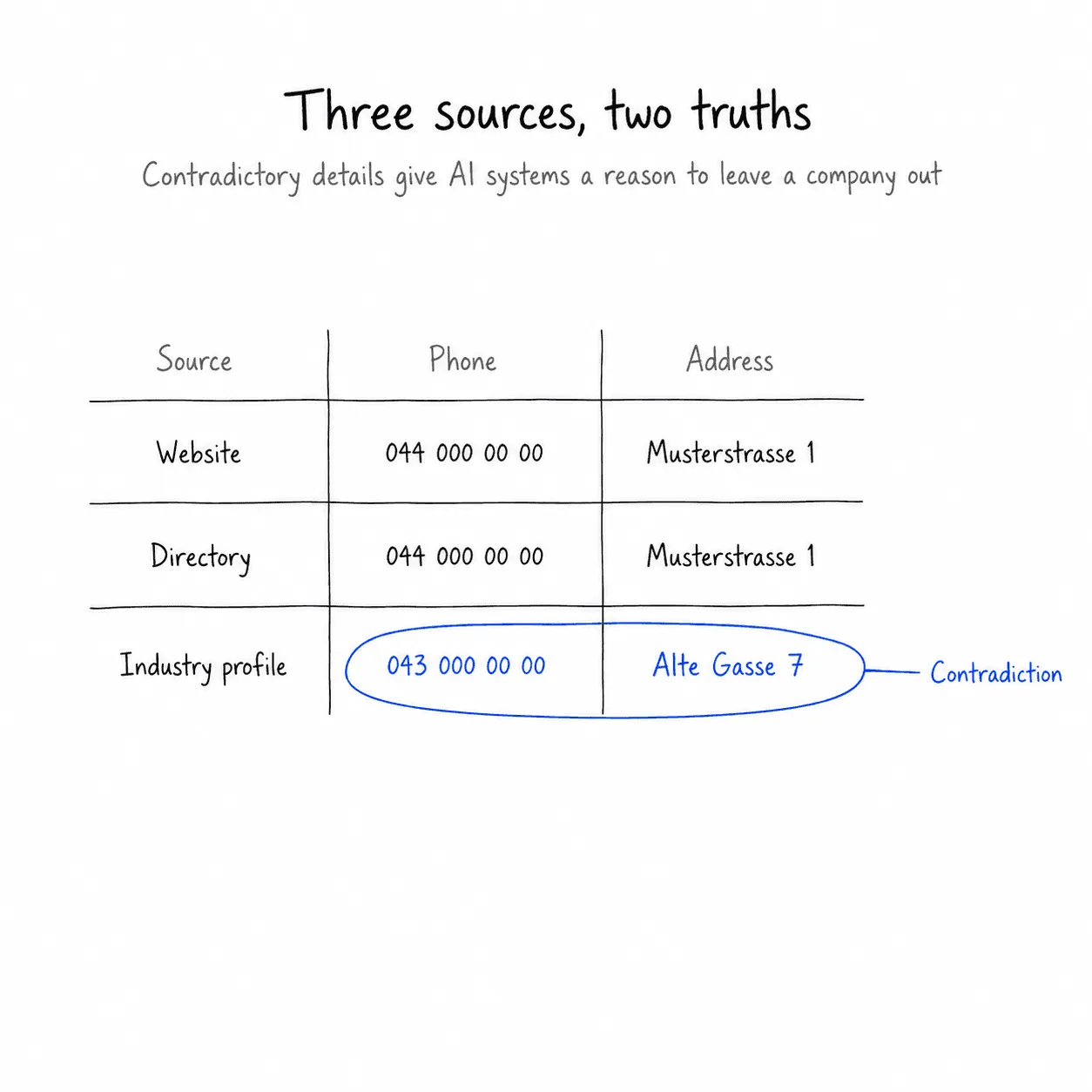
3. Corrected factual statements: resolving inaccuracies at the source
If an AI system claims outdated or incorrect information about your company (such as an old address, discontinued services, or made-up prices), a disclaimer on your own website alone will not help. The lever here is detective work: finding the source from which the statement originates and correcting it there. Subsequently, repeated measurement shows whether the correction has reached the answers.
What demonstrably does not work, however, are tricks. In the GEO paper, keyword stuffing performed worse than no optimization at all. The systems aim to deliver the best answer; relevance, clarity, and timeliness win.
What can you do yourself today?
A lot. The most effective first steps are solid craftsmanship and do not require an agency:
- Answer customer questions literally. Take the questions that new customers ask you most frequently and answer each on its own page: answer in the first sentence, explanation to follow.
- Keep your facts identical everywhere. Services, prices, address, telephone number, and service area must match across your website, Google profile, and directories. Inconsistencies are a reason for AI systems to omit you or adopt incorrect details.
- Support figures with sources. Statistics, citations, and source references are the most well-documented visibility levers. Do not publish any figure without a citeable source.
- Maintain the places that are cited. Industry directories, association profiles, and professional articles have a stronger impact than any self-promotion on your homepage.
- Do a self-check. Ask ChatGPT, Perplexity, and Google the five most common questions of your new customers, in several formulations and spread over several days. Note who is mentioned and which sources the answers cite.
This sounds unspectacular. That is precisely why it is so often left undone.
What you can skip: llms.txt
In many guides, the file llms.txt appears as a quick GEO trick: a text file meant to explain your website to AI crawlers. The reality is sobering: Google does not support llms.txt and has no plans to do so; representatives of the Google Search team clarified this multiple times in 2025. Similarly, OpenAI, Anthropic, and Perplexity do not document the file as a visibility signal. We deliberately invest no effort here until a major provider confirms its efficacy. Your time is better invested in clear answer pages.
How long does GEO take, and what is realistic?
The honest answer: there is no shortcut, but there is a typical sequence. It results from the mechanism:
- Week 1: Baseline assessment. Documenting which buyer questions currently list you, which sources are cited, and what is incorrectly represented.
- By day 30: Launching the quick levers: crawlability, clear answer passages on the most important pages, closing gaps on already trusted sources.
- Day 60 to 90: First reliable movement typically becomes visible, still volatile, but recognizable as a trend.
- Month 3 to 6: Sustained authority: thematic depth, consistent presence across multiple independent sources.
- New brand or new domain: 6 to 12 months or longer.
If no signal appears on the fast systems by day 90, experience shows this is due to crawlability, unclear company details, or weak third-party sources rather than a lack of patience. Why these timelines are what they are is derived in detail in our article “How long does it take to become visible in AI answers?”.
Just as important as the sequence is the limitation: no serious provider can guarantee fixed mentions, rankings, or specific dates with statistical systems. Anyone promising a fixed date (“in ChatGPT in 30 days”) is selling you a line.
How do you recognize if it is working?
By a trend over weeks, never by a single query. Because the same question yields different answers, a single spot-check is worthless; only the repeated measurement of the same questions over time becomes reliable.
In practice, this means having a documented baseline with the relevant buyer questions, followed by a weekly comparison of the same questions on the same systems, with each question asked multiple times. In our retainers, we document the baseline within seven days and then compare week by week, including what has not moved. A rising recommendation rate over weeks is realistic, never a mention in 100 percent of queries.
Frequently asked questions about GEO
Is GEO the same as AEO?
Practically, yes. GEO, AEO, LLMO, and “AI-SEO” refer to the same work; no binding distinction exists. Focus less on the acronym and more on what a provider actually implements and how they measure the impact.
Is classic SEO no longer enough?
SEO remains the foundation, but alone it is no longer sufficient. Only 37.9 percent of the URLs cited in Google AI answers originate from the top 10 of classic search (Ahrefs, early 2026). Visibility in AI answers additionally requires work on buyer questions, third-party sources, and dedicated measurement.
Does GEO work in German and for Switzerland?
Yes. Google AI Overviews have been running in Switzerland in the national languages since March 2025, and ChatGPT, Perplexity, and Gemini answer in German using Swiss sources. The consistency of the Swiss source landscape is decisive: commercial registers, directories, associations, and professional media from which the systems compile their picture of your company.
How do I check if my company appears in ChatGPT?
Ask the systems your new customers’ questions yourself: the same question in several formulations, spread over several days, and note the mentions and cited sources. A structured external perspective is provided by our free AI visibility analysis: enter your URL, and the report arrives by email, usually within 15 to 30 minutes.
What does GEO cost for a Swiss SME?
With us, the GEO retainer costs from CHF 2,800 per month plus VAT for a clearly defined scope of services, with no setup fee and no minimum term, cancellable monthly with 30 days’ notice to the end of the following month. Each additional service area with its own competitor set costs CHF 1,500 per month. This includes the baseline, daily monitoring, weekly comparison, and implementation: content, source work, technical foundations, and corrections.
The first step: knowing where you stand
Before you optimize, you need a baseline assessment. We offer two non-binding ways for this: our free AI visibility analysis shows you via a report whether ChatGPT mentions you, which competitors appear instead, and where statements about you are incorrect. Alternatively, you can book a 15-minute initial consultation: we open ChatGPT live, check together where your company currently appears for your customers’ questions, and you leave the conversation with two or three actionable levers. No sales pitch, no slides.
Related posts

llms.txt: Do You Need One? The Honest Answer (2026)

Check Your AI Visibility Yourself: Test in 30 Minutes Whether ChatGPT Recommends You (2026)